This old version of Proteopedia is provided for student assignments while the new version is undergoing repairs. Content and edits done in this old version of Proteopedia after March 1, 2026 will eventually be lost when it is retired in about June of 2026.
Apply for new accounts at the new Proteopedia. Your logins will work in both the old and new versions.
1hvx
From Proteopedia
(New page: 200px<br /><applet load="1hvx" size="450" color="white" frame="true" align="right" spinBox="true" caption="1hvx, resolution 2.0Å" /> '''BACILLUS STEAROTHERMO...) |
|||
| Line 1: | Line 1: | ||
| - | [[Image:1hvx.gif|left|200px]]<br /><applet load="1hvx" size=" | + | [[Image:1hvx.gif|left|200px]]<br /><applet load="1hvx" size="350" color="white" frame="true" align="right" spinBox="true" |
caption="1hvx, resolution 2.0Å" /> | caption="1hvx, resolution 2.0Å" /> | ||
'''BACILLUS STEAROTHERMOPHILUS ALPHA-AMYLASE'''<br /> | '''BACILLUS STEAROTHERMOPHILUS ALPHA-AMYLASE'''<br /> | ||
==Overview== | ==Overview== | ||
| - | The crystal structure of a thermostable alpha-amylase from Bacillus | + | The crystal structure of a thermostable alpha-amylase from Bacillus stearothermophilus (BSTA) has been determined at 2.0 A resolution. The main-chain fold is almost identical to that of the known crystal structure of Bacillus licheniformis alpha-amylase (BLA). BLA is known to be more stable than BSTA. A structural comparison between the crystal structures of BSTA and BLA showed significant differences that may account for the difference in their thermostabilities, as follows. (i) The two-residue insertion in BSTA, Ile181-Gly182, pushes away the spatially contacting region including Asp207, which corresponds to Ca(2+)-coordinating Asp204 in BLA. As a result, Asp207 cannot coordinate the Ca(2+). (ii) BSTA contains nine fewer hydrogen bonds than BLA, which costs about 12 kcal/mol. This tendency is prominent in the (beta/alpha)(8)-barrel, where 10 fewer hydrogen bonds were observed in BSTA. BLA forms a denser hydrogen bond network in the inter-helical region, which may stabilize alpha-helices in the barrel. (iii) A few small voids observed in the alpha-helical region of the (beta/alpha)(8)-barrel in BSTA decrease inter-helical compactness and hydrophobic interactions. (iv) The solvent-accessible surface area of charged residues in BLA is about two times larger than that in BSTA. |
==About this Structure== | ==About this Structure== | ||
| - | 1HVX is a [http://en.wikipedia.org/wiki/Single_protein Single protein] structure of sequence from [http://en.wikipedia.org/wiki/Geobacillus_stearothermophilus Geobacillus stearothermophilus] with CA and NA as [http://en.wikipedia.org/wiki/ligands ligands]. Active as [http://en.wikipedia.org/wiki/Alpha-amylase Alpha-amylase], with EC number [http://www.brenda-enzymes.info/php/result_flat.php4?ecno=3.2.1.1 3.2.1.1] Full crystallographic information is available from [http:// | + | 1HVX is a [http://en.wikipedia.org/wiki/Single_protein Single protein] structure of sequence from [http://en.wikipedia.org/wiki/Geobacillus_stearothermophilus Geobacillus stearothermophilus] with <scene name='pdbligand=CA:'>CA</scene> and <scene name='pdbligand=NA:'>NA</scene> as [http://en.wikipedia.org/wiki/ligands ligands]. Active as [http://en.wikipedia.org/wiki/Alpha-amylase Alpha-amylase], with EC number [http://www.brenda-enzymes.info/php/result_flat.php4?ecno=3.2.1.1 3.2.1.1] Full crystallographic information is available from [http://oca.weizmann.ac.il/oca-bin/ocashort?id=1HVX OCA]. |
==Reference== | ==Reference== | ||
| - | Crystal structure of Bacillus stearothermophilus alpha-amylase: possible factors determining the thermostability., Suvd D, Fujimoto Z, Takase K, Matsumura M, Mizuno H, J Biochem | + | Crystal structure of Bacillus stearothermophilus alpha-amylase: possible factors determining the thermostability., Suvd D, Fujimoto Z, Takase K, Matsumura M, Mizuno H, J Biochem. 2001 Mar;129(3):461-8. PMID:[http://ispc.weizmann.ac.il//pmbin/getpm?pmid=11226887 11226887] |
[[Category: Alpha-amylase]] | [[Category: Alpha-amylase]] | ||
[[Category: Geobacillus stearothermophilus]] | [[Category: Geobacillus stearothermophilus]] | ||
| Line 31: | Line 31: | ||
[[Category: thermostability]] | [[Category: thermostability]] | ||
| - | ''Page seeded by [http:// | + | ''Page seeded by [http://oca.weizmann.ac.il/oca OCA ] on Thu Feb 21 13:05:32 2008'' |
Revision as of 11:05, 21 February 2008
|
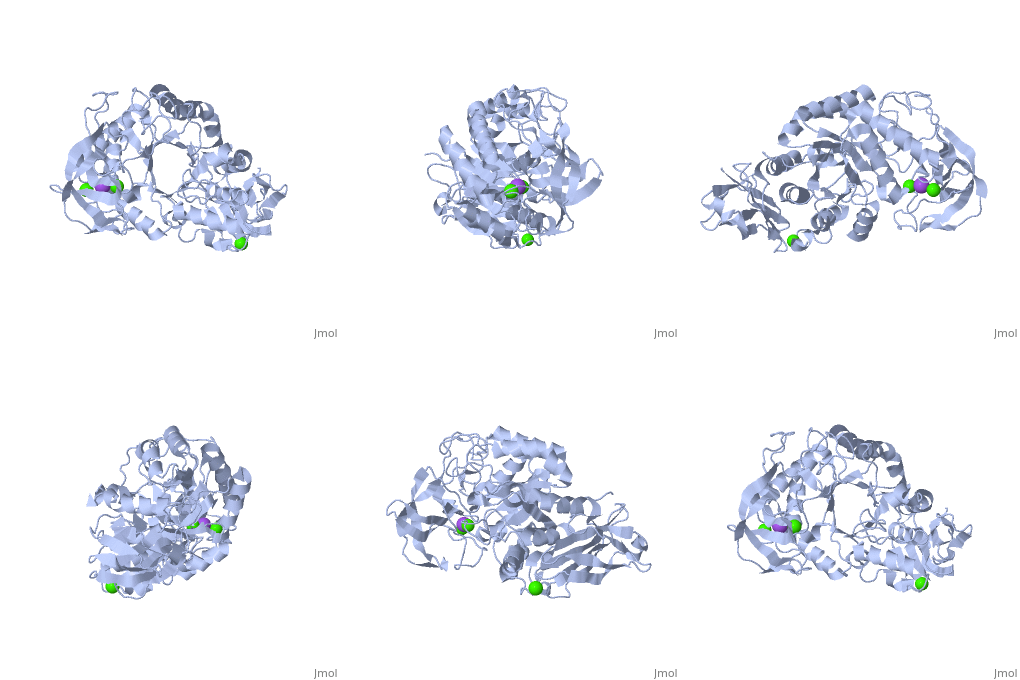
BACILLUS STEAROTHERMOPHILUS ALPHA-AMYLASE
Overview
The crystal structure of a thermostable alpha-amylase from Bacillus stearothermophilus (BSTA) has been determined at 2.0 A resolution. The main-chain fold is almost identical to that of the known crystal structure of Bacillus licheniformis alpha-amylase (BLA). BLA is known to be more stable than BSTA. A structural comparison between the crystal structures of BSTA and BLA showed significant differences that may account for the difference in their thermostabilities, as follows. (i) The two-residue insertion in BSTA, Ile181-Gly182, pushes away the spatially contacting region including Asp207, which corresponds to Ca(2+)-coordinating Asp204 in BLA. As a result, Asp207 cannot coordinate the Ca(2+). (ii) BSTA contains nine fewer hydrogen bonds than BLA, which costs about 12 kcal/mol. This tendency is prominent in the (beta/alpha)(8)-barrel, where 10 fewer hydrogen bonds were observed in BSTA. BLA forms a denser hydrogen bond network in the inter-helical region, which may stabilize alpha-helices in the barrel. (iii) A few small voids observed in the alpha-helical region of the (beta/alpha)(8)-barrel in BSTA decrease inter-helical compactness and hydrophobic interactions. (iv) The solvent-accessible surface area of charged residues in BLA is about two times larger than that in BSTA.
About this Structure
1HVX is a Single protein structure of sequence from Geobacillus stearothermophilus with and as ligands. Active as Alpha-amylase, with EC number 3.2.1.1 Full crystallographic information is available from OCA.
Reference
Crystal structure of Bacillus stearothermophilus alpha-amylase: possible factors determining the thermostability., Suvd D, Fujimoto Z, Takase K, Matsumura M, Mizuno H, J Biochem. 2001 Mar;129(3):461-8. PMID:11226887
Page seeded by OCA on Thu Feb 21 13:05:32 2008


