This old version of Proteopedia is provided for student assignments while the new version is undergoing repairs. Content and edits done in this old version of Proteopedia after March 1, 2026 will eventually be lost when it is retired in about June of 2026.
Apply for new accounts at the new Proteopedia. Your logins will work in both the old and new versions.
Amylase
From Proteopedia
| Line 1: | Line 1: | ||
| - | + | <StructureSection load='1hvx' size='400' side='right' scene='Sandbox_182/Alpha-amylase/1' caption=''> | |
| - | + | ||
| - | + | ||
=Introduction= | =Introduction= | ||
Discovered and isolated by [http://en.wikipedia.org/wiki/Anselme_Payen Anselme Payen] in 1833, amylase was the first enzyme to be discovered<ref name="book">Yamamoto T.1988. Handbook of Amylases and Related Enzymes: Their Sources, Isolation Methods, Properties and Applications. Osaka Japan: Pergamon Press</ref>. Amylases are hydrolases, acting on α-1,4-glycosidic bonds<ref name="Path">PMID:9541387</ref>. They can be further subdivided into α,β and γ amylases<ref name="book"/>.'''α-Amylase''' (AAM) is an enzyme that acts as a catalyst for the hydrolysis of alpha-linked polysaccharides into α-anomeric products<ref name="Main">PMID:11226887</ref>. The enzyme can be derived from a variety of sources, each with different characteristics. α-Amylase found within the human body serves as the enzyme active in pancreatic juice and salvia<ref name="Path"/>. α-Amylase is not only essential in human physiology but has a number of important biotechnological functions in various processing industries. Beta/alpha amylase (BAAM) is a precursor protein which is cleaved to form the beta-amylase and alpha-amylase after secretion. | Discovered and isolated by [http://en.wikipedia.org/wiki/Anselme_Payen Anselme Payen] in 1833, amylase was the first enzyme to be discovered<ref name="book">Yamamoto T.1988. Handbook of Amylases and Related Enzymes: Their Sources, Isolation Methods, Properties and Applications. Osaka Japan: Pergamon Press</ref>. Amylases are hydrolases, acting on α-1,4-glycosidic bonds<ref name="Path">PMID:9541387</ref>. They can be further subdivided into α,β and γ amylases<ref name="book"/>.'''α-Amylase''' (AAM) is an enzyme that acts as a catalyst for the hydrolysis of alpha-linked polysaccharides into α-anomeric products<ref name="Main">PMID:11226887</ref>. The enzyme can be derived from a variety of sources, each with different characteristics. α-Amylase found within the human body serves as the enzyme active in pancreatic juice and salvia<ref name="Path"/>. α-Amylase is not only essential in human physiology but has a number of important biotechnological functions in various processing industries. Beta/alpha amylase (BAAM) is a precursor protein which is cleaved to form the beta-amylase and alpha-amylase after secretion. | ||
| Line 25: | Line 23: | ||
α-Amylase is used extensively in various industrial processes. In textile weaving, starch is added for warping. After weaving, the starch is removed by ''Bacillus subtilis'' α-amylase<ref name="book"/>. Dextrin, which is a viscosity improver, filler, or ingredient of food, is manufactured by the liquefaction of starch by bacteria α-amylase<ref name="book"/>. Bacterial α-amylases of ''B.subtilis'', or ''B.licheniformis'' are used for the initial starch liquefaction in producing high conversion glucose syrup<ref name="book"/>. Pancreatitis can be tested by determining the level of amylases in the blood, a result of damaged amylase-producing cells, or excretion due to renal failure<ref>PMID: 16286272 </ref>. α-Amylase is used for the production of malt, as the enzyme is produced during the germination of cereal grains<ref name="book"/>. | α-Amylase is used extensively in various industrial processes. In textile weaving, starch is added for warping. After weaving, the starch is removed by ''Bacillus subtilis'' α-amylase<ref name="book"/>. Dextrin, which is a viscosity improver, filler, or ingredient of food, is manufactured by the liquefaction of starch by bacteria α-amylase<ref name="book"/>. Bacterial α-amylases of ''B.subtilis'', or ''B.licheniformis'' are used for the initial starch liquefaction in producing high conversion glucose syrup<ref name="book"/>. Pancreatitis can be tested by determining the level of amylases in the blood, a result of damaged amylase-producing cells, or excretion due to renal failure<ref>PMID: 16286272 </ref>. α-Amylase is used for the production of malt, as the enzyme is produced during the germination of cereal grains<ref name="book"/>. | ||
β/α amylase (BAAM) is a precursor protein which is cleaved to form the β-amylase and α-amylase after secretion. | β/α amylase (BAAM) is a precursor protein which is cleaved to form the β-amylase and α-amylase after secretion. | ||
| + | </StructureSection> | ||
| + | __NOTOC__ | ||
=3D structures of Amylase= | =3D structures of Amylase= | ||
Revision as of 14:33, 23 December 2013
| |||||||||||
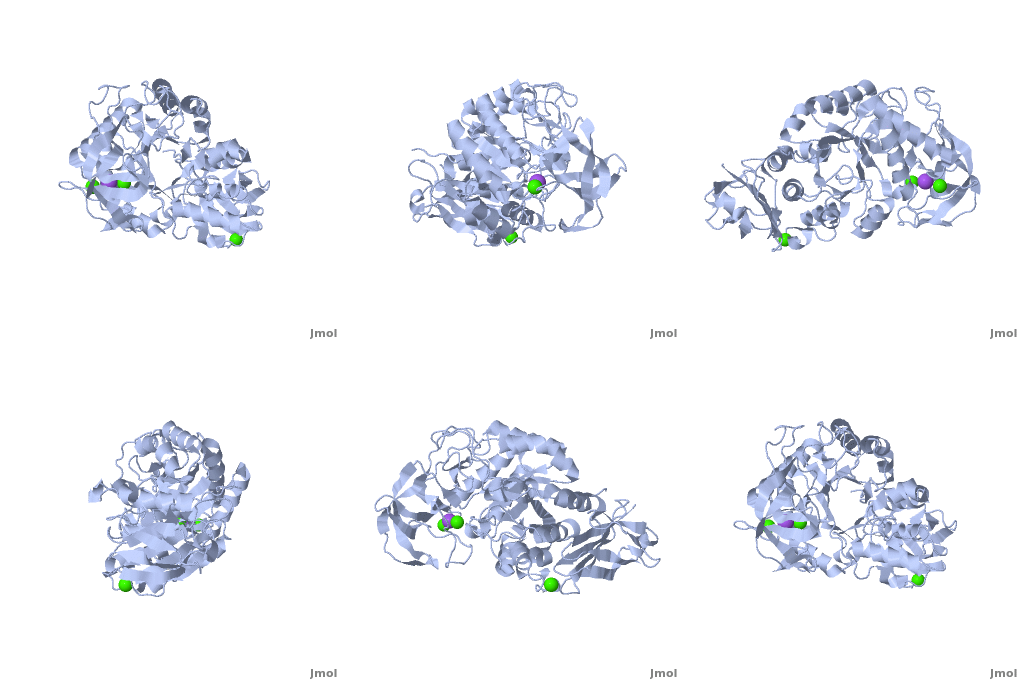
3D structures of Amylase
Updated on 23-December-2013
α-amylase
3ij7, 1xv8, 1c8q, 1bsi, 1smd, 1hny – hAAM – human
1xgz, 1q4n, 1kb3, 1kbb, 1kbk, 1kgu, 1kgw, 1kgx, 1jxj, 1jxk, 2cpu - hAAM (mutant)
3n8t – TkAAM – Thermococcus kodakarensis
3k8k – BtAAM – Bacterioides thetaiotaomicron
3kwx, 2guy – AoAAM – Aspergilluys oryzae
2wpg – AAM – Xanthomonas campestris
2wc7, 2wcs, 2wkg – AAM catalytic region – Cyanobacterium
3bh4 – BaAAM – Bacillus amyloliquefaciens
3bsg – bAAM (mutant)
3dhu – AAM – Lactobacillus plantarum
3dc0 – AAM – Bacillus KR8104
3bcf, 1wza – HoAAM – Halothermothrix orenii
2die, 1wp6 – AAM alkaline – Bacillus sp.
1ud2, 1ud4, 1ud5, 1ud6, 1ud8 - AAM – Bacillus sp. KSM-K38
1ud3 – AAM (mutant) – Bacillus sp. KSM-K38
2gjr – BhAAM – Bacillus halmapalus
2b5d – AAM – Thermotoga maritima
2c3g, 2c3v – BhaloAAM – Bacillus halodurans
1ji1, 1ji2, 1bvz - TvAAM – Thermoactinomyces vulgaris
1wzk, 1wzl, 1wzm, 1izj, 1izk, 1jf5, 1jf6 – TvAAM (mutant)
1mwo, 1mxd – PwAAM – Pyrococcus woesei
1ob0, 1bli - BlAAM (mutant) – Bacillus licheniformis
1vjs – BlAAM precursor
1bpl – BlAAM
1b0i, 1aqm, 1aqh – PhAAM - Pseudoalteromonas haloplanktis
1g5a – NpAAM – Neisseria polysaccharea
1hvx - BaAAM – Bacillus stearothermophilus
1qho – GsAAM – Geobacillus stearothermophilus
1jae – TmAAM – Tenebrio molitor
1pif – pAAM – pig
6taa, 2aaa - AoAAM
4aee – AAM catalytic domain – Staphylothermus marinus
3ren – AAM – Clostridium perfringens
3vm5 – AAM – Oryzias latipes
3vm7 – AAM – Malbranchea cinnamomea
4gkl – AAM – Thermotoga neapolitana
AAM binary complexes
1xd0, 1xd1, 1cpu, 1jfh - hAAM + saccharide
1b2y, 1xcw, 1xcx - hAAM + acarbose
3blk, 3blp, 1z32, 1nm9, 1mfu, 1mfv, 3cpu - hAAM (mutant) + saccharide
3dhp, 1xh0, 1xh2 - hAAM (mutant) + acarbose
3ij8, 3ij9 – hAAM catalytic intermediate
3baw – hAAM + N3
3bax - hAAM (mutant) + N3
3bak – hAAM (mutant) + NO3
1xh1 - hAAM (mutant) + Cl
2qv4, 3baj, 3bay - hAAM + acarbose + NO2
3old, 3ole, 3olg, 3oli – hAAM + statin
1u2y, 1u30, 1u33 – hAAM + inhibitor
4gqq – hAAM + ethyl caffeate
4gqr – hAAM + myricetin
3n92, 3n98 – TkAAM + saccharide
3l2l, 3l2m, 1vah, 1wo2, 1ua3, 1pig, 1ppi - pAAM + saccharide
1hx0 – pAAM + acarbose
1kxq, 1kxt, 1kxv – pAAM + antibody VHH fragment
1bvn, 1dhk – pAAM + protein inhibitor
1ose – pAAM + acarbose
3k8l - BtAAM (mutant) + saccharide
3k8m - BtAAM + acarbose
2d2o, 1jl8, 1jib - TvAAM + saccharide
3a6o – TvAAM + acarbose
2d0f, 2d0g, 2d0h, 1vb9, 1vfm, 1vfo, 1vfu, 1uh2, 1uh4 - TvAAM (mutant) + saccharide
1uh3 - TvAAM (mutant) + acarbose
1ava – bAAM + protein inhibitor
1bg9, 1rpk - bAAM + acarbose
1p6w – bAAM + substrate analog
1rp8, 1b1y, 1rp9 - bAAM (mutant) + saccharide
3bsh, 2qpu, 2qps - bAAM (mutant) + acarbose
3bcd - HoAAM + saccharide
3bc9 - HoAAM + acarbose
2gjp, 1w9x - BhAAM + saccharide
2gvy - AoAAM + saccharide
1zs2, 1s46, 1mvy, 1mw0, 1mw1, 1mw2, 1mw3 - NpAAM (mutant) + saccharide
1bag - BsAAM + saccharide – Bacillus subtilis
1ua7 – BsAAM + acarbose
2d3l, 2d3n - BacAAM + saccharide – Bacillus
2c3h, 2c3w, 2c3x - BhaloAAM + saccharide
1mxg - PwAAM + acarbose
1g9h, 1g94 - PhAAM + saccharide
1kxh - PhAAM (mutant) + acarbose
1l0p – PhAAM + NO3
1e40 – BaAAM chimera + saccharide
1e3z - BaAAM chimera + acarbose
1fa2 - AAM + saccharide – Sweet potato
1qhp - GsAAM + saccharide
4e2o - GsAAM + acarbose
1clv, 1viw, 1tmq – TmAAM + protein inhibitor
1gah, 1gai – AaAAM + acarbose – Aspergillus awamori
3gly, 1agm, 1glm – AaAAM + saccharide
Pullulanase α-amylase
2wan – AAM – Bacillus acidopullululyticus
2fgz – KaAAM – Klebsiella aerogenes
2e8y - BsAAM
1ji2 - TvAAM
1jl5, 1jf6, 1wzk, 1wzl, 1wzm - TvAAM (mutant)
Pullulanase α-amylase binary complexes
2fh6, 2fh8, 2fhb, 2fhc, 2fhf - KaAAM + saccharide
3fax - AAM + saccharide – Streptococcus agalactiae
2e8z, 2e9b - BsAAM + saccharide
2d2o - TvAAM + saccharide
1g1y, 1jib, 1jl8, 1vfm, 1vfo, 1vfu, 1vb9 - TvAAM (mutant) + saccharide
3a6o – TvAAM + acarbose
Neopullulanase α-amylase
4aef – AAM – Pyrococcus furiosus
β-amylase
2xfr – bBAM
1wdp – sBAM – soybean
2dqx, 1uko, 1ukp – sBAM (mutant)
1vem, 5bca, 1cqy, 1b90 – BcBAM – Bacillus cereus
1ven - BcBAM (mutant)
1fa2 - AAM + saccharide – Sweet potato
β-amylase binary complexes
2xff – bBAM + acarbose
2xfy, 2xg9, 2xgb, 2xgi – bBAM + inhibitor
1wdq, 1wdr, 1wds, 1v3h, 1v3i, 1q6d, 1q6e, 1q6f, 1q6g - sBAM (mutant) + saccharide
1q6c, 1bfn, 1bya, 1byb, 1byc, 1byd, 1btc - sBAM + saccharide
1j0y, 1j0z, 1j10, 1j11, 1j12, 1j18, 1b9z - BcBAM + saccharide
1veo, 1vep, 1itc - BcBAM (mutant) + saccharide
1b1y - AAM (mutant) + saccharide – Hordeum vulgare
γ-amylase
1lf6 – TtGAM – Thermoanaerobacterium thermosaccharolyticum
1lf9 - TtGAM + acarbose
β/α-amylase
2laa, 2lab – PpBAAM – Paenibacillus polymyxa - NMR
[[3voc – PpBAAM
Maltohexaose-producing amylase
1wp6 - BacMAM
1wpc – BacMAM + saccharide
Maltogenic amylase
1gvi, 1sma – MAM – Thermus sp.
Taka amylase
2taa – AoTAM
7taa – AoTAM + acarbose
References
- ↑ 1.0 1.1 1.2 1.3 1.4 1.5 Yamamoto T.1988. Handbook of Amylases and Related Enzymes: Their Sources, Isolation Methods, Properties and Applications. Osaka Japan: Pergamon Press
- ↑ 2.0 2.1 Aghajari N, Feller G, Gerday C, Haser R. Crystal structures of the psychrophilic alpha-amylase from Alteromonas haloplanctis in its native form and complexed with an inhibitor. Protein Sci. 1998 Mar;7(3):564-72. PMID:9541387
- ↑ 3.0 3.1 3.2 Suvd D, Fujimoto Z, Takase K, Matsumura M, Mizuno H. Crystal structure of Bacillus stearothermophilus alpha-amylase: possible factors determining the thermostability. J Biochem. 2001 Mar;129(3):461-8. PMID:11226887
- ↑ 4.0 4.1 4.2 Aghajari N, Feller G, Gerday C, Haser R. Structural basis of alpha-amylase activation by chloride. Protein Sci. 2002 Jun;11(6):1435-41. PMID:12021442
- ↑ Maurus R, Begum A, Williams LK, Fredriksen JR, Zhang R, Withers SG, Brayer GD. Alternative catalytic anions differentially modulate human alpha-amylase activity and specificity(,). Biochemistry. 2008 Mar 18;47(11):3332-44. Epub 2008 Feb 20. PMID:18284212 doi:10.1021/bi701652t
- ↑ 6.0 6.1 Maurus R, Begum A, Williams LK, Fredriksen JR, Zhang R, Withers SG, Brayer GD. Alternative catalytic anions differentially modulate human alpha-amylase activity and specificity(,). Biochemistry. 2008 Mar 18;47(11):3332-44. Epub 2008 Feb 20. PMID:18284212 doi:10.1021/bi701652t
- ↑ 7.0 7.1 7.2 7.3 Kuriki T, Imanaka T. The concept of the alpha-amylase family: structural similarity and common catalytic mechanism. J Biosci Bioeng. 1999;87(5):557-65. PMID:16232518
- ↑ 8.0 8.1 PPMID: 17713601
- ↑ Franco OL, Rigden DJ, Melo FR, Grossi-De-Sa MF. Plant alpha-amylase inhibitors and their interaction with insect alpha-amylases. Eur J Biochem. 2002 Jan;269(2):397-412. PMID:11856298
- ↑ Yang RW, Shao ZX, Chen YY, Yin Z, Wang WJ. Lipase and pancreatic amylase activities in diagnosis of acute pancreatitis in patients with hyperamylasemia. Hepatobiliary Pancreat Dis Int. 2005 Nov;4(4):600-3. PMID:16286272
Proteopedia Page Contributors and Editors (what is this?)
Shane Riley, Michal Harel, Joel L. Sussman, Randi Woodbeck, Jaime Prilusky, Alexander Berchansky, Ann Taylor, Andrea Gorrell, David Canner
