This old version of Proteopedia is provided for student assignments while the new version is undergoing repairs. Content and edits done in this old version of Proteopedia after March 1, 2026 will eventually be lost when it is retired in about June of 2026.
Apply for new accounts at the new Proteopedia. Your logins will work in both the old and new versions.
Introduction to protein structure
From Proteopedia
(Difference between revisions)
| Line 1: | Line 1: | ||
== Levels of Protein Structure == | == Levels of Protein Structure == | ||
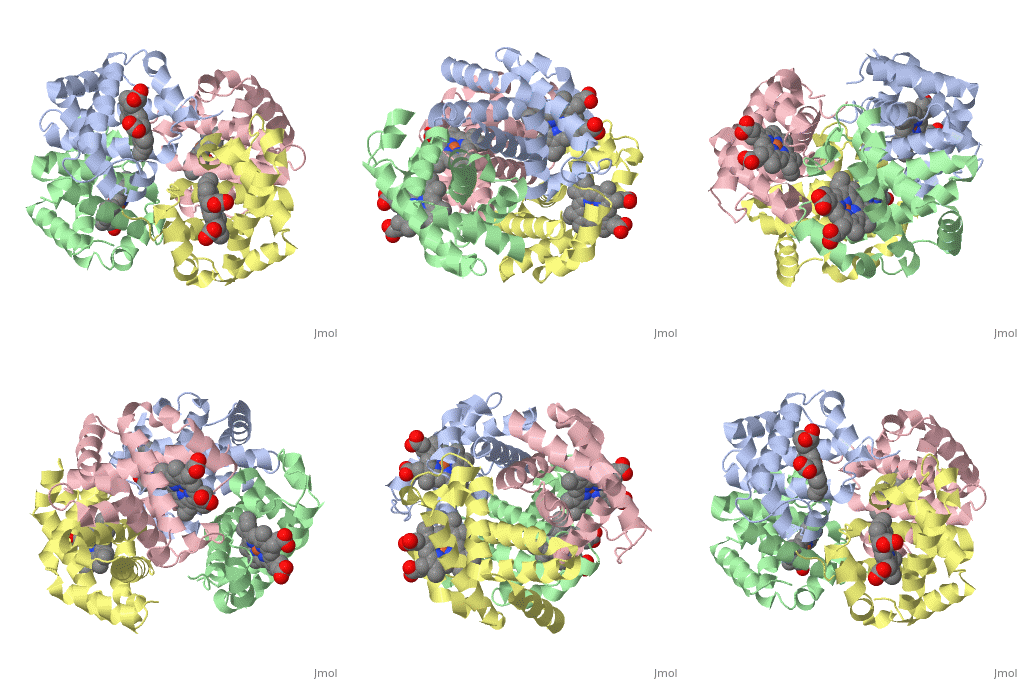
<StructureSection load='1A3N' size='350' side='right' caption='Structure of Hemoglobin (PDB entry [[1A3N]])' scene=''> | <StructureSection load='1A3N' size='350' side='right' caption='Structure of Hemoglobin (PDB entry [[1A3N]])' scene=''> | ||
| - | Proteins are condensation polymers of amino acids. The <scene name='57/575866/Primary_sequence/1'>primary structure</scene> is the amino acid sequence. The <scene name='57/575866/Secondary_sequence/1'>secondary structure</scene> is the local structure over short distances. This level of structure is stabilized by <scene name='57/575866/H_bond_a_helix/1'>hydrogen bonds</scene> along the <scene name='57/575866/Backbone/1'>backbone</scene>. These secondary structures pack together to form the overall form of the entire peptide chain, called the <scene name='57/575866/Tertiary/1'>tertiary structure</scene>. Some proteins, such as the displayed hemoglobin molecule, have more than one polypeptide chain that associate to form the functional unit of the protein; this is called <scene name='57/575866/Tertiary/2'>quaternary structure</scene>. | + | Proteins are condensation polymers of amino acids. The <scene name='57/575866/Primary_sequence/1'>primary structure</scene> is the amino acid sequence. The <scene name='57/575866/Secondary_sequence/1'>secondary structure</scene> is the local structure over short distances. This level of structure is stabilized by <scene name='57/575866/H_bond_a_helix/1'>hydrogen bonds</scene> along the <scene name='57/575866/Backbone/1'>backbone</scene>. These secondary structures <scene name='57/575866/Global_secondary_structures/1'>pack together</scene> to form the overall form of the entire peptide chain, called the <scene name='57/575866/Tertiary/1'>tertiary structure</scene>. Some proteins, such as the displayed hemoglobin molecule, have more than one polypeptide chain that associate to form the functional unit of the protein; this is called <scene name='57/575866/Tertiary/2'>quaternary structure</scene>. |
'''Questions based upon these scenes:''' | '''Questions based upon these scenes:''' | ||
What is the primary sequence shown in the first link? | What is the primary sequence shown in the first link? | ||
| Line 7: | Line 7: | ||
The ith C=O of the backbone is hydrogen bonded to which N(-H) (use i +/- # to represent the number)? | The ith C=O of the backbone is hydrogen bonded to which N(-H) (use i +/- # to represent the number)? | ||
What atom does this program NOT show? | What atom does this program NOT show? | ||
| + | What color is used to represent alpha helices? | ||
| + | How many alpha helices are present in the single peptide chain shown? | ||
| + | How many polypeptide chains make up the quaternary structure? | ||
== Ways of representing protein structure == | == Ways of representing protein structure == | ||
Revision as of 04:08, 16 January 2014
Levels of Protein Structure
| |||||||||||
Proteopedia Page Contributors and Editors (what is this?)
Ann Taylor, Joel L. Sussman, Alexander Berchansky, Eric Martz, Israel Hanukoglu, Jaime Prilusky, Nick Kenworthy
