This old version of Proteopedia is provided for student assignments while the new version is undergoing repairs. Content and edits done in this old version of Proteopedia after March 1, 2026 will eventually be lost when it is retired in about June of 2026.
Apply for new accounts at the new Proteopedia. Your logins will work in both the old and new versions.
Introduction to protein structure
From Proteopedia
(Difference between revisions)
| Line 20: | Line 20: | ||
== Ways of representing protein structure == | == Ways of representing protein structure == | ||
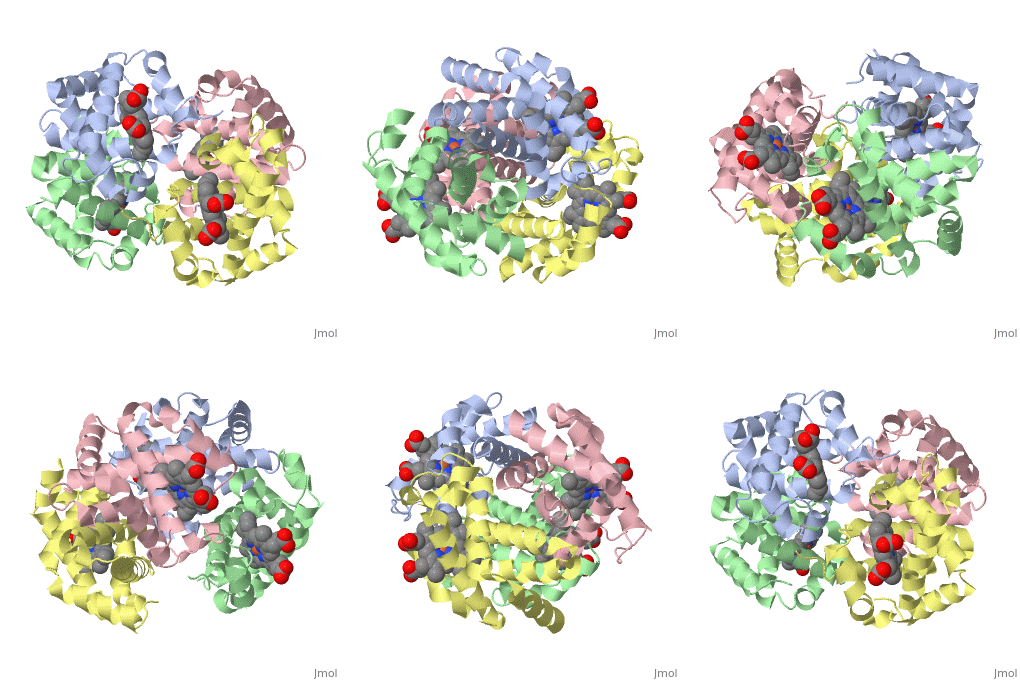
| + | Protein structures can be displayed in many different ways. In <scene name='57/575866/Spacefill_segment/1'>spacefilling</scene> models, all of the non-hydrogen atoms are shown as spheres with their van der Waals radii. In the <scene name='57/575866/Ball_and_stick_segment/1'>ball and stick</scene> model, the atoms are shown as smaller balls, connected by sticks; this is further simplified in the <scene name='57/575866/Stick_segment/1'>stick</scene> model, which only shows the bonds between atoms. <scene name='57/575866/Backbone/2'>Backbone</scene> shows only the N-Calpha-C=O repeating unit; the <scene name='57/575866/Cartoon/1'>cartoon</scene> representation shows the secondary structures. | ||
| + | |||
| + | '''Questions based upon these scenes:''' | ||
| + | Which of these representations would be best for showing... | ||
| + | |||
| + | --the secondary structures present in a molecule? | ||
| + | |||
| + | --Channels, holes, or pockets in a protein? | ||
| + | |||
| + | --Residues in the active site of an enzyme? | ||
| + | |||
| + | Explain your answers. | ||
== Secondary Structures == | == Secondary Structures == | ||
</StructureSection> | </StructureSection> | ||
Revision as of 04:39, 16 January 2014
Levels of Protein Structure
| |||||||||||
Proteopedia Page Contributors and Editors (what is this?)
Ann Taylor, Joel L. Sussman, Alexander Berchansky, Eric Martz, Israel Hanukoglu, Jaime Prilusky, Nick Kenworthy
