This old version of Proteopedia is provided for student assignments while the new version is undergoing repairs. Content and edits done in this old version of Proteopedia after March 1, 2026 will eventually be lost when it is retired in about June of 2026.
Apply for new accounts at the new Proteopedia. Your logins will work in both the old and new versions.
TGF-beta receptor
From Proteopedia
(Difference between revisions)
| Line 1: | Line 1: | ||
| - | <StructureSection load='1ktz' size='340' side='right' caption='Human hTGFBR-II extracellular domain complex with TGF-β3 (PDB code [[1ktz]])' scene=''> | + | <StructureSection load='1ktz' size='340' side='right' caption='Human hTGFBR-II extracellular domain (green) complex with TGF-β3 (grey) (PDB code [[1ktz]])' scene=''> |
'''TGF-β receptors''' (Transforming Growth Factor) (TGFBR) are serine/threonine kinase receptors. They are involved in paracrine signaling and are found in many types of tissue. TGF-β ligands include bone morphogenetic proteins, growth and initiation factors, anti-Mullerian hormone, activin, nodal TGF-β. TGFBR structure contains a 100-140 residues ligand-binding N-terminal extracellular domain; a transmembrane domain; a 350-400 amino acid cytoplasmic kinase domain; and a C-terminal zona pellucida (ZP) domain of ca 260 residues which has a role in protein polymerization.. There are 3 types of TGFBR. Both TGFBR I and II have high affinity for TGF-β1 and low affinity for TGF-β2. TGFBR III has high affinity for TGF-β1, TGF-β2 and TGF-β1.2. <br /> | '''TGF-β receptors''' (Transforming Growth Factor) (TGFBR) are serine/threonine kinase receptors. They are involved in paracrine signaling and are found in many types of tissue. TGF-β ligands include bone morphogenetic proteins, growth and initiation factors, anti-Mullerian hormone, activin, nodal TGF-β. TGFBR structure contains a 100-140 residues ligand-binding N-terminal extracellular domain; a transmembrane domain; a 350-400 amino acid cytoplasmic kinase domain; and a C-terminal zona pellucida (ZP) domain of ca 260 residues which has a role in protein polymerization.. There are 3 types of TGFBR. Both TGFBR I and II have high affinity for TGF-β1 and low affinity for TGF-β2. TGFBR III has high affinity for TGF-β1, TGF-β2 and TGF-β1.2. <br /> | ||
*'''TGFBR I''' forms heteromeric complex with TGFBR II when it is bound to TGF-β. The complex transduces the TGF-β signal from the cell surface to the cytoplasm by phosphorylating proteins which regulate the transcription of genes related to cell proliferation.<br /> | *'''TGFBR I''' forms heteromeric complex with TGFBR II when it is bound to TGF-β. The complex transduces the TGF-β signal from the cell surface to the cytoplasm by phosphorylating proteins which regulate the transcription of genes related to cell proliferation.<br /> | ||
Revision as of 10:09, 14 July 2015
| |||||||||||
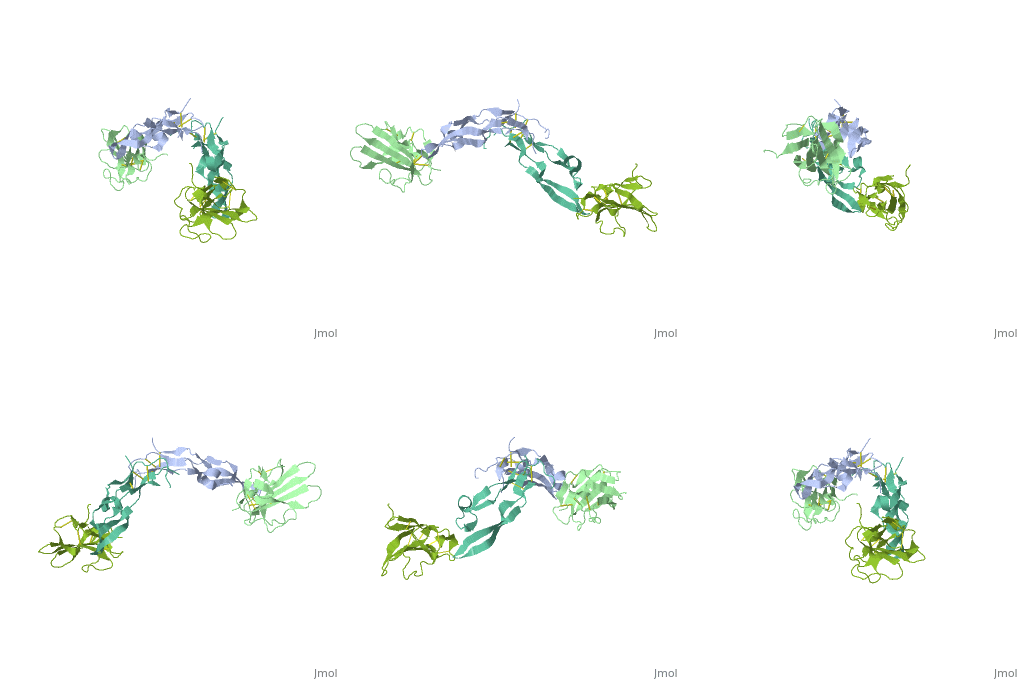
3D Structures of TGF-β receptor
Updated on 14-July-2015
