This old version of Proteopedia is provided for student assignments while the new version is undergoing repairs. Content and edits done in this old version of Proteopedia after March 1, 2026 will eventually be lost when it is retired in about June of 2026.
Apply for new accounts at the new Proteopedia. Your logins will work in both the old and new versions.
Replication Termination Protein
From Proteopedia
(Difference between revisions)
| Line 1: | Line 1: | ||
<StructureSection load='2dpd' size='450' side='right' scene='' caption='Assymetric RTP dimer bound to the B site in a Ter region (PDB code [[2dpd]])'> | <StructureSection load='2dpd' size='450' side='right' scene='' caption='Assymetric RTP dimer bound to the B site in a Ter region (PDB code [[2dpd]])'> | ||
== Function == | == Function == | ||
| - | [[Image:RTP.png| | + | [[Image:RTP.png|200px|left|thumb| Diagram of RTP monomer with secondary structure highlighted.]] |
The '''replication termination protein''' (RTP) is one of only two well-defined proteins known to be involved in arresting DNA replication forks, the other being a protein known as tus (termination utilisation substance) from E. coli <ref> Kamada K, Horiuchi T, Ohsumi K, Shimamoto N, Morkikawa K, (1996) Structure of a replication-terminator protein complexed with DNA. Nature, 383:598-603 </ref>. RTP was discovered in ''Bacillus subtilis'' and has been identified as a DNA binding protein of the winged helix family that forms a dimer of 29kDa. This dimeric form has been shown to have an exceptionally high affinity for its cognate binding sites( Kd ~10-11M-1)<ref> Wilce et. al. (2001) Structure of the RTP−DNA complex and the mechanism of polar replication fork arrest. Nature Structural Biology, 8:206-210 </ref>, otherwise known as Termination sites (Ter sites). These Ter sites are found in multiple locations in the ''B. subtilis'' genome <ref> Gautam A. et.al. (2001) A single domain of the replication termination protein of ''Bacillus subtilis'' is involved in arresting both DnaB helicase and RNA polymerase. Journal of Biological Chemistry, 276:23471-23479</ref>. For more details see:<br /> | The '''replication termination protein''' (RTP) is one of only two well-defined proteins known to be involved in arresting DNA replication forks, the other being a protein known as tus (termination utilisation substance) from E. coli <ref> Kamada K, Horiuchi T, Ohsumi K, Shimamoto N, Morkikawa K, (1996) Structure of a replication-terminator protein complexed with DNA. Nature, 383:598-603 </ref>. RTP was discovered in ''Bacillus subtilis'' and has been identified as a DNA binding protein of the winged helix family that forms a dimer of 29kDa. This dimeric form has been shown to have an exceptionally high affinity for its cognate binding sites( Kd ~10-11M-1)<ref> Wilce et. al. (2001) Structure of the RTP−DNA complex and the mechanism of polar replication fork arrest. Nature Structural Biology, 8:206-210 </ref>, otherwise known as Termination sites (Ter sites). These Ter sites are found in multiple locations in the ''B. subtilis'' genome <ref> Gautam A. et.al. (2001) A single domain of the replication termination protein of ''Bacillus subtilis'' is involved in arresting both DnaB helicase and RNA polymerase. Journal of Biological Chemistry, 276:23471-23479</ref>. For more details see:<br /> | ||
*[[RTP and Tus]]<br /> | *[[RTP and Tus]]<br /> | ||
Revision as of 05:54, 22 October 2017
| |||||||||||
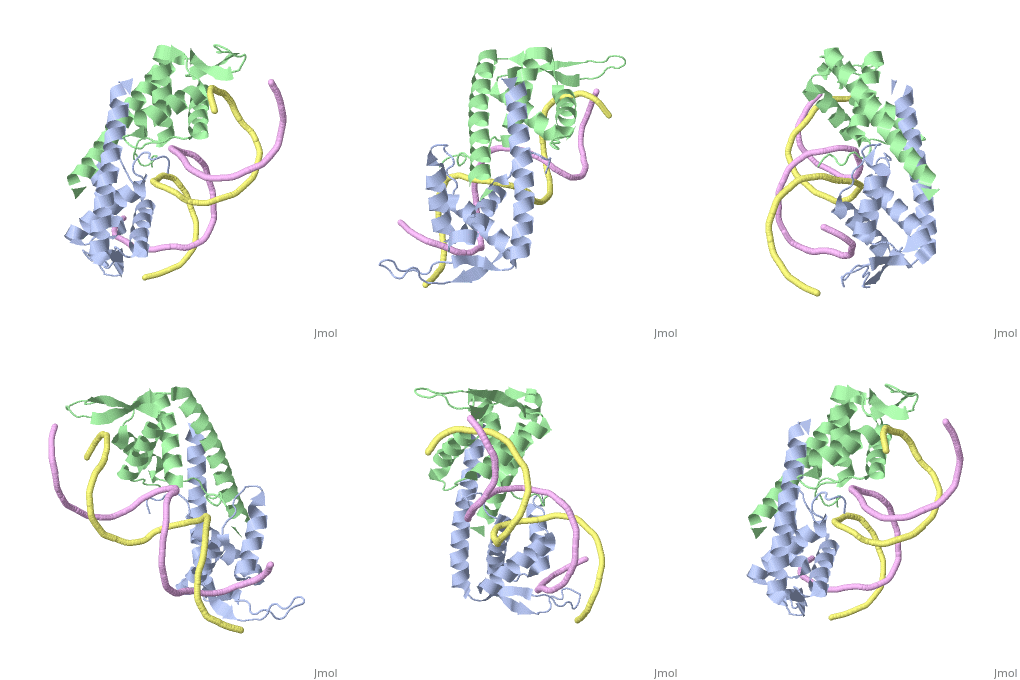


3D structures of replication terminator protein
1bm9 – BsRTP – Bacillus subtilis
1j0r, 2dqr - BsRTP (mutant)
2dpd - BsRTP + DNA
1f4k, 2dpu, 2efw – BsRTP (mutant) + DNA
1ecr – Tus + DNA – Escherichia coli
References
- ↑ Kamada K, Horiuchi T, Ohsumi K, Shimamoto N, Morkikawa K, (1996) Structure of a replication-terminator protein complexed with DNA. Nature, 383:598-603
- ↑ Wilce et. al. (2001) Structure of the RTP−DNA complex and the mechanism of polar replication fork arrest. Nature Structural Biology, 8:206-210
- ↑ Gautam A. et.al. (2001) A single domain of the replication termination protein of Bacillus subtilis is involved in arresting both DnaB helicase and RNA polymerase. Journal of Biological Chemistry, 276:23471-23479
- ↑ Noirot P (2007). "Replication of the Bacillus subtilis chromosome". In Graumann P. Bacillus: Cellular and Molecular Biology. Caister Academic Press. ISBN 978-1-904455-12-7
- ↑ Duggin I.G. (2006) DNA Replication Fork Arrest by the Bacillus subtilis RTP–DNA Complex Involves a Mechanism that Is Independent of the Affinity of RTP–DNA Binding. Journal of Molecular Biology, 361:1-6
- ↑ Vivian JP, Porter CJ, Wilce JA, Wilce MCJ, (2007) An asymmetric structure of the Bacillus subtilise Replication Terminator Protein in Complex with DNA. J. Mol. Bio, 370:481-491
- ↑ Vivian JP, Porter CJ, Wilce JA, Wilce MCJ, (2007) An asymmetric structure of the Bacillus subtilise Replication Terminator Protein in Complex with DNA. J. Mol. Bio, 370:481-491
- ↑ Bastia D. (1995) Crystal structure of the replication terminator protein from b. subtilis at 2.6 A. Cell 80: 651-660
- ↑ Wilce et. al. (2001) Structure of the RTP−DNA complex and the mechanism of polar replication fork arrest. Nature Structural Biology, 8:206-210
- ↑ Kaplan D.L., Bastia D. (2009). Mechanisms of polar arrest of a replication fork. Molecular Microbiology 72: 279-284
Proteopedia Page Contributors and Editors (what is this?)
Michal Harel, Alexander Berchansky, Craig Mooney, Joel L. Sussman
