This old version of Proteopedia is provided for student assignments while the new version is undergoing repairs. Content and edits done in this old version of Proteopedia after March 1, 2026 will eventually be lost when it is retired in about June of 2026.
Apply for new accounts at the new Proteopedia. Your logins will work in both the old and new versions.
Odorant binding protein
From Proteopedia
(Difference between revisions)
| (8 intermediate revisions not shown.) | |||
| Line 1: | Line 1: | ||
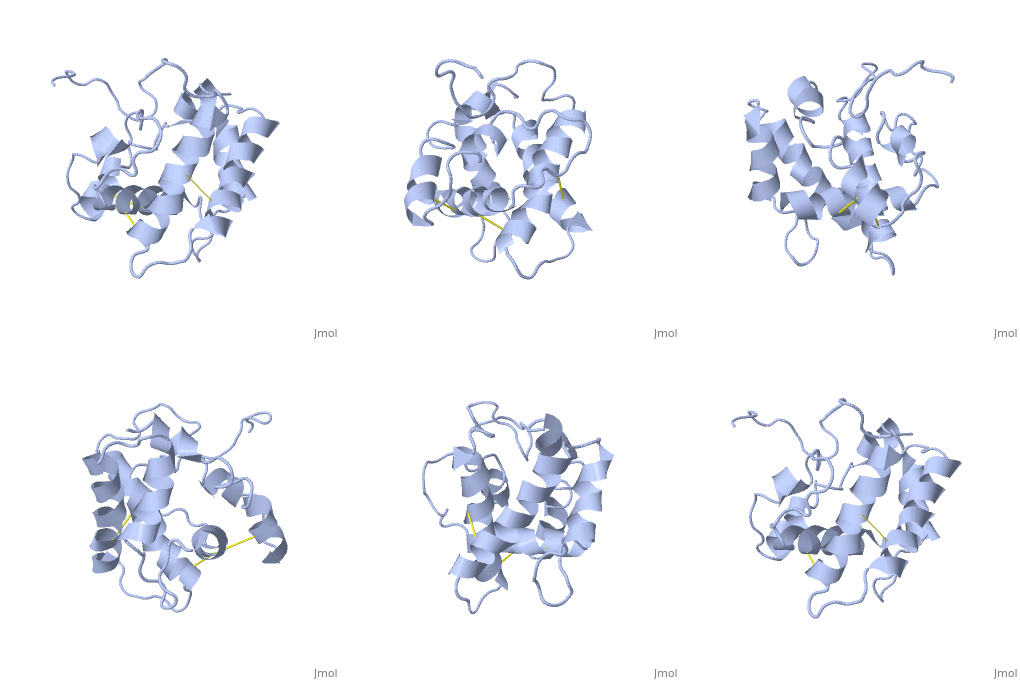
<StructureSection load='1ls8' size='340' side='right' caption='Bombyx mori PBP (PDB code [[1ls8]])' scene=''> | <StructureSection load='1ls8' size='340' side='right' caption='Bombyx mori PBP (PDB code [[1ls8]])' scene=''> | ||
[[Image:Bombyx mori.jpg|thumb|upright=2|''Bombyx mori'', the silk moth, picture by [https://www.flickr.com/photos/depredator007/2522038240/ Fernando Cuenca]]] | [[Image:Bombyx mori.jpg|thumb|upright=2|''Bombyx mori'', the silk moth, picture by [https://www.flickr.com/photos/depredator007/2522038240/ Fernando Cuenca]]] | ||
| - | [[Image:Bombykol. | + | [[Image:Bombykol.jpg|400px|thumb|upright=1|Bombykol, a sex pheromone of ''Bombyx mori'', from [http://pubchem.ncbi.nlm.nih.gov/compound/Bombykol#section=Top PubChem]]] |
==Introduction== | ==Introduction== | ||
Odorant-binding protein (OBP) are soluble proteins which are involved in the processes of odorant detection in the olfactory sensilla <ref name="Pelosi 2014">doi: 10.3389/fphys.2014.00320</ref>. Though functionally the same, vertebrates and insects OBP have different origin and structure. | Odorant-binding protein (OBP) are soluble proteins which are involved in the processes of odorant detection in the olfactory sensilla <ref name="Pelosi 2014">doi: 10.3389/fphys.2014.00320</ref>. Though functionally the same, vertebrates and insects OBP have different origin and structure. | ||
OBPs are important for insect olfaction. For instance, OBP76a (LUSH) in the fly [http://en.wikipedia.org/wiki/Drosophila_melanogaster ''Drosophila melanogaster''] is required for the detection of the pheromone vaccenyl acetate <ref name="Xu 2005">doi: 10.1016/j.neuron.2004.12.031</ref> and has been proven to adopt a conformation that activates the odorant receptor <ref name="Laughlin 2008">doi: 10.1016/j.cell.2008.04.046</ref>. | OBPs are important for insect olfaction. For instance, OBP76a (LUSH) in the fly [http://en.wikipedia.org/wiki/Drosophila_melanogaster ''Drosophila melanogaster''] is required for the detection of the pheromone vaccenyl acetate <ref name="Xu 2005">doi: 10.1016/j.neuron.2004.12.031</ref> and has been proven to adopt a conformation that activates the odorant receptor <ref name="Laughlin 2008">doi: 10.1016/j.cell.2008.04.046</ref>. | ||
| + | |||
| + | For more details see [[Chemical communication in arthropods]]. | ||
== OBP Function == | == OBP Function == | ||
| Line 63: | Line 65: | ||
==Activation by the complex pheromone-PBP== | ==Activation by the complex pheromone-PBP== | ||
An alternative mode of action was proposed for the receptor activation in ''Drosophila melanogaster'', where it was found that the complex of pheromone-PBP is required for the activity of pheromone-sensitive neurons <ref>DOI: 10.1016/j.neuron.2004.12.031</ref><ref>doi: 10.1016/j.cell.2008.04.046</ref> | An alternative mode of action was proposed for the receptor activation in ''Drosophila melanogaster'', where it was found that the complex of pheromone-PBP is required for the activity of pheromone-sensitive neurons <ref>DOI: 10.1016/j.neuron.2004.12.031</ref><ref>doi: 10.1016/j.cell.2008.04.046</ref> | ||
| - | + | ||
==3D structure of odorant binding protein== | ==3D structure of odorant binding protein== | ||
| + | [[Odorant binding protein 3D structures]] | ||
| - | + | </StructureSection> | |
| - | + | ||
| - | + | ||
| - | + | ||
| - | + | ||
| - | + | ||
| - | + | ||
| - | + | ||
| - | + | ||
| - | + | ||
| - | + | ||
| - | + | ||
| - | + | ||
| - | + | ||
| - | + | ||
| - | + | ||
| - | + | ||
| - | + | ||
| - | + | ||
| - | + | ||
| - | + | ||
| - | + | ||
| - | + | ||
| - | + | ||
| - | + | ||
| - | + | ||
| - | + | ||
| - | + | ||
| - | + | ||
| - | + | ||
| - | + | ||
| - | + | ||
| - | + | ||
| - | + | ||
| - | + | ||
| - | + | ||
== See also == | == See also == | ||
| Line 110: | Line 78: | ||
== References == | == References == | ||
<references/> | <references/> | ||
| + | [[Category:Topic Page]] | ||
Current revision
| |||||||||||


See also
- Odorant_binding_protein_3D_structures
- Chemical communication in arthropods
- Pheromone binding protein
- Bovine odorant binding protein
References
Proteopedia Page Contributors and Editors (what is this?)
Nurit Eliash, Michal Harel, Joel L. Sussman, Alexander Berchansky, Jaime Prilusky
