This old version of Proteopedia is provided for student assignments while the new version is undergoing repairs. Content and edits done in this old version of Proteopedia after March 1, 2026 will eventually be lost when it is retired in about June of 2026.
Apply for new accounts at the new Proteopedia. Your logins will work in both the old and new versions.
FK506 binding protein
From Proteopedia
(Difference between revisions)
| (17 intermediate revisions not shown.) | |||
| Line 1: | Line 1: | ||
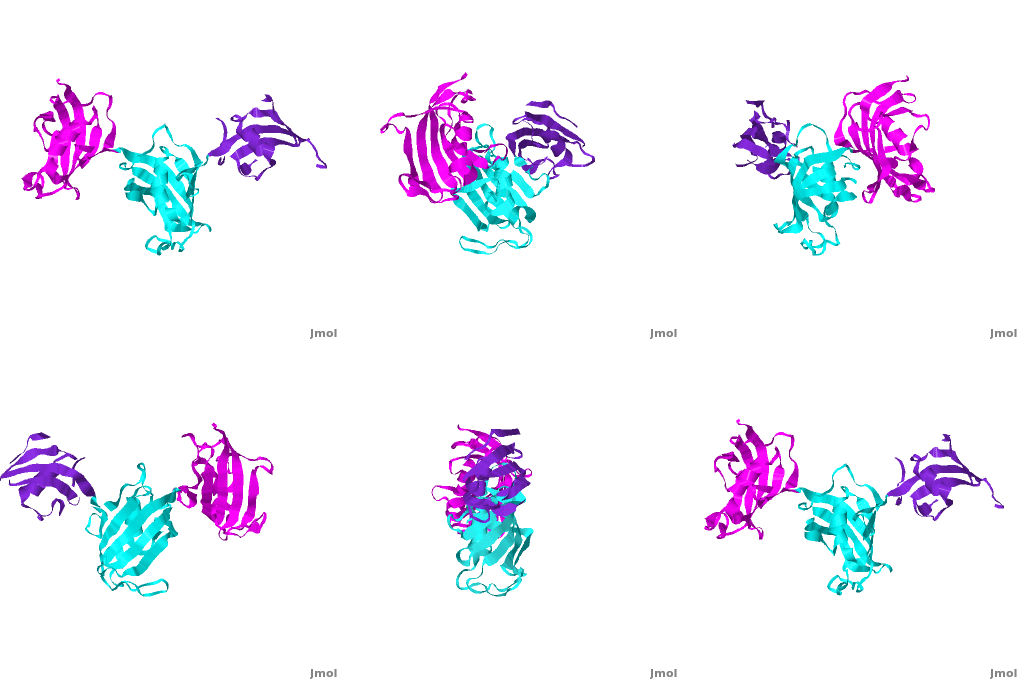
| - | <StructureSection load=' | + | <StructureSection load='' size='350' scene='3jym/Cv/2' caption='Wheat FKBP506 domains. Domain 1 (purple), 2 (cyan), 3 (magenta). [[3jym]]'> |
| - | '''FK506 binding protein (FKBP)''' is a prolyl isomerase related to the [[Cyclophilin|cyclophilins]]. FKBP is a folding chaperone for proteins containing prolines | + | == Function == |
| + | |||
| + | '''FK506 binding protein (FKBP)''' is a prolyl isomerase related to the [[Cyclophilin|cyclophilins]]. FKBP is a folding chaperone for proteins containing prolines<ref>PMID:18635947</ref>. For more details see<br /> | ||
* [[Human FKBP52]]<br /> | * [[Human FKBP52]]<br /> | ||
| - | * [[ | + | * [[Peptidyl-prolyl cis-trans isomerase]] for '''SlyD'''<br /> |
* [[Wheat FKBP73]]. | * [[Wheat FKBP73]]. | ||
| + | |||
| + | == Relevance == | ||
| + | |||
| + | '''FKBP12''' binds the immunosuppressor tacrolimus (ascomycin FK506) which is used against organ rejection and rapamycin<ref>PMID:9275110</ref>. | ||
==Wheat FKBP73 and its comparison with human FKBP52<ref >PMID:20306145</ref>== | ==Wheat FKBP73 and its comparison with human FKBP52<ref >PMID:20306145</ref>== | ||
| Line 9: | Line 15: | ||
{{Clear}} | {{Clear}} | ||
| - | The 3D structures of several FKBP family members from various species are solved, most of them comprise 1-2 FK domains (''e.g.'' human FKBP52, known also as FKBP4), while wFKBP73 has 3 FK domains which is characteristic to plants. A sequence-based structure comparison between each of the 3 FK domains of wFKBP73 and the 2 FK domains of hFKBP52 ([[1q1c]]) was performed. All 3 FK domains of wFKBP73 adopt a typical FK fold exhibiting significant diversity when superimposed. They are arranged in a linear manner in space as observed in the 2 FK domains of hFKBP52. While the 2 FK domains of hFKBP52 are in the same orientation, the orientation between any 2 consecutive wFK73 domains is different than that between the two FK domains of hFKBP52. <scene name='3jym/Al/2'>Superposition</scene> of the <font color='blueviolet'><b>wFK73_1 (in blueviolet)</b></font> and <span style="color:cyan;background-color:black;font-weight:bold;">wFK73_2 (in cyan)</span> domains on hFK52_1 (in yellow) and <font color='blue'><b>hFK52_2 (in blue)</b></font> revealed that while <span style="color:cyan;background-color:black;font-weight:bold;">wFK73_2</span> is perfectly aligned with <font color='blue'><b>hFK52_2</b></font>, N-terminal <font color='blueviolet'><b>wFK73_1</b></font> does not align with hFK52_1 (yellow). Similarly, <scene name='3jym/Al/3'>superposition</scene> of the <span style="color:cyan;background-color:black;font-weight:bold;">wFK73_2 | + | The 3D structures of several FKBP family members from various species are solved, most of them comprise 1-2 FK domains (''e.g.'' human FKBP52, known also as FKBP4), while wFKBP73 has 3 FK domains which is characteristic to plants. A sequence-based structure comparison between each of the 3 FK domains of wFKBP73 and the 2 FK domains of hFKBP52 ([[1q1c]]) was performed. All 3 FK domains of wFKBP73 adopt a typical FK fold exhibiting significant diversity when superimposed. They are arranged in a linear manner in space as observed in the 2 FK domains of hFKBP52. While the 2 FK domains of hFKBP52 are in the same orientation, the orientation between any 2 consecutive wFK73 domains is different than that between the two FK domains of hFKBP52. <scene name='3jym/Al/2'>Superposition</scene> of the <font color='blueviolet'><b>wFK73_1 (in blueviolet)</b></font> and <span style="color:cyan;background-color:black;font-weight:bold;">wFK73_2 (in cyan)</span> domains on hFK52_1 (in yellow) and <font color='blue'><b>hFK52_2 (in blue)</b></font> revealed that while <span style="color:cyan;background-color:black;font-weight:bold;">wFK73_2</span> is perfectly aligned with <font color='blue'><b>hFK52_2</b></font>, N-terminal <font color='blueviolet'><b>wFK73_1</b></font> does not align with hFK52_1 (yellow). Similarly, <scene name='3jym/Al/3'>superposition</scene> of the <span style="color:cyan;background-color:black;font-weight:bold;">wFK73_2</span> and <font color='magenta'><b>wFK73_3 (in magenta)</b></font> domains on hFKBP52 revealed that while <span style="color:cyan;background-color:black;font-weight:bold;">wFK73_2</span> is perfectly aligned with hFK52_1 (in yellow), <font color='magenta'><b>wFK73_3</b></font> does not align with <font color='blue'><b>hFK52_2</b></font>. This unique arrangement of wFKBP73 causes that the α-helices of <scene name='3jym/Al/4'>wFKBP73 3 FK domains</scene> are exposed on the same surface, while the <scene name='3jym/Al/5'>2 α-helices of hFK52</scene> are presented on opposite surfaces. |
{{Clear}} | {{Clear}} | ||
| Line 16: | Line 22: | ||
==SlyD<ref >DOI 10.1007/s00775-011-0855-y</ref>== | ==SlyD<ref >DOI 10.1007/s00775-011-0855-y</ref>== | ||
SlyD belongs to the FK506-binding protein (FKBP) family with both peptidylprolyl isomerase (PPIase) and chaperone activities, and is considered to be a ubiquitous cytosolic protein-folding facilitator in bacteria. It possesses a histidine- and cysteine-rich C-terminus binding to selected divalent metal ions (''e.g.'', Ni<sup>2+</sup>, Zn<sup>2+</sup>), which is important for its involvement in the maturation processes of metalloenzymes. The solution structure of <scene name='Journal:JBIC:14/Cv/3'>C-terminus-truncated SlyD</scene> from ''Helicobacter pylori'' (HpSlyDΔC) was determined ([[2kr7]]). HpSlyDΔC folds into <scene name='Journal:JBIC:14/Cv/4'>two well-separated, orientation-independent domains:</scene> the <span style="color:cyan;background-color:black;font-weight:bold;">PPIase-active FKBP domain (in cyan)</span> and the <font color='red'><b>chaperone-active insert-in-flap (IF) domain (in red)</b></font>, <font color='darkmagenta'><b>linkers are in darkmagenta</b></font>. The FKBP domain consists of a four-stranded antiparallel <scene name='Journal:JBIC:14/Cv/5'>β-sheet with an α-helix on one side, whereas the IF domain folds into a four-stranded antiparallel β-sheet accompanied by a short α-helix.</scene> Intact ''H. pylori'' SlyD binds both Ni<sup>2+</sup> and Zn<sup>2+</sup>, with dissociation constants of 2.74 and 3.79 μM respectively. Intriguingly, binding of Ni<sup>2+</sup> instead of Zn<sup>2+</sup> induces protein conformational changes around the <scene name='Journal:JBIC:14/Cv/6'>active sites of the FKBP domain, implicating a regulatory role of nickel</scene> <font color='blueviolet'><b>(residues experiencing relatively large chemical shift perturbations upon interactions of HpSlyDΔC with Ni<sup>2+</sup> are in blueviolet)</b></font>. <scene name='Journal:JBIC:14/Cv/7'>The twin-arginine translocation (Tat) signal peptide from the small subunit of [NiFe] hydrogenase (HydA) binds the protein at the IF domain</scene> <font color='orange'><b>(residues in orange)</b></font>. Surprisingly, several residues (Ile41, Gly42, Ile46, and Asn31) were from the FKBP domain, which is likely due to the binding of the longer n-region of HydA Tat peptide to the FKBP domain. Nickel binding and the recognition of the Tat signal peptide by the protein suggest that SlyD participates in [NiFe] hydrogenase maturation processes. | SlyD belongs to the FK506-binding protein (FKBP) family with both peptidylprolyl isomerase (PPIase) and chaperone activities, and is considered to be a ubiquitous cytosolic protein-folding facilitator in bacteria. It possesses a histidine- and cysteine-rich C-terminus binding to selected divalent metal ions (''e.g.'', Ni<sup>2+</sup>, Zn<sup>2+</sup>), which is important for its involvement in the maturation processes of metalloenzymes. The solution structure of <scene name='Journal:JBIC:14/Cv/3'>C-terminus-truncated SlyD</scene> from ''Helicobacter pylori'' (HpSlyDΔC) was determined ([[2kr7]]). HpSlyDΔC folds into <scene name='Journal:JBIC:14/Cv/4'>two well-separated, orientation-independent domains:</scene> the <span style="color:cyan;background-color:black;font-weight:bold;">PPIase-active FKBP domain (in cyan)</span> and the <font color='red'><b>chaperone-active insert-in-flap (IF) domain (in red)</b></font>, <font color='darkmagenta'><b>linkers are in darkmagenta</b></font>. The FKBP domain consists of a four-stranded antiparallel <scene name='Journal:JBIC:14/Cv/5'>β-sheet with an α-helix on one side, whereas the IF domain folds into a four-stranded antiparallel β-sheet accompanied by a short α-helix.</scene> Intact ''H. pylori'' SlyD binds both Ni<sup>2+</sup> and Zn<sup>2+</sup>, with dissociation constants of 2.74 and 3.79 μM respectively. Intriguingly, binding of Ni<sup>2+</sup> instead of Zn<sup>2+</sup> induces protein conformational changes around the <scene name='Journal:JBIC:14/Cv/6'>active sites of the FKBP domain, implicating a regulatory role of nickel</scene> <font color='blueviolet'><b>(residues experiencing relatively large chemical shift perturbations upon interactions of HpSlyDΔC with Ni<sup>2+</sup> are in blueviolet)</b></font>. <scene name='Journal:JBIC:14/Cv/7'>The twin-arginine translocation (Tat) signal peptide from the small subunit of [NiFe] hydrogenase (HydA) binds the protein at the IF domain</scene> <font color='orange'><b>(residues in orange)</b></font>. Surprisingly, several residues (Ile41, Gly42, Ile46, and Asn31) were from the FKBP domain, which is likely due to the binding of the longer n-region of HydA Tat peptide to the FKBP domain. Nickel binding and the recognition of the Tat signal peptide by the protein suggest that SlyD participates in [NiFe] hydrogenase maturation processes. | ||
| - | + | == 3D Structures of FKBP == | |
| + | [[FKBP 3D structures]] | ||
</StructureSection> | </StructureSection> | ||
| - | == 3D Structures of FKBP == | ||
| - | |||
| - | Updated on {{REVISIONDAY2}}-{{MONTHNAME|{{REVISIONMONTH}}}}-{{REVISIONYEAR}} | ||
| - | {{#tree:id=OrganizedByTopic|openlevels=0| | ||
| - | |||
| - | *FKBP | ||
| - | |||
| - | **[[1fks]], [[1fkr]], [[1fkt]] – EcFKBP – ''Escherichia coli''<br /> | ||
| - | **[[1q6h]], [[1q6u]] – EcFKBP<br /> | ||
| - | **[[1q6i]] – EcFKBP+FK-506<br /> | ||
| - | **[[1ix5]] – FKBP – ''Methanothermococcus thermolithotrophicus'' – NMR<br /> | ||
| - | **[[1bl4]] – hFKBP (mutant)+inhibitor<br /> | ||
| - | **[[1bkf]] – hFKBP (mutant)+FK-506<br /> | ||
| - | **[[1fkf]] - hFKBP+FK-506<br /> | ||
| - | **[[1fkr]], [[1fks]], [[1fkt]] – hFKBP - NMR | ||
| - | |||
| - | *FKBP1 | ||
| - | |||
| - | **[[4iq2]], [[4iqc]] - hFKBP-1B (mutant)<br /> | ||
| - | **[[4n19]] - hFKBP-1A (mutant)<br /> | ||
| - | **[[3mdy]] – hFKBP-1A + BMPR1B<br /> | ||
| - | **[[3h9r]] - hFKBP-1A+ activin receptor type I<br /> | ||
| - | **[[4c02]] - hFKBP-1B+ activin receptor type I<br /> | ||
| - | **[[1j4r]] – hFKBP-1+FKB-001<br /> | ||
| - | **[[4dh0]] - hFKBP-1A+ rapamycin<br /> | ||
| - | |||
| - | *FKBP3 | ||
| - | |||
| - | **[[3kz7]] – hFKBP FK506-binding domain + immunosuppressant - human | ||
| - | |||
| - | *FKBP4 | ||
| - | |||
| - | **[[1q1c]], [[4lav]], [[4law]] – hFKBP <br /> | ||
| - | **[[1n1a]] – hFKBP N terminal<br /> | ||
| - | **[[1p5q]] - hFKBP C terminal<br /> | ||
| - | **[[1qz2]] – hFKBP + Hsp90 peptide<br /> | ||
| - | **[[4drj]] – hFKBP FK506-binding domain + serine/threonine-protein kinase FRB domain + Immunospressant<br /> | ||
| - | |||
| - | *FKBP5 | ||
| - | |||
| - | **[[3o5d]], [[3o5e]], [[3o5f]] – hFKBP<br /> | ||
| - | **[[3o5g]], [[3o5i]], [[3o5j]], [[3o5k]] - hFKBP FK506-binding domain<br /> | ||
| - | **[[3o5l]], [[3o5m]], [[3o5o]], [[3o5p]], [[3o5q]] - hFKBP FK506-binding domain (mutant)<br /> | ||
| - | **[[4lax]] – hFKBP + FK506<br /> | ||
| - | **[[4lay]] – hFKBP + I63<br /> | ||
| - | **[[3o5r]] - hFKBP FK506-binding domain (mutant) + immunosuppressant<br /> | ||
| - | **[[4drq]] – hFKBP + pipecolate sulfonamide<br /> | ||
| - | **[[4drk]], [[4drm]], [[4drn]], [[4dro]], [[4drp]] – hFKBP FK506-binding domain + FK506 analog<br /> | ||
| - | |||
| - | *FKBP8 | ||
| - | |||
| - | **[[2f2d]], [[3ey6]], [[2awg]] - hFKBP FK506-binding domain<br /> | ||
| - | **[[2d9f]] – hFKBP – NMR<br /> | ||
| - | **[[2mf9]], [[2jwx]] – hFKBP N terminal – NMR<br /> | ||
| - | |||
| - | *FKBP12 | ||
| - | |||
| - | **[[1eym]], [[2ppo]], [[4ipx]] – hFKBP (mutant) <br /> | ||
| - | **[[1fkk]] – hFKBP<br /> | ||
| - | **[[2gaq]], [[2pnu]]– hFKBP - NMR<br /> | ||
| - | **[[3uqi]] – ymFKBP – yellowfever mosquito<br /> | ||
| - | **[[2lpv]] – ymFKBP - NMR<br /> | ||
| - | **[[1fkd]], [[1fkj]], [[2fke]], [[1qpf]], [[1qpl]] – hFKBP + immunosuppressant<br /> | ||
| - | **[[2ppp]], [[2ppn]], [[2dg3]], [[1d6o]] – hFKBP<br /> | ||
| - | **[[1j4h]], [[1j4i]] – hFKBP + inhibitor<br /> | ||
| - | **[[1b6c]] – hFKBP + TGF-B superfamily receptor I<br /> | ||
| - | **[[3fap]] – hFKBP + FKBP12-rapamycin associated protein<br /> | ||
| - | **[[4fap]] - hFKBP + FKBP12-rapamycin associated protein + immunosuppressant<br /> | ||
| - | **[[1tco]] - FKBP + Ser/Thr phosphatase B2 + immunosuppressant - bovine<br /> | ||
| - | **[[1yat]] – FKBP + antagonist – yeast<br /> | ||
| - | **[[2dg4]], [[1fkb]], [[1c9h]] - hFKBP+rapamycin<br /> | ||
| - | **[[2fap]], [[1nsg]], [[1fap]] - hFKBP+rapamycin+FRB<br /> | ||
| - | **[[1f40]] – hFKBP +GPI-1046<br /> | ||
| - | **[[1a7x]] – hFKBP +FK-1012<br /> | ||
| - | **[[1d7h]], [[1d7i]], [[1d7j]], [[1fkg]], [[1fkh]], [[1fki]] – hFKBP +ligand<br /> | ||
| - | **[[4dh0]] – hFKBP + rapamycin<br /> | ||
| - | **[[2rse]] – hFKBP + serine/threonine protein kinase MTOR peptide + rapamycin - NMR<br /> | ||
| - | **[[2dg9]] - hFKBP (mutant)+rapamycin<br /> | ||
| - | **[[1fkl]] – cFKBP +rapamycin – cow | ||
| - | |||
| - | *FKBP13 | ||
| - | |||
| - | **[[2pbc]] – hFKBP <br /> | ||
| - | **[[4nnr]] – hFKBP + FK506<br /> | ||
| - | **[[1y0o]], [[1u79]] – AtFKBP - ''Arabidopsis thaliana'' | ||
| - | |||
| - | *FKBP14 | ||
| - | |||
| - | **[[4dip]], [[4msp]] – hFKBP <br /> | ||
| - | |||
| - | *FKBP22 | ||
| - | |||
| - | **[[3b09]] – FKBP N terminal - ''Shewanella''<br /> | ||
| - | |||
| - | *FKBP25 | ||
| - | |||
| - | **[[2kfv]] – hFKBP N terminal<br /> | ||
| - | **[[1pbk]] – hFKBP C terminal<br /> | ||
| - | |||
| - | *FKBP26 | ||
| - | |||
| - | **[[3pr9]], [[3pra]], [[3prb]], [[3prd]] – FKBP – ''Methanocaldococcus jannaschii'' | ||
| - | |||
| - | *FKBP35 | ||
| - | |||
| - | **[[2vn1]] – PfFKBP FK506-binding domain+FK506 <br /> | ||
| - | **[[4j4n]] – PfFKBP FK506-binding domain+ antimalarial drug <br /> | ||
| - | |||
| - | *FKBP36 | ||
| - | |||
| - | **[[3b7x]] – hFKBP <br /> | ||
| - | |||
| - | *FKBP38 | ||
| - | |||
| - | **[[2jwx]] - hFKBP N terminal - NMR | ||
| - | |||
| - | *FKBP39 | ||
| - | |||
| - | **[[4ca9]] - FKBP N terminal – ''Drosophila melanogaster'' – NMR<br /> | ||
| - | |||
| - | *FKBP42 | ||
| - | |||
| - | **[[2f4e]] – AtFKBP N-terminal <br /> | ||
| - | **[[2if4]] – AtFKBP <br /> | ||
| - | |||
| - | *FKBP51 | ||
| - | |||
| - | **[[1kt0]], [[1kt1]] – hFKBP<br /> | ||
| - | **[[4drq]] – hFKBP FK1 domain + pipecolate sulfonamide<br /> | ||
| - | **[[4jfi]], [[4jfj]], [[4jfk]], [[4jfl]], [[4jfm]], [[4tw6]], [[4tw7]], [[4tx0]], [[4w9o]], [[4w9p]], [[4w9q]] – hFKBP FK1 domain (mutant) + inhibitor<br /> | ||
| - | **[[4tw8]] – hFKBP FK1+FK2 domains (mutant) + inhibitor<br /> | ||
| - | **[[4drk]], [[4drm]], [[4drn]], [[4dro]], [[4drp]] – hFKBP FK1 domain + FK506 analog<br /> | ||
| - | **[[4drh]], [[4dri]] – hFKBP FK1 domain + serine/threonine protein kinase MTOR peptide + rapamycin <br /> | ||
| - | |||
| - | *FKBP52 | ||
| - | |||
| - | **[[4drj]] – hFKBP FK1 domain + serine/threonine protein kinase MTOR peptide + rapamycin <br /> | ||
| - | |||
| - | *FKBP59 | ||
| - | |||
| - | **[[1rot]], [[1rou]] – FKBP N terminal – NMR – rabbit | ||
| - | |||
| - | **[[2lgo]] – FKBP – NMR –'' Giardia lamblia'' | ||
| - | |||
| - | *FKBP73 | ||
| - | + | == References == | |
| + | <references/> | ||
| - | }} | ||
[[Category: Topic Page]] | [[Category: Topic Page]] | ||
Current revision
| |||||||||||
References
- ↑ Kang CB, Hong Y, Dhe-Paganon S, Yoon HS. FKBP family proteins: immunophilins with versatile biological functions. Neurosignals. 2008;16(4):318-25. doi: 10.1159/000123041. Epub 2008 Jul 18. PMID:18635947 doi:http://dx.doi.org/10.1159/000123041
- ↑ Mayer AD, Dmitrewski J, Squifflet JP, Besse T, Grabensee B, Klein B, Eigler FW, Heemann U, Pichlmayr R, Behrend M, Vanrenterghem Y, Donck J, van Hooff J, Christiaans M, Morales JM, Andres A, Johnson RW, Short C, Buchholz B, Rehmert N, Land W, Schleibner S, Forsythe JL, Talbot D, Pohanka E, et al.. Multicenter randomized trial comparing tacrolimus (FK506) and cyclosporine in the prevention of renal allograft rejection: a report of the European Tacrolimus Multicenter Renal Study Group. Transplantation. 1997 Aug 15;64(3):436-43. PMID:9275110
- ↑ Unger T, Dym O, Albeck S, Jacobovitch Y, Bernehim R, Marom D, Pisanty O, Breiman A. Crystal structure of the three FK506 binding protein domains of wheat FKBP73: evidence for a unique wFK73_2 domain. J Struct Funct Genomics. 2010 Jun;11(2):113-23. Epub 2010 Mar 20. PMID:20306145 doi:10.1007/s10969-010-9085-8
- ↑ Cheng T, Li H, Xia W, Sun H. Multifaceted SlyD from Helicobacter pylori: implication in [NiFe] hydrogenase maturation. J Biol Inorg Chem. 2011 Nov 2. PMID:22045417 doi:10.1007/s00775-011-0855-y
