This old version of Proteopedia is provided for student assignments while the new version is undergoing repairs. Content and edits done in this old version of Proteopedia after March 1, 2026 will eventually be lost when it is retired in about June of 2026.
Apply for new accounts at the new Proteopedia. Your logins will work in both the old and new versions.
Protegrin
From Proteopedia
| Line 1: | Line 1: | ||
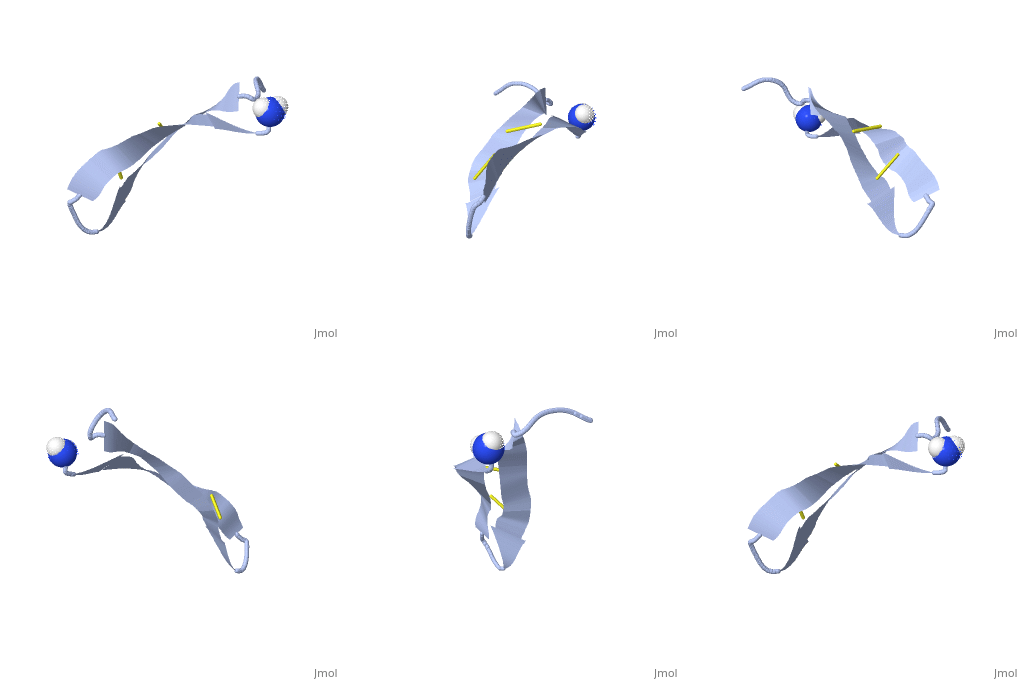
<StructureSection load='1pg1' size='350' side='right' caption='NMR structure of pig protegrin 1, [[1pg1]]' scene=''> | <StructureSection load='1pg1' size='350' side='right' caption='NMR structure of pig protegrin 1, [[1pg1]]' scene=''> | ||
| + | |||
| + | __Toc__ | ||
==About this Structure== | ==About this Structure== | ||
1PG1 is a [[Single protein]] structure of sequence from [http://en.wikipedia.org/wiki/Sus_scrofa Sus scrofa]. Full experimental information is available from [http://oca.weizmann.ac.il/oca-bin/ocashort?id=1PG1 OCA]. 1PG1 is an arginine and cysteine rich protein, which forms a double stranded anti-parallel β-sheet structure. The single chain forms a membrane-bound dimer, of structure [http://proteopedia.org/wiki/index.php/1zy6 1ZY6]. The structure of 1PG1 is similar to that of some other [http://en.wikipedia.org/wiki/Antimicrobial_peptide antimicrobial peptides] such as [http://en.wikipedia.org/wiki/Defensin defensins]<ref>Interaction of human defensins with Escherichia coli. Mechanism of bactericidal activity., Lehrer RI, Barton A, Daher KA, Harwig SS, Ganz T, Selsted ME., J Clin Invest. 1989 Aug;84(2):553-61. PMID: [http://www.ncbi.nlm.nih.gov/pubmed/2668334 2668334]</ref>. In one study comparing the susceptibility of [http://en.wikipedia.org/wiki/Chlamydia_trachomatis Chlamydia trachomatis] to 1PG1 and a similar defensin peptide, 1PG1 was shown to be significantly more effective at inactivating the bacteria<ref>Susceptibility of Chlamydia trachomatis to protegrins and defensins., Yasin B, Harwig SS, Lehrer RI, Wagar EA., Infect Immun. 1996 Mar;64(3):709-13. PMID: [http://www.ncbi.nlm.nih.gov/pubmed/8641770 8641770]</ref>. The antimicrobial action of this protein is believed to be due to its ability to create pores in bacterial membranes causing ion leakage <ref>Membrane channel formation by antimicrobial protegrins., Sokolov Y, Mirzabekov T, Martin DW, Lehrer RI, Kagan BL, Biochim Biophys Acta. 1999 Aug 20;1420(1-2):23-9. PMID:[http://www.ncbi.nlm.nih.gov/pubmed/10446287 10446287]</ref>. This antimicrobial activity has given rise to the idea of using the peptide as a therapeutic for local or systemic infections<ref>Protegrin-1: a broad-spectrum, rapidly microbicidal peptide with in vivo activity, D A Steinberg, M A Hurst, C A Fujii, A H Kung, J F Ho, F C Cheng, D J Loury, and J C Fiddes, Antimicrob Agents Chemother. 1997 August; 41(8): 1738–1742. PMCID: [https://www.ncbi.nlm.nih.gov/pmc/articles/PMC163996/ PMC163996]</ref>. The protegrin is synthesized as a ca. 149 amino acid precursor with a cathelin-like domain. | 1PG1 is a [[Single protein]] structure of sequence from [http://en.wikipedia.org/wiki/Sus_scrofa Sus scrofa]. Full experimental information is available from [http://oca.weizmann.ac.il/oca-bin/ocashort?id=1PG1 OCA]. 1PG1 is an arginine and cysteine rich protein, which forms a double stranded anti-parallel β-sheet structure. The single chain forms a membrane-bound dimer, of structure [http://proteopedia.org/wiki/index.php/1zy6 1ZY6]. The structure of 1PG1 is similar to that of some other [http://en.wikipedia.org/wiki/Antimicrobial_peptide antimicrobial peptides] such as [http://en.wikipedia.org/wiki/Defensin defensins]<ref>Interaction of human defensins with Escherichia coli. Mechanism of bactericidal activity., Lehrer RI, Barton A, Daher KA, Harwig SS, Ganz T, Selsted ME., J Clin Invest. 1989 Aug;84(2):553-61. PMID: [http://www.ncbi.nlm.nih.gov/pubmed/2668334 2668334]</ref>. In one study comparing the susceptibility of [http://en.wikipedia.org/wiki/Chlamydia_trachomatis Chlamydia trachomatis] to 1PG1 and a similar defensin peptide, 1PG1 was shown to be significantly more effective at inactivating the bacteria<ref>Susceptibility of Chlamydia trachomatis to protegrins and defensins., Yasin B, Harwig SS, Lehrer RI, Wagar EA., Infect Immun. 1996 Mar;64(3):709-13. PMID: [http://www.ncbi.nlm.nih.gov/pubmed/8641770 8641770]</ref>. The antimicrobial action of this protein is believed to be due to its ability to create pores in bacterial membranes causing ion leakage <ref>Membrane channel formation by antimicrobial protegrins., Sokolov Y, Mirzabekov T, Martin DW, Lehrer RI, Kagan BL, Biochim Biophys Acta. 1999 Aug 20;1420(1-2):23-9. PMID:[http://www.ncbi.nlm.nih.gov/pubmed/10446287 10446287]</ref>. This antimicrobial activity has given rise to the idea of using the peptide as a therapeutic for local or systemic infections<ref>Protegrin-1: a broad-spectrum, rapidly microbicidal peptide with in vivo activity, D A Steinberg, M A Hurst, C A Fujii, A H Kung, J F Ho, F C Cheng, D J Loury, and J C Fiddes, Antimicrob Agents Chemother. 1997 August; 41(8): 1738–1742. PMCID: [https://www.ncbi.nlm.nih.gov/pmc/articles/PMC163996/ PMC163996]</ref>. The protegrin is synthesized as a ca. 149 amino acid precursor with a cathelin-like domain. | ||
| Line 33: | Line 35: | ||
[[1pg1]], [[1zy6]] – pPRO1 – pig – NMR<BR /> | [[1pg1]], [[1zy6]] – pPRO1 – pig – NMR<BR /> | ||
| + | [[2muh]] - pPRO2 residues 131-146 - NMR<br /> | ||
[[1n5h]], [[1n5p]] – pPRO3 cathelin-like domain – NMR<br /> | [[1n5h]], [[1n5p]] – pPRO3 cathelin-like domain – NMR<br /> | ||
[[1kwi]], [[1lxe]], [[1pfp]] – pPRO3 cathelin-like domain <br /> | [[1kwi]], [[1lxe]], [[1pfp]] – pPRO3 cathelin-like domain <br /> | ||
Revision as of 06:53, 8 October 2020
| |||||||||||
References
Solution structure of protegrin-1, a broad-spectrum antimicrobial peptide from porcine leukocytes., Fahrner RL, Dieckmann T, Harwig SS, Lehrer RI, Eisenberg D, Feigon J, Chem Biol. 1996 Jul;3(7):543-50. PMID:8807886
3D structures of protegrin
Updated on 08-October-2020
1pg1, 1zy6 – pPRO1 – pig – NMR
2muh - pPRO2 residues 131-146 - NMR
1n5h, 1n5p – pPRO3 cathelin-like domain – NMR
1kwi, 1lxe, 1pfp – pPRO3 cathelin-like domain
2m2z - pPRO3 residues 131-148 - NMR
6qkf – pPtn-4 - NMR
- ↑ Interaction of human defensins with Escherichia coli. Mechanism of bactericidal activity., Lehrer RI, Barton A, Daher KA, Harwig SS, Ganz T, Selsted ME., J Clin Invest. 1989 Aug;84(2):553-61. PMID: 2668334
- ↑ Susceptibility of Chlamydia trachomatis to protegrins and defensins., Yasin B, Harwig SS, Lehrer RI, Wagar EA., Infect Immun. 1996 Mar;64(3):709-13. PMID: 8641770
- ↑ Membrane channel formation by antimicrobial protegrins., Sokolov Y, Mirzabekov T, Martin DW, Lehrer RI, Kagan BL, Biochim Biophys Acta. 1999 Aug 20;1420(1-2):23-9. PMID:10446287
- ↑ Protegrin-1: a broad-spectrum, rapidly microbicidal peptide with in vivo activity, D A Steinberg, M A Hurst, C A Fujii, A H Kung, J F Ho, F C Cheng, D J Loury, and J C Fiddes, Antimicrob Agents Chemother. 1997 August; 41(8): 1738–1742. PMCID: PMC163996
- ↑ NPG1. EBI QuickGO. http://www.ebi.ac.uk/QuickGO/GProtein?ac=P32194
- ↑ Protein: Protegrin 1 (PG1) from Pig (Sus scrofa). Structural Classification of Proteins. http://scop.mrc-lmb.cam.ac.uk/scop/data/scop.b.ba.e.b.f.b.html
Created with the participation of Lee Tien.
