This old version of Proteopedia is provided for student assignments while the new version is undergoing repairs. Content and edits done in this old version of Proteopedia after March 1, 2026 will eventually be lost when it is retired in about June of 2026.
Apply for new accounts at the new Proteopedia. Your logins will work in both the old and new versions.
Adhesin
From Proteopedia
(Difference between revisions)
| (19 intermediate revisions not shown.) | |||
| Line 1: | Line 1: | ||
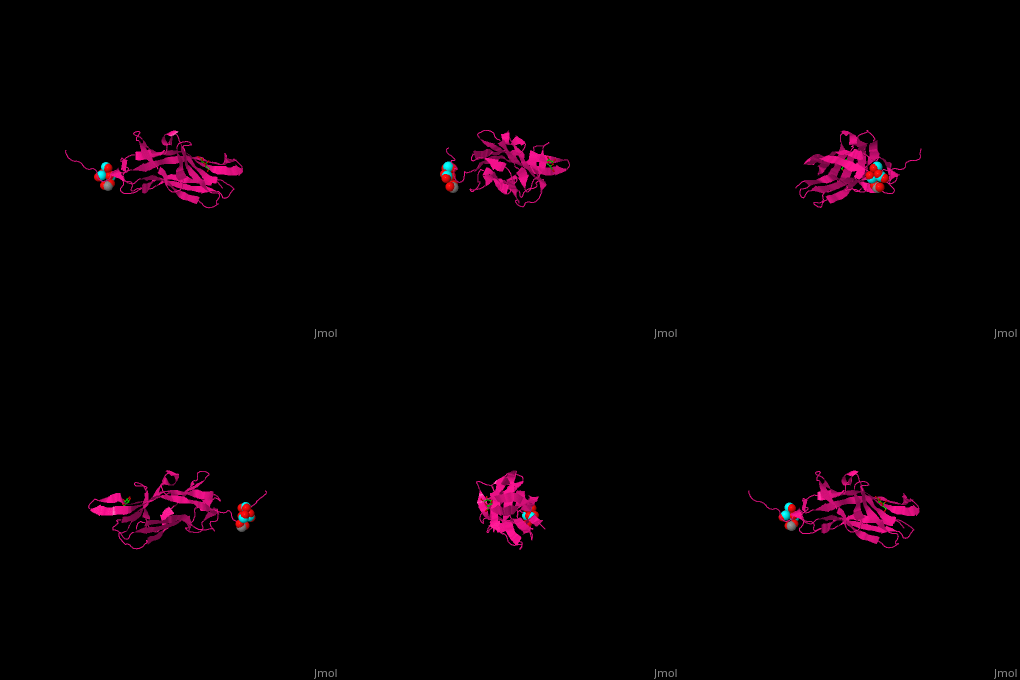
| - | <StructureSection load=' | + | <StructureSection load='' size='350' side='right' caption='Adhesin PsaA complex with tert-butyl formate and galactose (stick model) (PDB ID [[4f8p]])' scene='70/705684/Cv/1'> |
== Function == | == Function == | ||
| - | '''Adhesins''' (Adh) are surface components of bacteria which facillitate adhesion to surfaces or other cells. Adh are specific surface recognition protein and are regarded as virulence factors.<ref>PMID:11043979</ref> | + | '''Adhesins''' (Adh) are surface components of bacteria which facillitate adhesion to surfaces or other cells. Adh are specific surface recognition protein and are regarded as virulence factors.<ref>PMID:11043979</ref> '''FimH''' is the ''E. coli'' adhesin which is part of the type 1 pili of the bacteria. The pili is composed of subunits '''FimF, FimG''' and '''FimD'''<ref>PMID:18369105</ref>. The main Adhesins of the pathogen ''Mycoplasma genitalium'' are '''P110''' or '''Mgp-operon protein 3''' and '''P140'''<ref>PMID:30367053</ref>. See also [[Journal:Acta Cryst D:S2059798320008116|Novel structure of the N-terminal helical domain of BibA, a Group B Streptococcus immunogenic bacterial adhesin]]. |
| + | |||
| + | For trimeric autotransporter adhesin see [[EibD]]. | ||
== Disease == | == Disease == | ||
| - | Bacterial pathogens use adhesins as a major factor in adhesion-based virulence. Adhesins serve as vaccine targets since they are essential to infection | + | Bacterial pathogens use adhesins as a major factor in adhesion-based virulence. Adhesins serve as vaccine targets since they are essential to infection<ref>PMID:10341176</ref>. |
| - | + | ||
| - | + | == Structural highlights == | |
| - | == | + | |
| - | + | <scene name='70/705684/Cv/4'>Adhesin PsaA complex with galactose, acetate and tert-butyl formate</scene> (PDB ID [[4f8p]])<ref>PMID:23277582</ref> | |
| - | + | *<scene name='70/705684/Cv/3'>Galactose binding site</scene>. Water molecules are shown as red spheres. | |
| + | *<scene name='70/705684/Cv/5'>Tert-butyl formate/Acetate binding site</scene>. | ||
| - | + | == 3D Structures of adhesin == | |
| + | [[Adhesin 3D structures]] | ||
| - | + | </StructureSection> | |
| - | + | ||
| - | + | ||
| - | + | ||
| - | + | ||
| - | + | ||
| - | + | ||
| - | + | ||
| - | + | ||
| - | + | ||
| - | + | ||
| - | + | ||
| - | + | ||
| - | + | ||
| - | + | ||
| - | + | ||
| - | + | ||
| - | + | ||
| - | + | ||
| - | + | ||
| - | + | ||
| - | + | ||
| - | + | ||
| - | + | ||
| - | + | ||
| - | + | ||
| - | + | ||
| - | + | ||
| - | + | ||
| - | + | ||
| - | + | ||
| - | + | ||
| - | + | ||
| - | + | ||
== References == | == References == | ||
<references/> | <references/> | ||
| + | [[Category:Topic Page]] | ||
Current revision
| |||||||||||
References
- ↑ Klemm P, Schembri MA. Bacterial adhesins: function and structure. Int J Med Microbiol. 2000 Mar;290(1):27-35. PMID:11043979 doi:http://dx.doi.org/10.1016/S1438-4221(00)80102-2
- ↑ Nishiyama M, Ishikawa T, Rechsteiner H, Glockshuber R. Reconstitution of pilus assembly reveals a bacterial outer membrane catalyst. Science. 2008 Apr 18;320(5874):376-9. doi: 10.1126/science.1154994. Epub 2008 Mar, 27. PMID:18369105 doi:http://dx.doi.org/10.1126/science.1154994
- ↑ Aparicio D, Torres-Puig S, Ratera M, Querol E, Pinol J, Pich OQ, Fita I. Mycoplasma genitalium adhesin P110 binds sialic-acid human receptors. Nat Commun. 2018 Oct 26;9(1):4471. doi: 10.1038/s41467-018-06963-y. PMID:30367053 doi:http://dx.doi.org/10.1038/s41467-018-06963-y
- ↑ Wizemann TM, Adamou JE, Langermann S. Adhesins as targets for vaccine development. Emerg Infect Dis. 1999 May-Jun;5(3):395-403. doi: 10.3201/eid0503.990310. PMID:10341176 doi:http://dx.doi.org/10.3201/eid0503.990310
- ↑ Bao R, Nair MK, Tang WK, Esser L, Sadhukhan A, Holland RL, Xia D, Schifferli DM. Structural basis for the specific recognition of dual receptors by the homopolymeric pH 6 antigen (Psa) fimbriae of Yersinia pestis. Proc Natl Acad Sci U S A. 2013 Jan 15;110(3):1065-70. doi:, 10.1073/pnas.1212431110. Epub 2012 Dec 31. PMID:23277582 doi:10.1073/pnas.1212431110
