This old version of Proteopedia is provided for student assignments while the new version is undergoing repairs. Content and edits done in this old version of Proteopedia after March 1, 2026 will eventually be lost when it is retired in about June of 2026.
Apply for new accounts at the new Proteopedia. Your logins will work in both the old and new versions.
Insulin-like growth factor receptor
From Proteopedia
(Difference between revisions)
(New page: <StructureSection load='3nw6' size='400' side='right' caption='Structure of IGFR I kinase domain complex with inhibitor (PDB entry 3nw6)' scene=''> '''Insulin-like growth facto...) |
|||
| (20 intermediate revisions not shown.) | |||
| Line 1: | Line 1: | ||
| + | <StructureSection load='3i81' size='350' side='right' scene='' caption='Human insulin-like growth factor 1 receptor complex with inhibitor (PDB code [[3i81]])'> | ||
| + | '''Insulin-like growth factor receptors''' (IGFR) are transmembrane receptors which are stimulated by insulin-like growth factors (IGF). IGFR contains 2 extracellular α chains and 2 transmembranal β chains. Upon binding of IGF, a tyrosine in the β chain becomes autophosphorylated and triggers a cascade of intracellular signaling. The insulin-like growth factor 1 (IGF-1) receptor belongs to the large class of [[Receptor tyrosine kinases|tyrosine kinase receptors]]. See also [[IGF1]], [[Growth factors]] and [[Kinase-linked, enzyme-linked and related receptors]]. | ||
| + | . | ||
| - | < | + | === Memory-Enhancement by Traditional Chinese Medicine? <ref>doi 10.1080/07391102.2012.741052</ref>=== |
| + | Cognitive impairment is an emerging issue and increasing research points to the significant role of insulin-like growth factor I (IGF-I) in cognitive brain functions. <scene name='Journal:JBSD:38/Cv/3'>IGF receptor </scene> (IGF-IR, PDB ID: [[3i81]], <font color='darkmagenta'><b>colored in darkmagenta</b></font>) activation is critical for IGF-I to elicit desirable cognitive functions. Traditional Chinese medicine (TCM) ligands <scene name='Journal:JBSD:38/Cv/2'>3-(2-carboxyphenyl)-4(3H)-quinazolinone</scene> (orgin: ''Isatisin digotica'', <span style="color:lime;background-color:black;font-weight:bold;">colored in green</span>), <scene name='Journal:JBSD:38/Cv/4'>(+)-N-methyllaurotetanine</scene> (origin: ''Lindera aggregate'', <span style="color:deeppink;background-color:black;font-weight:bold;">colored in deeppink</span>), and <scene name='Journal:JBSD:38/Cv/5'>(+)-1(R)-Coclaurine</scene> (origin: ''Nelumbonucifera Gaertn'', <span style="color:salmon;background-color:black;font-weight:bold;">colored in salmon</span>) showed high binding affinity towards IGF-IR at the binding site defined by the control in PDB ID: [[3i81]]. Molecular dynamics simulation revealed that the TCM ligands were secured at the opening of the IGF-IR binding site for the duration of the MD. <scene name='Journal:JBSD:38/Cv/7'>3-(2-carboxyphenyl)-4(3H)-quinazolinone</scene> was stabilized by <scene name='Journal:JBSD:38/Cv/8'>Asp1056</scene>, <scene name='Journal:JBSD:38/Cv/9'>(+)-N-methyllaurotetanine</scene> was stabilized by <scene name='Journal:JBSD:38/Cv/10'>Leu975 and Asp1056</scene>, and <scene name='Journal:JBSD:38/Cv/11'>(+)-1(R)-Coclaurine</scene> was stabilized by <scene name='Journal:JBSD:38/Cv/12'>Leu975 and Gly1055</scene> (<span style="color:yellow;background-color:black;font-weight:bold;">key residues are colored in yellow</span>). Four different quantitative-structure activity relationship models consistently predicted bioactivity of the TCM ligands towards IGF-IR. In summary, the TCM candidates exhibit drug-like potential in both structural-based and ligand-based properties and may have potential for further applications in enhancing cognition. | ||
| + | </StructureSection> | ||
| + | __NOTOC__ | ||
| + | ==3D structures of insulin-like growth factor receptor== | ||
| - | + | Updated on {{REVISIONDAY2}}-{{MONTHNAME|{{REVISIONMONTH}}}}-{{REVISIONYEAR}} | |
| - | + | {{#tree:id=OrganizedByTopic|openlevels=0| | |
| - | + | *IGFR I | |
| - | + | **[[1igr]] – hIGFR I domains 1-3 31-492– human<BR /> | |
| + | **[[1jqh]], [[1p4o]] - hIGFR I kinase domain (mutant) 983-1286<BR /> | ||
| + | **[[1m7n]] - hIGFR I kinase domain<BR /> | ||
| + | **[[1k3a]] - hIGFR I kinase domain + insulin receptor substrate peptide<BR /> | ||
| + | **[[2oj9]], [[2zm3]], [[3d94]], [[3f5p]], [[3i81]], [[3lvp]], [[3nw5]], [[3nw6]], [[3nw7]], [[3lw0]], [[3qqu]], [[3o23]], [[4d2r]], [[5fxq]], [[5fxr]], [[5fxs]], [[5hzn]] - hIGFR I kinase domain + inhibitor<BR /> | ||
| + | **[[5u8r]] - hIGFR I (mutant) + antibody<BR /> | ||
| + | **[[5u8q]] - hIGFR I (mutant) + IGFI + antibody<BR /> | ||
| + | **[[6pyh]] - hIGFR I + IGFI – Cryo EM<BR /> | ||
| + | **[[6vwg]], [[6vwh]], [[6vwi]], [[6vwj]] - hIGFR I + IGFII – Cryo EM<BR /> | ||
| + | **[[7s8v]] - hIGFR I + insulin receptor – Cryo EM<BR /> | ||
| + | **[[7s0q]] - hIGFR I + insulin receptor + IGF I – Cryo EM<BR /> | ||
| - | + | *IGFR II | |
| - | + | ||
| - | + | ||
| - | + | ||
| - | + | ||
| - | + | ||
| - | + | ||
| - | + | ||
| - | + | **[[1gqb]] - hIGFR II<BR /> | |
| + | **[[2kva]] - hIGFR II domain 5 – NMR<BR /> | ||
| + | **[[2cnj]] - hIGFR II domain 11 - NMR<BR /> | ||
| + | **[[2l2a]], [[2m68]], [[2m6t]] - hIGFR II domains 11 (mutant) - NMR<BR /> | ||
| + | **[[2kvb]] - hIGFR II domain 5 + inhibitor – NMR<BR /> | ||
| + | **[[2v5n]] - hIGFR II domains 11-12<BR /> | ||
| + | **[[2v5o]] - hIGFR II domains 11-14<BR /> | ||
| + | **[[2v5p]] - hIGFR II domains 11-13 + IGF II<BR /> | ||
| + | **[[2l29]] - hIGFR II domain 11 + IGF II - NMR<BR /> | ||
| + | **[[1gp0]], [[1gp3]], [[1e6f]] - hIGFR II IGF II-binding domain<br /> | ||
| + | **[[1q25]] - bIGFR II domains 1-3 – bovine<BR /> | ||
| + | **[[1syo]], [[1sz0]] - bIGFR II domains 1-3 + mannose-6-phosphate<BR /> | ||
| + | **[[2lla]] - IGFR II domain 11 – short-beaked echidna - NMR<BR /> | ||
| + | **[[2l2g]] - IGFR II domain 11 – opossum - NMR<BR /> | ||
| + | }} | ||
| + | == References == | ||
| - | + | <references/> | |
| - | [[ | + | [[Category:Topic Page]] |
| - | + | ||
| - | + | ||
| - | + | ||
| - | + | ||
| - | + | ||
| - | + | ||
| - | + | ||
Current revision
| |||||||||||
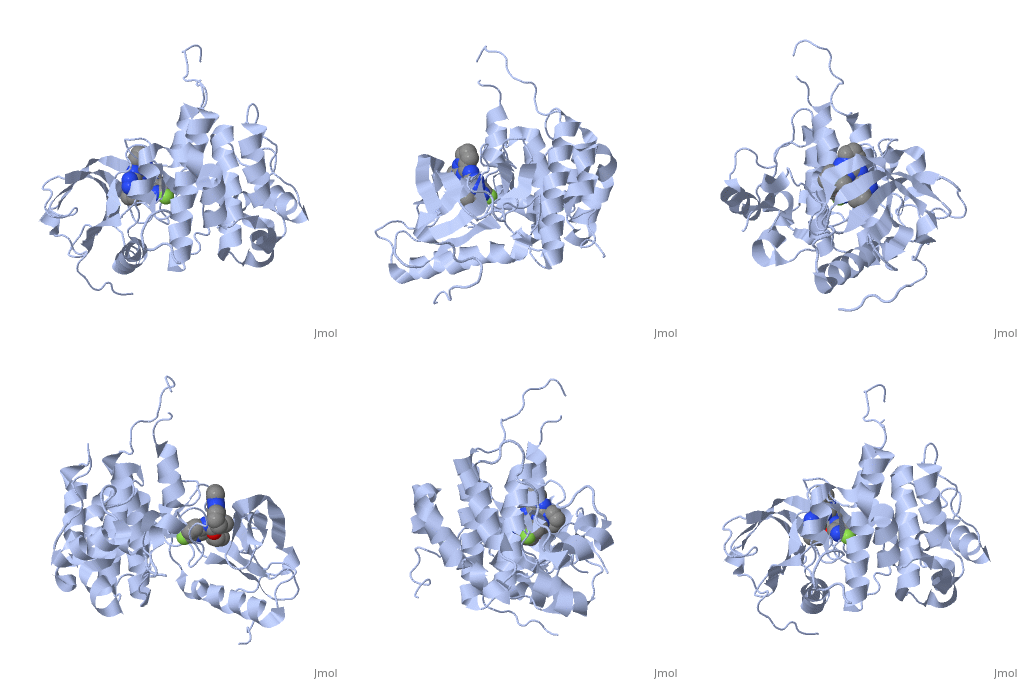
3D structures of insulin-like growth factor receptor
Updated on 08-June-2023
References
- ↑ Hung IC, Chang SS, Chang PC, Lee CC, Chen CY. Memory enhancement by traditional Chinese medicine? J Biomol Struct Dyn. 2012 Dec 19. PMID:23249175 doi:10.1080/07391102.2012.741052
