This old version of Proteopedia is provided for student assignments while the new version is undergoing repairs. Content and edits done in this old version of Proteopedia after March 1, 2026 will eventually be lost when it is retired in about June of 2026.
Apply for new accounts at the new Proteopedia. Your logins will work in both the old and new versions.
1x9d
From Proteopedia
(Difference between revisions)
| (10 intermediate revisions not shown.) | |||
| Line 1: | Line 1: | ||
| - | {{Seed}} | ||
| - | [[Image:1x9d.png|left|200px]] | ||
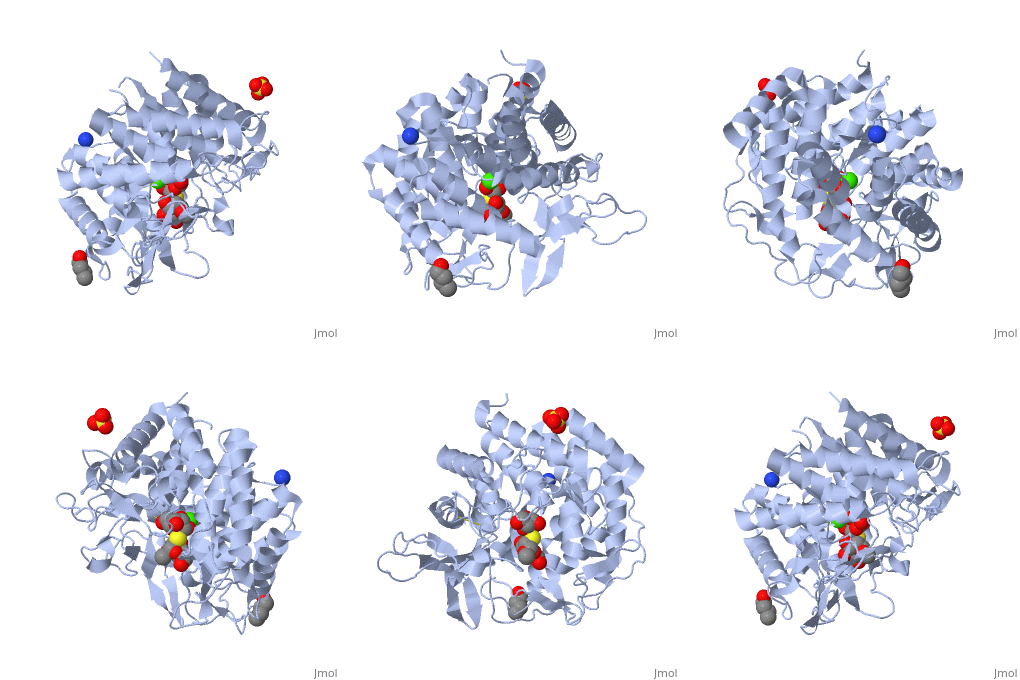
| - | < | + | ==Crystal Structure Of Human Class I alpha-1,2-Mannosidase In Complex With Thio-Disaccharide Substrate Analogue== |
| - | + | <StructureSection load='1x9d' size='340' side='right'caption='[[1x9d]], [[Resolution|resolution]] 1.41Å' scene=''> | |
| - | You may | + | == Structural highlights == |
| - | + | <table><tr><td colspan='2'>[[1x9d]] is a 1 chain structure with sequence from [https://en.wikipedia.org/wiki/Homo_sapiens Homo sapiens]. Full crystallographic information is available from [http://oca.weizmann.ac.il/oca-bin/ocashort?id=1X9D OCA]. For a <b>guided tour on the structure components</b> use [https://proteopedia.org/fgij/fg.htm?mol=1X9D FirstGlance]. <br> | |
| - | + | </td></tr><tr id='method'><td class="sblockLbl"><b>[[Empirical_models|Method:]]</b></td><td class="sblockDat" id="methodDat">X-ray diffraction, [[Resolution|Resolution]] 1.41Å</td></tr> | |
| - | -- | + | <tr id='ligand'><td class="sblockLbl"><b>[[Ligand|Ligands:]]</b></td><td class="sblockDat" id="ligandDat"><scene name='pdbligand=BU1:1,4-BUTANEDIOL'>BU1</scene>, <scene name='pdbligand=CA:CALCIUM+ION'>CA</scene>, <scene name='pdbligand=MAN:ALPHA-D-MANNOSE'>MAN</scene>, <scene name='pdbligand=PRD_900033:methyl+2-S-alpha-D-mannopyranosyl-2-thio-alpha-D-mannopyranoside'>PRD_900033</scene>, <scene name='pdbligand=SO4:SULFATE+ION'>SO4</scene>, <scene name='pdbligand=Z5L:methyl+2-thio-alpha-D-mannopyranoside'>Z5L</scene></td></tr> |
| - | + | <tr id='resources'><td class="sblockLbl"><b>Resources:</b></td><td class="sblockDat"><span class='plainlinks'>[https://proteopedia.org/fgij/fg.htm?mol=1x9d FirstGlance], [http://oca.weizmann.ac.il/oca-bin/ocaids?id=1x9d OCA], [https://pdbe.org/1x9d PDBe], [https://www.rcsb.org/pdb/explore.do?structureId=1x9d RCSB], [https://www.ebi.ac.uk/pdbsum/1x9d PDBsum], [https://prosat.h-its.org/prosat/prosatexe?pdbcode=1x9d ProSAT]</span></td></tr> | |
| + | </table> | ||
| + | == Disease == | ||
| + | [https://www.uniprot.org/uniprot/MA1B1_HUMAN MA1B1_HUMAN] Defects in MAN1B1 are the cause of mental retardation autosomal recessive type 15 (MRT15) [MIM:[https://omim.org/entry/614202 614202]. Mental retardation is characterized by significantly below average general intellectual functioning associated with impairments in adaptative behavior and manifested during the developmental period.<ref>PMID:21763484</ref> | ||
| + | == Function == | ||
| + | [https://www.uniprot.org/uniprot/MA1B1_HUMAN MA1B1_HUMAN] Involved in glycoprotein quality control targeting of misfolded glycoproteins for degradation. It primarily trims a single alpha-1,2-linked mannose residue from Man(9)GlcNAc(2) to produce Man(8)GlcNAc(2), but at high enzyme concentrations, as found in the ER quality control compartment (ERQC), it further trims the carbohydrates to Man(5-6)GlcNAc(2).<ref>PMID:12090241</ref> <ref>PMID:18003979</ref> | ||
| + | == Evolutionary Conservation == | ||
| + | [[Image:Consurf_key_small.gif|200px|right]] | ||
| + | Check<jmol> | ||
| + | <jmolCheckbox> | ||
| + | <scriptWhenChecked>; select protein; define ~consurf_to_do selected; consurf_initial_scene = true; script "/wiki/ConSurf/x9/1x9d_consurf.spt"</scriptWhenChecked> | ||
| + | <scriptWhenUnchecked>script /wiki/extensions/Proteopedia/spt/initialview01.spt</scriptWhenUnchecked> | ||
| + | <text>to colour the structure by Evolutionary Conservation</text> | ||
| + | </jmolCheckbox> | ||
| + | </jmol>, as determined by [http://consurfdb.tau.ac.il/ ConSurfDB]. You may read the [[Conservation%2C_Evolutionary|explanation]] of the method and the full data available from [http://bental.tau.ac.il/new_ConSurfDB/main_output.php?pdb_ID=1x9d ConSurf]. | ||
| + | <div style="clear:both"></div> | ||
| + | <div style="background-color:#fffaf0;"> | ||
| + | == Publication Abstract from PubMed == | ||
| + | Quality control in the endoplasmic reticulum (ER) determines the fate of newly synthesized glycoproteins toward either correct folding or disposal by ER-associated degradation. Initiation of the disposal process involves selective trimming of N-glycans attached to misfolded glycoproteins by ER alpha-mannosidase I and subsequent recognition by the ER degradation-enhancing alpha-mannosidase-like protein family of lectins, both members of glycosylhydrolase family 47. The unusual inverting hydrolytic mechanism catalyzed by members of this family is investigated here by a combination of kinetic and binding analyses of wild type and mutant forms of human ER alpha-mannosidase I as well as by structural analysis of a co-complex with an uncleaved thiodisaccharide substrate analog. These data reveal the roles of potential catalytic acid and base residues and the identification of a novel (3)S(1) sugar conformation for the bound substrate analog. The co-crystal structure described here, in combination with the (1)C(4) conformation of a previously identified co-complex with the glycone mimic, 1-deoxymannojirimycin, indicates that glycoside bond cleavage proceeds through a least motion conformational twist of a properly predisposed substrate in the -1 subsite. A novel (3)H(4) conformation is proposed as the exploded transition state. | ||
| - | + | Mechanism of class 1 (glycosylhydrolase family 47) {alpha}-mannosidases involved in N-glycan processing and endoplasmic reticulum quality control.,Karaveg K, Siriwardena A, Tempel W, Liu ZJ, Glushka J, Wang BC, Moremen KW J Biol Chem. 2005 Apr 22;280(16):16197-207. Epub 2005 Feb 15. PMID:15713668<ref>PMID:15713668</ref> | |
| + | From MEDLINE®/PubMed®, a database of the U.S. National Library of Medicine.<br> | ||
| + | </div> | ||
| + | <div class="pdbe-citations 1x9d" style="background-color:#fffaf0;"></div> | ||
| - | + | ==See Also== | |
| - | + | *[[Mannosidase 3D structures|Mannosidase 3D structures]] | |
| - | + | == References == | |
| - | + | <references/> | |
| - | + | __TOC__ | |
| - | + | </StructureSection> | |
| - | == | + | |
| - | + | ||
| - | + | ||
| - | == | + | |
| - | < | + | |
[[Category: Homo sapiens]] | [[Category: Homo sapiens]] | ||
| - | [[Category: | + | [[Category: Large Structures]] |
| - | [[Category: Karaveg | + | [[Category: Karaveg K]] |
| - | [[Category: Liu | + | [[Category: Liu ZJ]] |
| - | [[Category: Moremen | + | [[Category: Moremen KW]] |
| - | [[Category: Siriwardena | + | [[Category: Siriwardena A]] |
| - | [[Category: Tempel | + | [[Category: Tempel W]] |
| - | [[Category: Wang | + | [[Category: Wang BC]] |
| - | + | ||
| - | + | ||
| - | + | ||
| - | + | ||
| - | + | ||
Current revision
Crystal Structure Of Human Class I alpha-1,2-Mannosidase In Complex With Thio-Disaccharide Substrate Analogue
| |||||||||||

Categories: Homo sapiens | Large Structures | Karaveg K | Liu ZJ | Moremen KW | Siriwardena A | Tempel W | Wang BC
