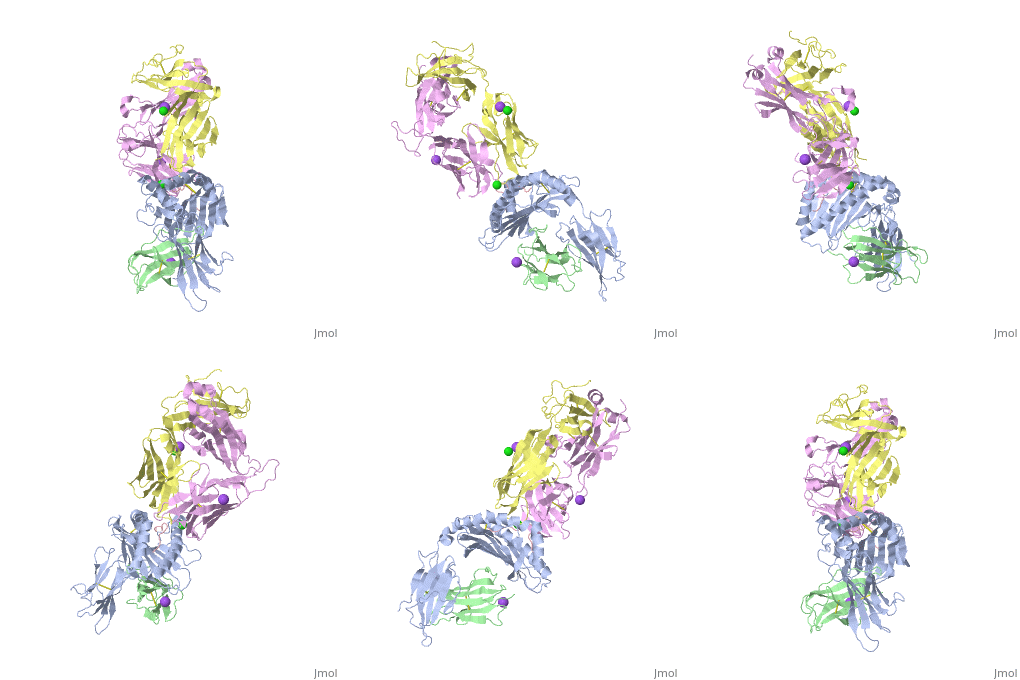
This old version of Proteopedia is provided for student assignments while the new version is undergoing repairs. Content and edits done in this old version of Proteopedia after March 1, 2026 will eventually be lost when it is retired in about June of 2026.
Apply for new accounts at the new Proteopedia. Your logins will work in both the old and new versions.
4pri
From Proteopedia
(Difference between revisions)
| (5 intermediate revisions not shown.) | |||
| Line 1: | Line 1: | ||
| - | {{STRUCTURE_4pri| PDB=4pri | SCENE= }} | ||
| - | ===Crystal structure of TK3 TCR-HLA-B*35:08-HPVG complex=== | ||
| - | == | + | ==Crystal structure of TK3 TCR-HLA-B*35:08-HPVG complex== |
| - | [[ | + | <StructureSection load='4pri' size='340' side='right'caption='[[4pri]], [[Resolution|resolution]] 2.40Å' scene=''> |
| + | == Structural highlights == | ||
| + | <table><tr><td colspan='2'>[[4pri]] is a 5 chain structure with sequence from [https://en.wikipedia.org/wiki/Homo_sapiens Homo sapiens] and [https://en.wikipedia.org/wiki/Human_herpesvirus_4_strain_B95-8 Human herpesvirus 4 strain B95-8]. Full crystallographic information is available from [http://oca.weizmann.ac.il/oca-bin/ocashort?id=4PRI OCA]. For a <b>guided tour on the structure components</b> use [https://proteopedia.org/fgij/fg.htm?mol=4PRI FirstGlance]. <br> | ||
| + | </td></tr><tr id='method'><td class="sblockLbl"><b>[[Empirical_models|Method:]]</b></td><td class="sblockDat" id="methodDat">X-ray diffraction, [[Resolution|Resolution]] 2.4Å</td></tr> | ||
| + | <tr id='ligand'><td class="sblockLbl"><b>[[Ligand|Ligands:]]</b></td><td class="sblockDat" id="ligandDat"><scene name='pdbligand=CL:CHLORIDE+ION'>CL</scene>, <scene name='pdbligand=NA:SODIUM+ION'>NA</scene></td></tr> | ||
| + | <tr id='resources'><td class="sblockLbl"><b>Resources:</b></td><td class="sblockDat"><span class='plainlinks'>[https://proteopedia.org/fgij/fg.htm?mol=4pri FirstGlance], [http://oca.weizmann.ac.il/oca-bin/ocaids?id=4pri OCA], [https://pdbe.org/4pri PDBe], [https://www.rcsb.org/pdb/explore.do?structureId=4pri RCSB], [https://www.ebi.ac.uk/pdbsum/4pri PDBsum], [https://prosat.h-its.org/prosat/prosatexe?pdbcode=4pri ProSAT]</span></td></tr> | ||
| + | </table> | ||
| + | == Function == | ||
| + | [https://www.uniprot.org/uniprot/C5MK56_HUMAN C5MK56_HUMAN] Involved in the presentation of foreign antigens to the immune system (By similarity).[SAAS:SAAS003006_004_004364] | ||
| + | <div style="background-color:#fffaf0;"> | ||
| + | == Publication Abstract from PubMed == | ||
| + | Mutations within T cell epitopes represent a common mechanism of viral escape from the host protective immune response. The diverse T cell repertoire and the extensive human leukocyte antigen (HLA) polymorphism across populations is the evolutionary response to viral mutation. However, the molecular basis underpinning the interplay between HLA polymorphism, the T cell repertoire, and viral escape is unclear. Here we investigate the T cell response to a HLA-B*35:01- and HLA-B*35:08-restricted 407HPVGEADYFEY417 epitope from Epstein-Barr virus and naturally occurring variants at positions 4 and 5 thereof. Each viral variant differently impacted on the epitope's flexibility and conformation when bound to HLA-B*35:08 or HLA-B*35:01. We provide a molecular basis for understanding how the single residue polymorphism that discriminates between HLA-B*35:01/08 profoundly impacts on T cell receptor recognition. Surprisingly, one viral variant (P5-Glu to P5-Asp) effectively changed restriction preference from HLA-B*35:01 to HLA-B*35:08. Collectively, our study portrays the interplay between the T cell response, viral escape, and HLA polymorphism, whereby HLA polymorphism enables altered presentation of epitopes from different strains of Epstein-Barr virus. | ||
| - | + | A Molecular Basis for the Interplay between T Cells, Viral Mutants, and Human Leukocyte Antigen Micropolymorphism.,Liu YC, Chen Z, Neller MA, Miles JJ, Purcell AW, McCluskey J, Burrows SR, Rossjohn J, Gras S J Biol Chem. 2014 Jun 13;289(24):16688-16698. Epub 2014 Apr 23. PMID:24759101<ref>PMID:24759101</ref> | |
| - | + | ||
| - | + | From MEDLINE®/PubMed®, a database of the U.S. National Library of Medicine.<br> | |
| - | + | </div> | |
| + | <div class="pdbe-citations 4pri" style="background-color:#fffaf0;"></div> | ||
| - | == | + | ==See Also== |
| - | + | *[[Beta-2 microglobulin 3D structures|Beta-2 microglobulin 3D structures]] | |
| - | [[ | + | *[[MHC 3D structures|MHC 3D structures]] |
| - | [[ | + | *[[MHC I 3D structures|MHC I 3D structures]] |
| - | [[ | + | *[[T-cell receptor 3D structures|T-cell receptor 3D structures]] |
| - | [[ | + | == References == |
| - | [[Category: | + | <references/> |
| - | [[Category: Human | + | __TOC__ |
| - | [[Category: | + | </StructureSection> |
| - | [[Category: | + | [[Category: Homo sapiens]] |
| - | [[Category: | + | [[Category: Human herpesvirus 4 strain B95-8]] |
| - | [[Category: | + | [[Category: Large Structures]] |
| + | [[Category: Gras S]] | ||
| + | [[Category: Rossjohn J]] | ||
| + | [[Category: Yu Chih L]] | ||
Current revision
Crystal structure of TK3 TCR-HLA-B*35:08-HPVG complex
| |||||||||||