This old version of Proteopedia is provided for student assignments while the new version is undergoing repairs. Content and edits done in this old version of Proteopedia after March 1, 2026 will eventually be lost when it is retired in about June of 2026.
Apply for new accounts at the new Proteopedia. Your logins will work in both the old and new versions.
2kfw
From Proteopedia
(Difference between revisions)
| (6 intermediate revisions not shown.) | |||
| Line 1: | Line 1: | ||
| + | |||
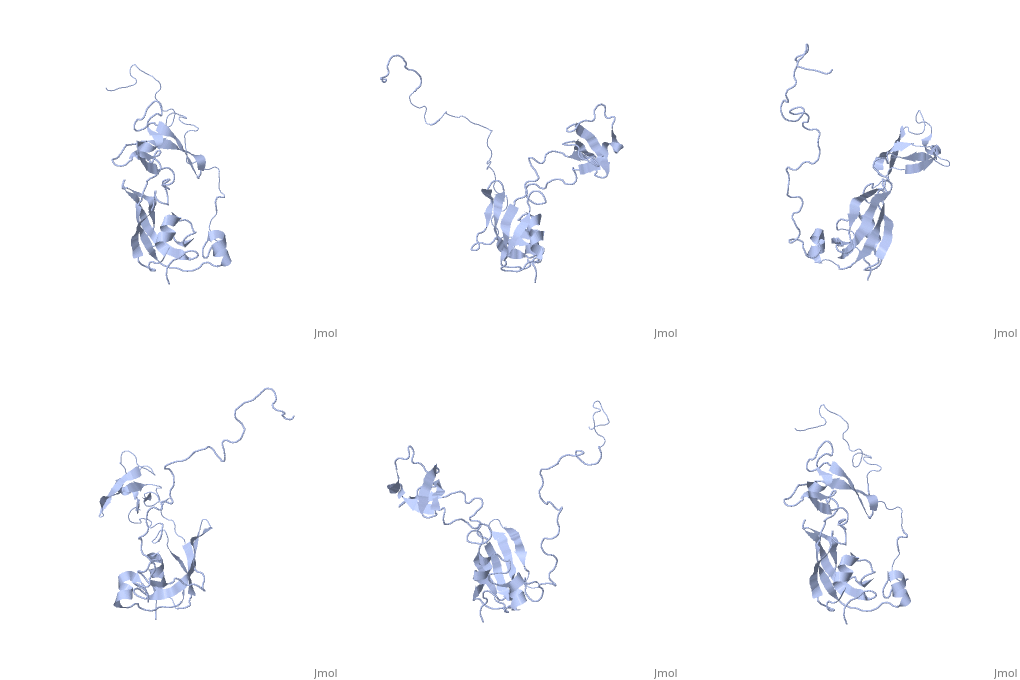
==Solution structure of full-length SlyD from E.coli== | ==Solution structure of full-length SlyD from E.coli== | ||
| - | <StructureSection load='2kfw' size='340' side='right' caption='[[2kfw | + | <StructureSection load='2kfw' size='340' side='right'caption='[[2kfw]]' scene=''> |
== Structural highlights == | == Structural highlights == | ||
| - | <table><tr><td colspan='2'>[[2kfw]] is a 1 chain structure with sequence from [ | + | <table><tr><td colspan='2'>[[2kfw]] is a 1 chain structure with sequence from [https://en.wikipedia.org/wiki/Escherichia_coli Escherichia coli]. Full experimental information is available from [http://oca.weizmann.ac.il/oca-bin/ocashort?id=2KFW OCA]. For a <b>guided tour on the structure components</b> use [https://proteopedia.org/fgij/fg.htm?mol=2KFW FirstGlance]. <br> |
| - | </td></tr><tr><td class="sblockLbl"><b>[[ | + | </td></tr><tr id='method'><td class="sblockLbl"><b>[[Empirical_models|Method:]]</b></td><td class="sblockDat" id="methodDat">Solution NMR</td></tr> |
| - | <tr | + | <tr id='resources'><td class="sblockLbl"><b>Resources:</b></td><td class="sblockDat"><span class='plainlinks'>[https://proteopedia.org/fgij/fg.htm?mol=2kfw FirstGlance], [http://oca.weizmann.ac.il/oca-bin/ocaids?id=2kfw OCA], [https://pdbe.org/2kfw PDBe], [https://www.rcsb.org/pdb/explore.do?structureId=2kfw RCSB], [https://www.ebi.ac.uk/pdbsum/2kfw PDBsum], [https://prosat.h-its.org/prosat/prosatexe?pdbcode=2kfw ProSAT]</span></td></tr> |
| - | + | </table> | |
| - | <table> | + | == Function == |
| + | [https://www.uniprot.org/uniprot/SLYD_ECOLI SLYD_ECOLI] Folding helper with both chaperone and peptidyl-prolyl cis-trans isomerase (PPIase) activities. Chaperone activity prevents aggregation of unfolded or partially folded proteins and promotes their correct folding. PPIases catalyze the cis-trans isomerization of Xaa-Pro bonds of peptides, which accelerates slow steps of protein folding and thus shortens the lifetime of intermediates. Both strategies lower the concentration of intermediates and increase the productivity and yield of the folding reaction. SlyD could be involved in Tat-dependent translocation, by binding to the Tat-type signal of folded proteins. The PPIase substrate specificity, carried out with synthetic peptides of the 'suc-Ala-Xaa-Pro-Phe-4NA' type (where Xaa is the AA tested), was found to be Phe > Ala > Leu.<ref>PMID:12100551</ref> <ref>PMID:15569666</ref> <ref>PMID:16388577</ref> <ref>PMID:17720786</ref> <ref>PMID:17215254</ref> <ref>PMID:19356587</ref> Required for lysis of phiX174 infected cells by stabilizing the hydrophobic viral lysis protein E and allowing it to accumulate to the levels required to exert its lytic effect. May act by a chaperone-like mechanism.<ref>PMID:12100551</ref> <ref>PMID:15569666</ref> <ref>PMID:16388577</ref> <ref>PMID:17720786</ref> <ref>PMID:17215254</ref> <ref>PMID:19356587</ref> Also involved in hydrogenase metallocenter assembly, probably by participating in the nickel insertion step. This function in hydrogenase biosynthesis requires chaperone activity and the presence of the metal-binding domain, but not PPIase activity.<ref>PMID:12100551</ref> <ref>PMID:15569666</ref> <ref>PMID:16388577</ref> <ref>PMID:17720786</ref> <ref>PMID:17215254</ref> <ref>PMID:19356587</ref> | ||
== Evolutionary Conservation == | == Evolutionary Conservation == | ||
[[Image:Consurf_key_small.gif|200px|right]] | [[Image:Consurf_key_small.gif|200px|right]] | ||
Check<jmol> | Check<jmol> | ||
<jmolCheckbox> | <jmolCheckbox> | ||
| - | <scriptWhenChecked>select protein; define ~consurf_to_do selected; consurf_initial_scene = true; script "/wiki/ConSurf/kf/2kfw_consurf.spt"</scriptWhenChecked> | + | <scriptWhenChecked>; select protein; define ~consurf_to_do selected; consurf_initial_scene = true; script "/wiki/ConSurf/kf/2kfw_consurf.spt"</scriptWhenChecked> |
<scriptWhenUnchecked>script /wiki/extensions/Proteopedia/spt/initialview01.spt</scriptWhenUnchecked> | <scriptWhenUnchecked>script /wiki/extensions/Proteopedia/spt/initialview01.spt</scriptWhenUnchecked> | ||
<text>to colour the structure by Evolutionary Conservation</text> | <text>to colour the structure by Evolutionary Conservation</text> | ||
</jmolCheckbox> | </jmolCheckbox> | ||
| - | </jmol>, as determined by [http://consurfdb.tau.ac.il/ ConSurfDB]. You may read the [[Conservation%2C_Evolutionary|explanation]] of the method and the full data available from [http://bental.tau.ac.il/new_ConSurfDB/ | + | </jmol>, as determined by [http://consurfdb.tau.ac.il/ ConSurfDB]. You may read the [[Conservation%2C_Evolutionary|explanation]] of the method and the full data available from [http://bental.tau.ac.il/new_ConSurfDB/main_output.php?pdb_ID=2kfw ConSurf]. |
<div style="clear:both"></div> | <div style="clear:both"></div> | ||
| - | <div style="background-color:#fffaf0;"> | ||
| - | == Publication Abstract from PubMed == | ||
| - | The sensitive to lysis D (SlyD) protein from Escherichia coli is related to the FK506-binding protein family, and it harbours both peptidyl-prolyl cis-trans isomerase (PPIase) and chaperone-like activity, preventing aggregation and promoting the correct folding of other proteins. Whereas a functional role of SlyD as a protein-folding catalyst in vivo remains unclear, SlyD has been shown to be an essential component for [Ni-Fe]-hydrogenase metallocentre assembly in bacteria. Interestingly, the isomerase activity of SlyD is uniquely modulated by nickel ions, which possibly regulate its functions in response to external stimuli. In this work, we investigated the solution structure of SlyD and its interaction with nickel ions, enabling us to gain insights into the molecular mechanism of this regulation. We have revealed that the PPIase module of SlyD contains an additional C-terminal alpha-helix packed against the catalytic site of the domain; unexpectedly, our results show that the interaction of SlyD with nickel ions entails participation of the novel structural features of the PPIase domain, eliciting structural alterations of the catalytic pocket. We suggest that such conformational rearrangements upon metal binding underlie the ability of nickel ions to regulate the isomerase activity of SlyD. | ||
| - | |||
| - | The interaction of the Escherichia coli protein SlyD with nickel ions illuminates the mechanism of regulation of its peptidyl-prolyl isomerase activity.,Martino L, He Y, Hands-Taylor KL, Valentine ER, Kelly G, Giancola C, Conte MR FEBS J. 2009 Aug;276(16):4529-44. Epub 2009 Jul 23. PMID:19645725<ref>PMID:19645725</ref> | ||
| - | + | ==See Also== | |
| - | + | *[[Peptidyl-prolyl cis-trans isomerase 3D structures|Peptidyl-prolyl cis-trans isomerase 3D structures]] | |
== References == | == References == | ||
<references/> | <references/> | ||
| Line 30: | Line 27: | ||
</StructureSection> | </StructureSection> | ||
[[Category: Escherichia coli]] | [[Category: Escherichia coli]] | ||
| - | [[Category: | + | [[Category: Large Structures]] |
| - | [[Category: Conte | + | [[Category: Conte MR]] |
| - | [[Category: Giancola | + | [[Category: Giancola C]] |
| - | [[Category: Hands-Taylor | + | [[Category: Hands-Taylor KL]] |
| - | [[Category: He | + | [[Category: He Y]] |
| - | [[Category: Kelly | + | [[Category: Kelly G]] |
| - | [[Category: Martino | + | [[Category: Martino L]] |
| - | [[Category: Valentine | + | [[Category: Valentine ER]] |
| - | + | ||
| - | + | ||
| - | + | ||
| - | + | ||
| - | + | ||
| - | + | ||
| - | + | ||
Current revision
Solution structure of full-length SlyD from E.coli
| |||||||||||