This old version of Proteopedia is provided for student assignments while the new version is undergoing repairs. Content and edits done in this old version of Proteopedia after March 1, 2026 will eventually be lost when it is retired in about June of 2026.
Apply for new accounts at the new Proteopedia. Your logins will work in both the old and new versions.
Laccase
From Proteopedia
(Difference between revisions)
| (45 intermediate revisions not shown.) | |||
| Line 1: | Line 1: | ||
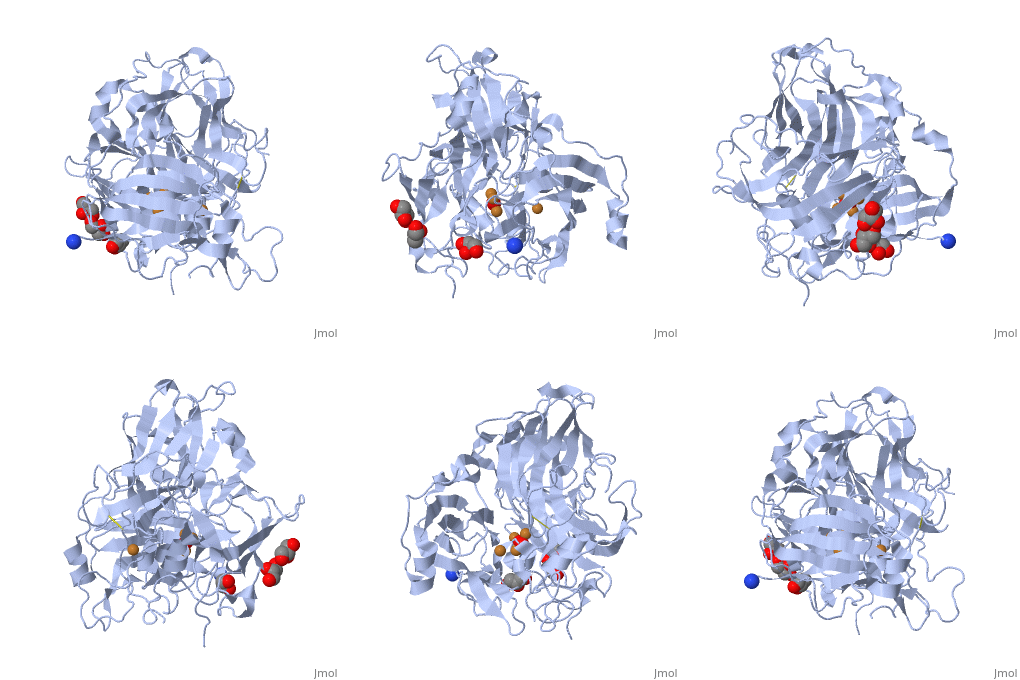
| - | + | <StructureSection load='1w6l' size='350' side='right' scene='' caption='CotA laccase complex with glycerol, O2 and Cu+2 (orange), [[1w6l]]'> | |
| - | < | + | == Function == |
| - | CotA laccase | + | '''Laccase''' (Lac) or '''multicopper oxidase''' is a multi-copper protein which uses molecular oxygen to oxidize various aromatic and non-aromatic compounds by a radical-catalyzed reaction mechanism<ref>PMID:15036303</ref>. '''Laccase 2''' (Lac2) acts in lignin degradation and in detoxification of lignin products. Typically, laccases show a three cupredoxin-domain folding<ref>PMID:25586560</ref>. '''Two-domain laccase''' or small lactase have unusual resistance to inhibitors<ref>PMID:25778839</ref>. '''CotA laccase''' belongs to the multi-copper oxidase family. |
The multi-copper oxidases constitute a family of enzymes whose | The multi-copper oxidases constitute a family of enzymes whose | ||
principal members are laccase (benzenediol oxygen oxidoreductase, | principal members are laccase (benzenediol oxygen oxidoreductase, | ||
EC 1.10.3.2), ascorbate oxidase (L-ascorbate oxygen | EC 1.10.3.2), ascorbate oxidase (L-ascorbate oxygen | ||
oxidoreductase, EC 1.10.3.3) and ceruloplasmin (Fe(II) oxygen | oxidoreductase, EC 1.10.3.3) and ceruloplasmin (Fe(II) oxygen | ||
| - | oxidoreductase, EC 1.16.3.1). Similar to the other laccases the three dimensional | + | oxidoreductase, EC 1.16.3.1). Similar to the other laccases the three dimensional structure of CotA [[1w6l]] comprises three cupredoxin domains and four copper ions organised in <scene name='CotA_laccase/Copper_centers/5'>Two copper centers</scene>: |
| - | a mononuclear blue type 1 copper | + | a <scene name='40/404916/Cv/3'>mononuclear blue type 1 copper center</scene> and <scene name='40/404916/Cv/2'>a trinuclear center</scene>.<ref>PMID:11514528</ref><ref>PMID:16234932</ref> |
| - | + | For laccase with nitrotyrosine modification see [[Nitrotyrosine]]. | |
| - | + | ||
| - | + | ||
| + | == Relevance == | ||
| + | Laccase from various fungi is used in adsorption of dyes from polluted environment</ref><ref>PMID:30997348</ref>. Laccases play an important role in food industry, paper and pulp industry, textile industry, synthetic chemistry, cosmetics, soil bioremediation and biodegradation of phenolic pollutants<ref>PMID:21755038</ref>. | ||
| - | The trinuclear | + | == Structural highlights == |
| + | |||
| + | The trinuclear center of CotA laccase has two type 3 copper ions, that can be anti-ferromagnetically | ||
coupled through an hydroxyl moiety in between them, and one | coupled through an hydroxyl moiety in between them, and one | ||
type 2 copper ion.‡ The mononuclear copper is able to accept an | type 2 copper ion.‡ The mononuclear copper is able to accept an | ||
| - | electron | + | electron from a variety of phenolic substrates and then transmit |
it to the trinuclear centre. | it to the trinuclear centre. | ||
| + | |||
| + | ==3D structures of laccase== | ||
| + | [[Laccase 3D structures]] | ||
| + | |||
| + | </StructureSection> | ||
| + | == References == | ||
| + | <references/> | ||
| + | [[Category:Topic Page]] | ||
Current revision
| |||||||||||
References
- ↑ Claus H. Laccases: structure, reactions, distribution. Micron. 2004;35(1-2):93-6. doi: 10.1016/j.micron.2003.10.029. PMID:15036303 doi:http://dx.doi.org/10.1016/j.micron.2003.10.029
- ↑ Pardo I, Camarero S. Laccase engineering by rational and evolutionary design. Cell Mol Life Sci. 2015 Mar;72(5):897-910. doi: 10.1007/s00018-014-1824-8. Epub, 2015 Jan 14. PMID:25586560 doi:http://dx.doi.org/10.1007/s00018-014-1824-8
- ↑ Trubitsina LI, Tishchenko SV, Gabdulkhakov AG, Lisov AV, Zakharova MV, Leontievsky AA. Structural and functional characterization of two-domain laccase from Streptomyces viridochromogenes. Biochimie. 2015 May;112:151-9. doi: 10.1016/j.biochi.2015.03.005. Epub 2015 Mar, 13. PMID:25778839 doi:http://dx.doi.org/10.1016/j.biochi.2015.03.005
- ↑ Hullo MF, Moszer I, Danchin A, Martin-Verstraete I. CotA of Bacillus subtilis is a copper-dependent laccase. J Bacteriol. 2001 Sep;183(18):5426-30. PMID:11514528
- ↑ Bento I, Martins LO, Gato Lopes G, Armenia Carrondo M, Lindley PF. Dioxygen reduction by multi-copper oxidases; a structural perspective. Dalton Trans. 2005 Nov 7;(21):3507-13. Epub 2005 Sep 27. PMID:16234932 doi:10.1039/b504806k
- ↑ Bankole PO, Adekunle AA, Govindwar SP. Demethylation and desulfonation of textile industry dye, Thiazole Yellow G by Aspergillus niger LAG. Biotechnol Rep (Amst). 2019 Mar 28;23:e00327. doi: 10.1016/j.btre.2019.e00327., eCollection 2019 Sep. PMID:30997348 doi:http://dx.doi.org/10.1016/j.btre.2019.e00327
- ↑ Shraddha, Shekher R, Sehgal S, Kamthania M, Kumar A. Laccase: microbial sources, production, purification, and potential biotechnological applications. Enzyme Res. 2011;2011:217861. doi: 10.4061/2011/217861. Epub 2011 Jun 21. PMID:21755038 doi:http://dx.doi.org/10.4061/2011/217861
Proteopedia Page Contributors and Editors (what is this?)
Michal Harel, Isabel Bento, Alexander Berchansky, David Canner, Jaime Prilusky
