This old version of Proteopedia is provided for student assignments while the new version is undergoing repairs. Content and edits done in this old version of Proteopedia after March 1, 2026 will eventually be lost when it is retired in about June of 2026.
Apply for new accounts at the new Proteopedia. Your logins will work in both the old and new versions.
C-Myc
From Proteopedia
| (18 intermediate revisions not shown.) | |||
| Line 1: | Line 1: | ||
| - | < | + | <StructureSection load='2A93-custom.pdb' size='350' side='right' scene='C-Myc/Custom/2' caption='c-Myc [[2a93]] is a [http://en.wikipedia.org/wiki/DNA-binding_protein DNA binding protein]'> |
| - | |||
== Overview == | == Overview == | ||
---- | ---- | ||
| - | + | ||
| - | The c-Myc [http://en.wikipedia.org/wiki/Oncogene oncogene] encodes a [http://en.wikipedia.org/wiki/Transcription_factor transcription factor], c-Myc protein, which is involved in the regulation of the [http://en.wikipedia.org/wiki/Cell_cycle cell cycle]. C-Myc belongs to the [http://en.wikipedia.org/wiki/C-myc Myc] family of proteins including B-Myc, L-Myc, N-Myc, and s-Myc. c-Myc is a [http://en.wikipedia.org/wiki/Basic_helix-loop-helix_leucine_zipper_transcription_factors b-HLH-LZ] (basic helix-loop-helix-leucine zipper) protein that must form a [http://en.wikipedia.org/wiki/Heterodimer heterodimer] with another b-HLH-LZ protein, [http://en.wikipedia.org/wiki/MAX_(gene) Max], in order to bind DNA and activate [http://en.wikipedia.org/wiki/Transcription_(genetics) transcription]. | + | The '''c-Myc''' [http://en.wikipedia.org/wiki/Oncogene oncogene] encodes a [http://en.wikipedia.org/wiki/Transcription_factor transcription factor], c-Myc protein, which is involved in the regulation of the [http://en.wikipedia.org/wiki/Cell_cycle cell cycle]. C-Myc belongs to the [http://en.wikipedia.org/wiki/C-myc Myc] family of proteins including B-Myc, L-Myc, N-Myc, and s-Myc. c-Myc is a [http://en.wikipedia.org/wiki/Basic_helix-loop-helix_leucine_zipper_transcription_factors b-HLH-LZ] (basic helix-loop-helix-leucine zipper) protein that must form a [http://en.wikipedia.org/wiki/Heterodimer heterodimer] with another b-HLH-LZ protein, [http://en.wikipedia.org/wiki/MAX_(gene) Max], in order to bind DNA and activate [http://en.wikipedia.org/wiki/Transcription_(genetics) transcription]. |
| - | Mutations in myc proteins or overexpression of their encoding genes have been linked to several forms of cancer, among these are lymphoma, myeloma, liver, lung, and breast cancer. | + | Mutations in myc proteins or overexpression of their encoding genes have been linked to several forms of cancer, among these are lymphoma, myeloma, liver, lung, and breast cancer. See<br /> |
| + | [[Kwon sandbox]]<br /> | ||
| + | [[Transcription and RNA Processing]]<br /> | ||
| + | [[Proteins involved in cancer]]<br /> | ||
| + | [[Oncogenes & Tumor Suppressor Genes]]. | ||
| + | [[Category:Topic Page]] | ||
| Line 34: | Line 38: | ||
==Experiments with C-myc== | ==Experiments with C-myc== | ||
| - | An experiment was done to see if mice could survive embryonic development without the C-myc gene. This was done by using a mutation to make the C-myc allele null at the protein level. They gave some of the embryos one correct copy of the allele and others no correct copy. The homozygous mice (two null C-myc alleles), died between 9.5 and 10.5 days of gestation. The mice also were smaller and had many health problems. This showed that C-myc is vital to the development of embryos of organisms. | + | An experiment was done to see if mice could survive embryonic development without the C-myc gene. This was done by using a mutation to make the C-myc allele null at the protein level. They gave some of the embryos one correct copy of the allele and others no correct copy. The homozygous mice (two null C-myc alleles), died between 9.5 and 10.5 days of gestation. The mice also were smaller and had many health problems. This showed that C-myc is vital to the development of embryos of organisms. |
| + | </StructureSection> | ||
| + | ==3D structures of C-myc== | ||
| + | |||
| + | Updated on {{REVISIONDAY2}}-{{MONTHNAME|{{REVISIONMONTH}}}}-{{REVISIONYEAR}} | ||
| + | |||
| + | [[2a93]] – Cmyc-Max leucine zipper – synthetic – NMR<br /> | ||
| + | [[2ap2]] – sCmyc + antibody<br /> | ||
| + | [[5i4z]] - hCmyc bHLHZ domain residues 348-439 - human<br /> | ||
| + | [[7c36]] - hCmyc residues 62-223 - NMR<br /> | ||
| + | [[5i50]] - hCmyc bHLHZ domain + DNA<br /> | ||
| + | [[6g6j]], [[6g6k]], [[6g6l]] – hCmyc + hMax<br /> | ||
| + | [[1nkp]] – hCmyc + hMax + DNA <br /> | ||
| + | [[1mv0]] – hCmyc residues 55-68 + box-dependent-interacting protein residues 513-593 - NMR | ||
==Additional Resources== | ==Additional Resources== | ||
| - | For additional information, see: [[Cancer]] | + | For additional information, see: [[Cancer]] <br /> |
| - | For additional information, see: [[Oncogenes]] | + | For additional information, see: [[Oncogenes]] <br /> |
| + | For additional information, see: [[Transcription and RNA Processing]] | ||
| + | <br /> | ||
<br /> | <br /> | ||
Current revision
| |||||||||||
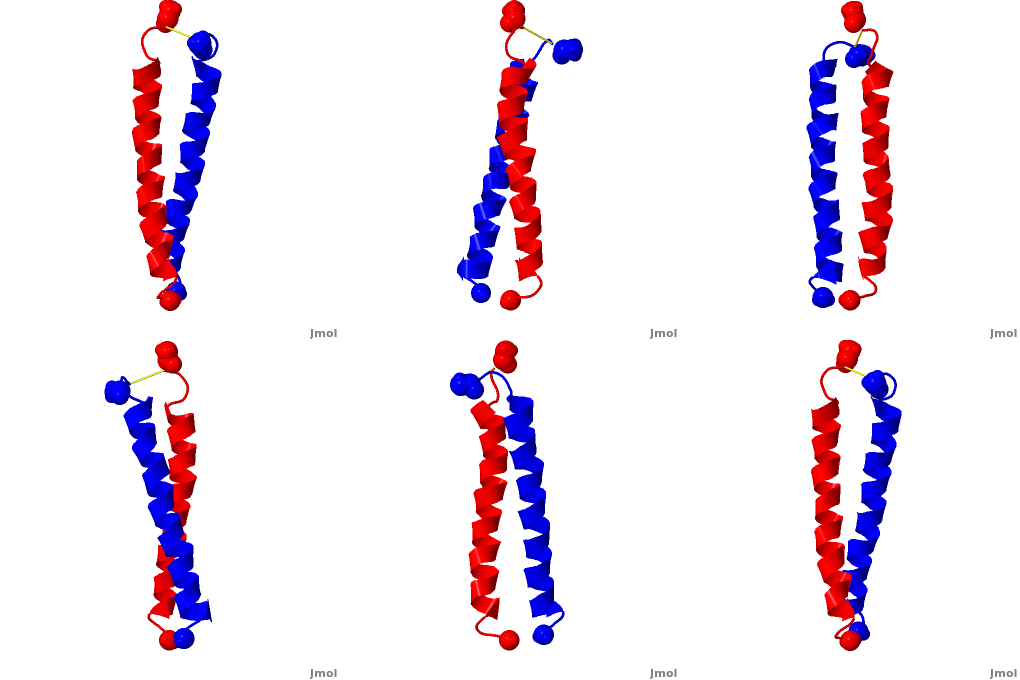
3D structures of C-myc
Updated on 24-November-2022
2a93 – Cmyc-Max leucine zipper – synthetic – NMR
2ap2 – sCmyc + antibody
5i4z - hCmyc bHLHZ domain residues 348-439 - human
7c36 - hCmyc residues 62-223 - NMR
5i50 - hCmyc bHLHZ domain + DNA
6g6j, 6g6k, 6g6l – hCmyc + hMax
1nkp – hCmyc + hMax + DNA
1mv0 – hCmyc residues 55-68 + box-dependent-interacting protein residues 513-593 - NMR
Additional Resources
For additional information, see: Cancer
For additional information, see: Oncogenes
For additional information, see: Transcription and RNA Processing
References
Dang, C.V.(1999) c-Myc Target Genes Involved in Cell Growth, Apoptosis, and Metabolism. Molecular and Cellular Biology, 19: 1-11.
Nair & Burley (2003) X-Ray Structures of Myc-Max and Mad-Max Recognizing DNA: Molecular Bases of Regulation by Proto-Oncogenic Transcription Factors. Cell, 112:193-205.
Ohtsuki, Nishitani, Hatamochi, Yawata, & Namba (1991) Analysis of methylation in the c-Myc gene in five human myeloma cell lines. British Journal of Haematology. 77: 172-179.
Takahashi et al., (2007) Induction of Pluripotent Stem Cells from Adult Human Fibroblasts by Defined Factors. Cell. 131: 1-12.
Kaji, Norrby, Paca, Mileikovsky, Mohseni, & Woltjen (2009) Virus-free induction of pluripotency and subsequent excision of reprogramming factors. Nature. 458: 771-776.
Gardner, Lee, & Dang (2002) The c-Myc Oncogenic Transcription Factor. [1]
Dose et al., (2006) C-Myc mediates pre-TCR-induced proliferation but not developmental progression. Blood. 108: 2669-2677.
Gilbert, S.F. http://8e.devbio.com/article.php?ch=5&id=42. September 21,2009.
C-myc gene found to play role in immune system. The Medical News. [2]
Davis AC, Wims M, Spotts GD, Hann SR, Bradley A. A null c-myc mutation causes lethality before 10.5 days of gestation in homozygotes and reduced fertility in heterozygous female mice. Genes & Development 1993 Apr;7(4):671-82
Proteopedia Page Contributors and Editors (what is this?)
Michal Harel, Hillary Sigale, Kim Smith, David Canner, Joel L. Sussman, Alexander Berchansky
