This old version of Proteopedia is provided for student assignments while the new version is undergoing repairs. Content and edits done in this old version of Proteopedia after March 1, 2026 will eventually be lost when it is retired in about June of 2026.
Apply for new accounts at the new Proteopedia. Your logins will work in both the old and new versions.
Sandbox Reserved 20
From Proteopedia
(Difference between revisions)
| (15 intermediate revisions not shown.) | |||
| Line 1: | Line 1: | ||
| - | < | + | <!-- DO NOT DELETE THE TEMPLATE LINE --> |
| - | + | {{Template:Sandbox Reserved Eric Martz}} | |
| + | <!-- INSERT YOUR SCENES AND TEXT BELOW THIS LINE --> | ||
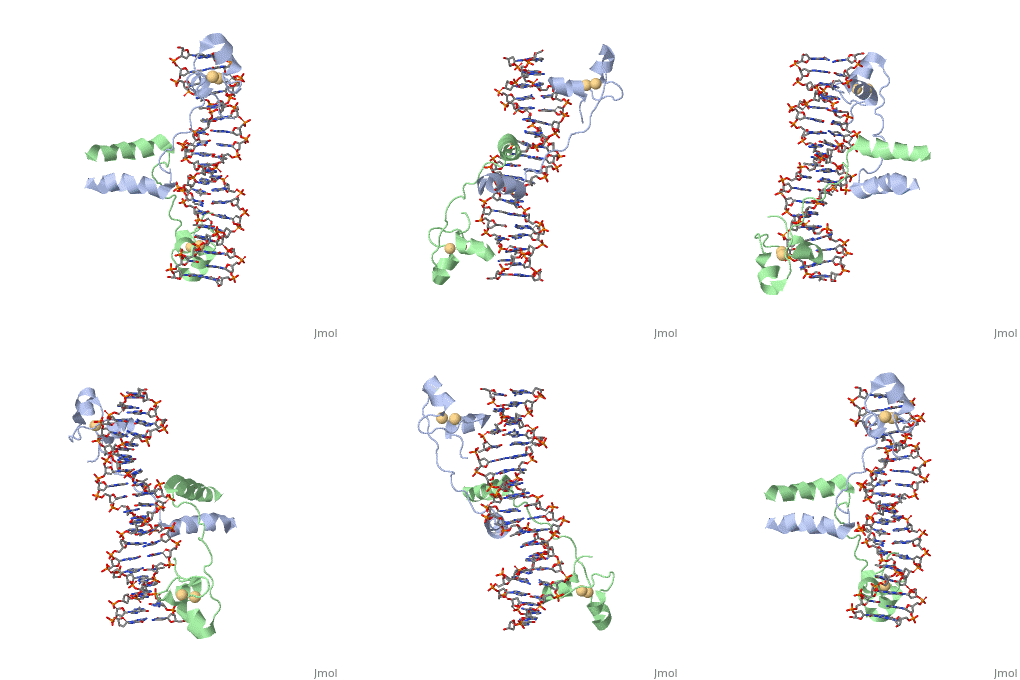
| - | == | + | <Structure load='1d66' size='450' frame='true' align='right' caption='Insert caption here' scene='Insert optional scene name here' /> |
| - | Because of its important role in virus infectivity, several anti-viral drugs have been designed to target neuraminidase, including oseltamivir (Tamiflu) and zanamivir (Relenza). Oseltamavir binding to neuraminidase moves glutamate 276 towards histidine 274, making more room for oseltamavir to bind tightly ('''PDB entry''' [[2hu4]]). But, in a common mutant (H274Y), a larger tyrosine replaces the smaller histidine 274, preventing glutamate 276 from moving to make room for oseltamavir binding, resulting in weaker drug binding and thus resistance (PDB entry [[3cl0]]). Luckily the H274Y neuraminidase mutant is still susceptible to zanamivir, which is smaller than oseltamavir. | ||
| - | <scene name='Sandbox_Reserved_20/ | + | #The surface of the Gal4 DNA-binding domain that contacts DNA <scene name='Sandbox_Reserved_20/Gal4_charge/2'>has only positive (blue) charges</scene>. |
| + | #<scene name='Sandbox_Reserved_20/Gal4_conservation2/1'>Lysine 18 is highly conserved</scene> (burgandy color) because it participates in recognizing the CCG sequence of DNA. | ||
Current revision
| This Sandbox is Reserved from May 10, 2015, through July 31, 2015 for use by the class Protein 3D Structure Visualization & Structural Bioinformatics taught by Eric Martz and Keiichi Namba at Osaka University, Japan. This reservation includes Sandbox Reserved 1 through Sandbox Reserved 10. Syllabus. |
To get started:
More help: Getting Started in Proteopedia, Help:Editing, Main Help Page. |
|
- The surface of the Gal4 DNA-binding domain that contacts DNA .
- (burgandy color) because it participates in recognizing the CCG sequence of DNA.
