This old version of Proteopedia is provided for student assignments while the new version is undergoing repairs. Content and edits done in this old version of Proteopedia after March 1, 2026 will eventually be lost when it is retired in about June of 2026.
Apply for new accounts at the new Proteopedia. Your logins will work in both the old and new versions.
Cathepsin
From Proteopedia
(Difference between revisions)
| (59 intermediate revisions not shown.) | |||
| Line 1: | Line 1: | ||
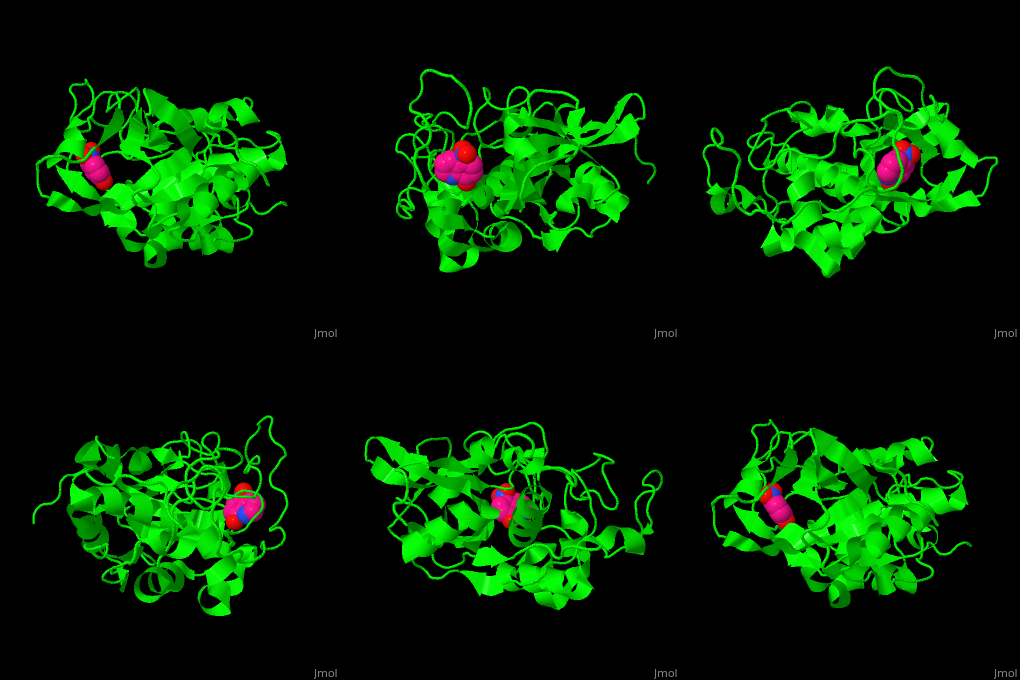
| - | + | <StructureSection load='' size='350' side='right' scene='42/421669/Cv/10' caption='human cathepsin B complex with inhibitor [[3ai8]]'> | |
| - | + | == Function == | |
| - | [[Cathepsin]] (CTS) is a protease which becomes activated at low pH. It is found in lysosomes. Members of the CTS group are denoted as CTSA, CTSB etc and cleave proteins at different peptide bonds. The CTSs are expressed as an inactive precursor pro-CTS (PCTS) which | + | [[Cathepsin]] (CTS) is a protease which becomes activated at low pH. It is found in lysosomes. Members of the CTS group are denoted as CTSA, CTSB etc and cleave proteins at different peptide bonds. The CTSs are expressed as an inactive precursor '''pro-CTS''' (PCTS) which becomes active when a long residue prosegment is cleaved off producing the mature CTS (MCTS).<ref>PMID:15751268</ref> For details on pro-CTS see [[Molecular Playground/Human PPCA]]. |
| - | + | *'''CTS B, F, H, L, L1, L2''' are cysteine proteases.<br /> | |
| - | <br /> | + | *'''CTS D, E''' are aspartyl proteases which degrade insulin.<br /> |
| - | <br /> | + | *'''CTS G''' is a serine protease with activity similar to chymotrypsin C.<br /> |
| - | <br /> | + | *'''CTS K''' is a cysteine protease involved in bone resorption. For details see [[Cathepsin k]].<br /> |
| - | <br /> | + | *'''CTS S''' is a cysteine protease involved in degradation of antigenic proteins.<br /> |
| - | <br /> | + | *'''CTS X''' is a cysteine protease cleaving proteins at their C-terminus.<br /> |
| - | <br /> | + | |
| - | == | + | ==Disease == |
| - | + | CTS B overexpression is associated with metastatic phenotypes in cancer. CTS C mutations are responsible for the Papillon-Lefevre syndrome. CTS K is involved in osteoporosis. CTS H overexpression is associated with prostate cancer. CTS L1 is implicated in myofibril necrosis. | |
| - | == | + | == Relevance == |
| + | CTS B breaks down proteins which are involved in amyloid plaques. CTS D is used as a breast cancer marker. CTS L is a potential drug target in cancer treatment. CTS L2 is expressed by cells of breast and colorectal carcinomas. | ||
| - | + | == Structural highlights == | |
| - | + | ||
| - | + | CTS B is a cysteine protease. The <scene name='42/421669/Cv/11'>active site</scene> contains a <scene name='42/421669/Cv/13'>C26 residue from the N-terminal domain and H199 residue from the C-terminal domain</scene> (in cyan).<ref>PMID:21598397</ref> | |
| - | + | ||
| - | + | ||
| - | + | ||
| - | + | ||
| - | + | ||
| - | + | ||
| - | + | ||
| - | + | ||
| - | + | ||
| - | + | ||
| - | + | ||
| - | + | ||
| - | + | ||
| - | + | ||
| - | + | ||
| - | + | ||
| - | + | ||
| - | + | ||
| - | + | ||
| - | + | ||
| - | + | ||
| - | + | ||
| - | + | ||
| - | + | ||
| - | + | ||
| - | + | ||
| - | + | ||
| - | + | ||
| - | + | ||
| - | + | ||
| - | + | ||
| - | = | + | |
| - | + | ||
| - | + | ||
| - | + | ||
| - | + | ||
| - | + | ||
| - | + | ||
| - | + | ||
| - | + | ||
| - | + | ||
| - | + | ||
| - | + | ||
| - | + | ||
| - | + | ||
| - | + | ||
| - | + | ||
| - | + | ||
| - | + | ||
| - | + | ||
| - | + | ||
| - | + | ||
| - | + | ||
| - | + | ||
| - | + | ||
| - | + | ||
| - | + | ||
| - | + | ||
| - | + | ||
| - | + | ||
| - | + | ||
| - | + | ||
| - | + | ||
| - | + | ||
| - | + | ||
| - | + | ||
| - | + | ||
| - | + | ||
| - | + | ||
| - | + | ||
| - | + | ||
| - | + | ||
| - | + | ||
| - | + | ||
| - | + | ||
| - | + | ||
| - | + | ||
| - | + | ||
| - | + | ||
| - | + | ||
| - | + | ||
| - | + | ||
| - | + | ||
| - | + | ||
| - | + | ||
| - | + | ||
| - | + | ||
| - | + | ||
| - | + | ||
| - | + | ||
| - | + | ||
| - | + | ||
| - | + | ||
| - | + | ||
| - | + | ||
| - | + | ||
| - | + | ||
| - | = | + | |
| - | + | ||
| - | + | ||
| - | + | ||
| - | + | ||
| - | + | ||
| - | + | ||
| - | + | ||
| - | + | ||
| - | + | ||
| - | + | ||
| - | + | ||
| - | + | ||
| - | + | ||
| - | + | ||
| - | + | ||
| - | + | ||
| - | + | ||
| - | + | ||
| - | + | ||
| - | + | ||
| - | + | ||
| - | + | ||
| - | + | ||
| - | + | ||
| - | + | ||
| - | + | ||
| - | + | ||
| - | + | ||
| - | + | ||
| - | + | ||
| - | + | ||
| - | + | ||
| - | + | ||
| - | + | ||
| - | + | ||
| - | + | ||
| - | + | ||
| - | + | ||
| - | + | ||
| - | + | ||
| - | + | ||
| - | + | ||
| - | + | ||
| - | + | ||
| - | + | ||
| - | + | ||
| - | + | ||
| - | + | ||
| - | + | ||
| - | + | ||
| - | + | ||
| + | == 3D Structures of Cathepsin == | ||
| + | [[Cathepsin 3D structures]] | ||
| - | + | </StructureSection> | |
| - | + | == References == | |
| + | <references/> | ||
[[Category:Topic Page]] | [[Category:Topic Page]] | ||
Current revision
| |||||||||||
References
- ↑ Nomura T, Katunuma N. Involvement of cathepsins in the invasion, metastasis and proliferation of cancer cells. J Med Invest. 2005 Feb;52(1-2):1-9. PMID:15751268
- ↑ Mirkovic B, Renko M, Turk S, Sosic I, Jevnikar Z, Obermajer N, Turk D, Gobec S, Kos J. Novel Mechanism of Cathepsin B Inhibition by Antibiotic Nitroxoline and Related Compounds. ChemMedChem. 2011 May 20. doi: 10.1002/cmdc.201100098. PMID:21598397 doi:10.1002/cmdc.201100098
