This old version of Proteopedia is provided for student assignments while the new version is undergoing repairs. Content and edits done in this old version of Proteopedia after March 1, 2026 will eventually be lost when it is retired in about June of 2026.
Apply for new accounts at the new Proteopedia. Your logins will work in both the old and new versions.
2axi
From Proteopedia
(Difference between revisions)
m (Protected "2axi" [edit=sysop:move=sysop]) |
|||
| (7 intermediate revisions not shown.) | |||
| Line 1: | Line 1: | ||
| - | [[Image:2axi.png|left|200px]] | ||
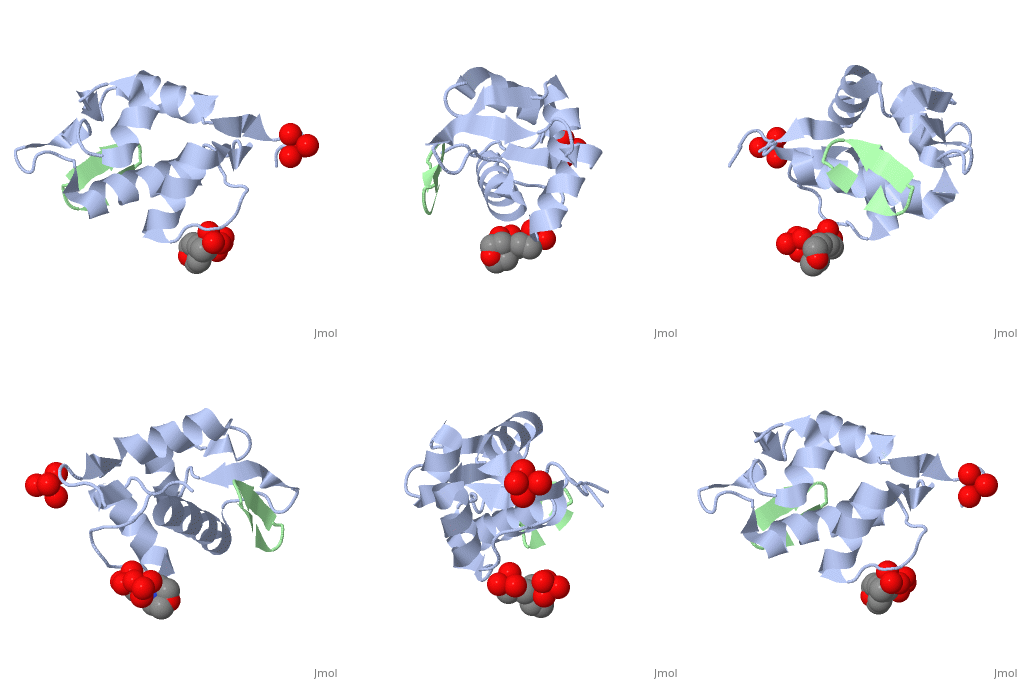
| - | + | ==HDM2 in complex with a beta-hairpin== | |
| + | <StructureSection load='2axi' size='340' side='right'caption='[[2axi]], [[Resolution|resolution]] 1.40Å' scene=''> | ||
| + | == Structural highlights == | ||
| + | <table><tr><td colspan='2'>[[2axi]] is a 2 chain structure with sequence from [https://en.wikipedia.org/wiki/Homo_sapiens Homo sapiens]. Full crystallographic information is available from [http://oca.weizmann.ac.il/oca-bin/ocashort?id=2AXI OCA]. For a <b>guided tour on the structure components</b> use [https://proteopedia.org/fgij/fg.htm?mol=2AXI FirstGlance]. <br> | ||
| + | </td></tr><tr id='method'><td class="sblockLbl"><b>[[Empirical_models|Method:]]</b></td><td class="sblockDat" id="methodDat">X-ray diffraction, [[Resolution|Resolution]] 1.4Å</td></tr> | ||
| + | <tr id='ligand'><td class="sblockLbl"><b>[[Ligand|Ligands:]]</b></td><td class="sblockDat" id="ligandDat"><scene name='pdbligand=6CW:6-CHLORO-L-TRYPTOPHAN'>6CW</scene>, <scene name='pdbligand=DPR:D-PROLINE'>DPR</scene>, <scene name='pdbligand=MPO:3[N-MORPHOLINO]PROPANE+SULFONIC+ACID'>MPO</scene>, <scene name='pdbligand=SO4:SULFATE+ION'>SO4</scene></td></tr> | ||
| + | <tr id='resources'><td class="sblockLbl"><b>Resources:</b></td><td class="sblockDat"><span class='plainlinks'>[https://proteopedia.org/fgij/fg.htm?mol=2axi FirstGlance], [http://oca.weizmann.ac.il/oca-bin/ocaids?id=2axi OCA], [https://pdbe.org/2axi PDBe], [https://www.rcsb.org/pdb/explore.do?structureId=2axi RCSB], [https://www.ebi.ac.uk/pdbsum/2axi PDBsum], [https://prosat.h-its.org/prosat/prosatexe?pdbcode=2axi ProSAT]</span></td></tr> | ||
| + | </table> | ||
| + | == Disease == | ||
| + | [https://www.uniprot.org/uniprot/MDM2_HUMAN MDM2_HUMAN] Note=Seems to be amplified in certain tumors (including soft tissue sarcomas, osteosarcomas and gliomas). A higher frequency of splice variants lacking p53 binding domain sequences was found in late-stage and high-grade ovarian and bladder carcinomas. Four of the splice variants show loss of p53 binding. | ||
| + | == Function == | ||
| + | [https://www.uniprot.org/uniprot/MDM2_HUMAN MDM2_HUMAN] E3 ubiquitin-protein ligase that mediates ubiquitination of p53/TP53, leading to its degradation by the proteasome. Inhibits p53/TP53- and p73/TP73-mediated cell cycle arrest and apoptosis by binding its transcriptional activation domain. Also acts as an ubiquitin ligase E3 toward itself and ARRB1. Permits the nuclear export of p53/TP53. Promotes proteasome-dependent ubiquitin-independent degradation of retinoblastoma RB1 protein. Inhibits DAXX-mediated apoptosis by inducing its ubiquitination and degradation. Component of the TRIM28/KAP1-MDM2-p53/TP53 complex involved in stabilizing p53/TP53. Also component of the TRIM28/KAP1-ERBB4-MDM2 complex which links growth factor and DNA damage response pathways. Mediates ubiquitination and subsequent proteasome degradation of DYRK2 in nucleus. Ubiquitinates IGF1R and promotes it to proteasomal degradation.<ref>PMID:12821780</ref> <ref>PMID:15053880</ref> <ref>PMID:15195100</ref> <ref>PMID:16337594</ref> <ref>PMID:15632057</ref> <ref>PMID:17290220</ref> <ref>PMID:19098711</ref> <ref>PMID:19219073</ref> <ref>PMID:19965871</ref> <ref>PMID:20858735</ref> <ref>PMID:20173098</ref> | ||
| + | == Evolutionary Conservation == | ||
| + | [[Image:Consurf_key_small.gif|200px|right]] | ||
| + | Check<jmol> | ||
| + | <jmolCheckbox> | ||
| + | <scriptWhenChecked>; select protein; define ~consurf_to_do selected; consurf_initial_scene = true; script "/wiki/ConSurf/ax/2axi_consurf.spt"</scriptWhenChecked> | ||
| + | <scriptWhenUnchecked>script /wiki/extensions/Proteopedia/spt/initialview01.spt</scriptWhenUnchecked> | ||
| + | <text>to colour the structure by Evolutionary Conservation</text> | ||
| + | </jmolCheckbox> | ||
| + | </jmol>, as determined by [http://consurfdb.tau.ac.il/ ConSurfDB]. You may read the [[Conservation%2C_Evolutionary|explanation]] of the method and the full data available from [http://bental.tau.ac.il/new_ConSurfDB/main_output.php?pdb_ID=2axi ConSurf]. | ||
| + | <div style="clear:both"></div> | ||
| + | <div style="background-color:#fffaf0;"> | ||
| + | == Publication Abstract from PubMed == | ||
| + | Inhibitors of the interaction between the p53 tumor-suppressor protein and its natural human inhibitor HDM2 are attractive as potential anticancer agents. In earlier work we explored designing beta-hairpin peptidomimetics of the alpha-helical epitope on p53 that would bind tightly to the p53-binding site on HDM2. The beta-hairpin is used as a scaffold to display energetically hot residues in an optimal array for interaction with HDM2. The initial lead beta-hairpin mimetic, with a weak inhibitory activity (IC(50)=125 microM), was optimized to afford cyclo-(L-Pro-Phe-Glu-6ClTrp-Leu-Asp-Trp-Glu-Phe-D-Pro) (where 6ClTrp=L-6-chlorotryptophan), which has an affinity almost 1,000 times higher (IC(50)=140 nM). In this work, insights into the origins of this affinity maturation based on structure-activity studies and an X-ray crystal structure of the inhibitor/HDM2(residues 17-125) complex at 1.4 A resolution are described. The crystal structure confirms the beta-hairpin conformation of the bound ligand, and also reveals that a significant component of the affinity increase arises through new aromatic/aromatic stacking interactions between side chains around the hairpin and groups on the surface of HDM2. | ||
| - | + | Structure-activity studies in a family of beta-hairpin protein epitope mimetic inhibitors of the p53-HDM2 protein-protein interaction.,Fasan R, Dias RL, Moehle K, Zerbe O, Obrecht D, Mittl PR, Grutter MG, Robinson JA Chembiochem. 2006 Mar;7(3):515-26. PMID:16511824<ref>PMID:16511824</ref> | |
| - | + | From MEDLINE®/PubMed®, a database of the U.S. National Library of Medicine.<br> | |
| - | + | </div> | |
| - | + | <div class="pdbe-citations 2axi" style="background-color:#fffaf0;"></div> | |
| - | + | ||
==See Also== | ==See Also== | ||
| - | *[[MDM2|MDM2]] | + | *[[MDM2 3D structures|MDM2 3D structures]] |
| - | + | == References == | |
| - | == | + | <references/> |
| - | < | + | __TOC__ |
| + | </StructureSection> | ||
[[Category: Homo sapiens]] | [[Category: Homo sapiens]] | ||
| - | [[Category: | + | [[Category: Large Structures]] |
| - | [[Category: | + | [[Category: Fasan R]] |
| - | + | [[Category: Gruetter MG]] | |
| - | [[Category: | + | [[Category: Mittl PRE]] |
| - | [[Category: | + | [[Category: Robinson J]] |
| - | [[Category: | + | |
| - | + | ||
| - | + | ||
| - | + | ||
Current revision
HDM2 in complex with a beta-hairpin
| |||||||||||