This old version of Proteopedia is provided for student assignments while the new version is undergoing repairs. Content and edits done in this old version of Proteopedia after March 1, 2026 will eventually be lost when it is retired in about June of 2026.
Apply for new accounts at the new Proteopedia. Your logins will work in both the old and new versions.
2qkh
From Proteopedia
| (4 intermediate revisions not shown.) | |||
| Line 1: | Line 1: | ||
| - | {{STRUCTURE_2qkh| PDB=2qkh | SCENE= }} | ||
| - | ===Crystal structure of the extracellular domain of human GIP receptor in complex with the hormone GIP=== | ||
| - | {{ABSTRACT_PUBMED_17715056}} | ||
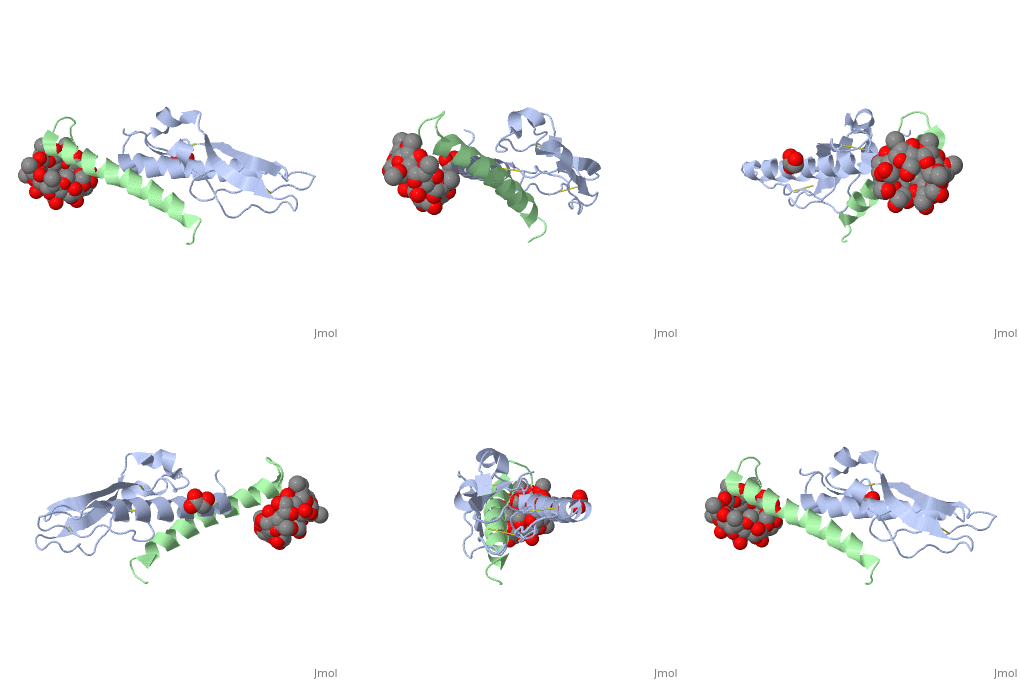
| - | == | + | ==Crystal structure of the extracellular domain of human GIP receptor in complex with the hormone GIP== |
| - | [[2qkh]] is a 2 chain structure with sequence from [ | + | <StructureSection load='2qkh' size='340' side='right'caption='[[2qkh]], [[Resolution|resolution]] 1.90Å' scene=''> |
| + | == Structural highlights == | ||
| + | <table><tr><td colspan='2'>[[2qkh]] is a 2 chain structure with sequence from [https://en.wikipedia.org/wiki/Human Human]. Full crystallographic information is available from [http://oca.weizmann.ac.il/oca-bin/ocashort?id=2QKH OCA]. For a <b>guided tour on the structure components</b> use [https://proteopedia.org/fgij/fg.htm?mol=2QKH FirstGlance]. <br> | ||
| + | </td></tr><tr id='ligand'><td class="sblockLbl"><b>[[Ligand|Ligands:]]</b></td><td class="sblockDat" id="ligandDat"><scene name='pdbligand=GLC:ALPHA-D-GLUCOSE'>GLC</scene>, <scene name='pdbligand=TAR:D(-)-TARTARIC+ACID'>TAR</scene></td></tr> | ||
| + | <tr id='NonStdRes'><td class="sblockLbl"><b>[[Non-Standard_Residue|NonStd Res:]]</b></td><td class="sblockDat"><scene name='pdbligand=ZB0:'>ZB0</scene>, <scene name='pdbligand=ZB1:'>ZB1</scene>, <scene name='pdbligand=ZB2:'>ZB2</scene>, <scene name='pdbligand=ZB3:'>ZB3</scene></td></tr> | ||
| + | <tr id='gene'><td class="sblockLbl"><b>[[Gene|Gene:]]</b></td><td class="sblockDat">GIPR ([https://www.ncbi.nlm.nih.gov/Taxonomy/Browser/wwwtax.cgi?mode=Info&srchmode=5&id=9606 HUMAN])</td></tr> | ||
| + | <tr id='resources'><td class="sblockLbl"><b>Resources:</b></td><td class="sblockDat"><span class='plainlinks'>[https://proteopedia.org/fgij/fg.htm?mol=2qkh FirstGlance], [http://oca.weizmann.ac.il/oca-bin/ocaids?id=2qkh OCA], [https://pdbe.org/2qkh PDBe], [https://www.rcsb.org/pdb/explore.do?structureId=2qkh RCSB], [https://www.ebi.ac.uk/pdbsum/2qkh PDBsum], [https://prosat.h-its.org/prosat/prosatexe?pdbcode=2qkh ProSAT]</span></td></tr> | ||
| + | </table> | ||
| + | == Function == | ||
| + | [[https://www.uniprot.org/uniprot/GIP_HUMAN GIP_HUMAN]] Potent stimulator of insulin secretion and relatively poor inhibitor of gastric acid secretion. [[https://www.uniprot.org/uniprot/GIPR_HUMAN GIPR_HUMAN]] This is a receptor for GIP. The activity of this receptor is mediated by G proteins which activate adenylyl cyclase. | ||
| + | == Evolutionary Conservation == | ||
| + | [[Image:Consurf_key_small.gif|200px|right]] | ||
| + | Check<jmol> | ||
| + | <jmolCheckbox> | ||
| + | <scriptWhenChecked>; select protein; define ~consurf_to_do selected; consurf_initial_scene = true; script "/wiki/ConSurf/qk/2qkh_consurf.spt"</scriptWhenChecked> | ||
| + | <scriptWhenUnchecked>script /wiki/extensions/Proteopedia/spt/initialview01.spt</scriptWhenUnchecked> | ||
| + | <text>to colour the structure by Evolutionary Conservation</text> | ||
| + | </jmolCheckbox> | ||
| + | </jmol>, as determined by [http://consurfdb.tau.ac.il/ ConSurfDB]. You may read the [[Conservation%2C_Evolutionary|explanation]] of the method and the full data available from [http://bental.tau.ac.il/new_ConSurfDB/main_output.php?pdb_ID=2qkh ConSurf]. | ||
| + | <div style="clear:both"></div> | ||
| + | <div style="background-color:#fffaf0;"> | ||
| + | == Publication Abstract from PubMed == | ||
| + | Incretins, endogenous polypeptide hormones released in response to food intake, potentiate insulin secretion from pancreatic beta cells after oral glucose ingestion (the incretin effect). This response is signaled by the two peptide hormones glucose-dependent insulinotropic polypeptide (GIP) (also known as gastric inhibitory polypeptide) and glucagon-like peptide 1 through binding and activation of their cognate class 2 G protein-coupled receptors (GPCRs). Because the incretin effect is lost or significantly reduced in patients with type 2 diabetes mellitus, glucagon-like peptide 1 and GIP have attracted considerable attention for their potential in antidiabetic therapy. A paucity of structural information precludes a detailed understanding of the processes of hormone binding and receptor activation, hampering efforts to develop novel pharmaceuticals. Here we report the crystal structure of the complex of human GIP receptor extracellular domain (ECD) with its agonist, the incretin GIP(1-42). The hormone binds in an alpha-helical conformation in a surface groove of the ECD largely through hydrophobic interactions. The N-terminal ligand residues would remain free to interact with other parts of the receptor. Thermodynamic data suggest that binding is concomitant with structural organization of the hormone, resulting in a complex mode of receptor-ligand recognition. The presentation of a well structured, alpha-helical ligand by the ECD is expected to be conserved among other hormone receptors of this class. | ||
| + | |||
| + | Crystal structure of the incretin-bound extracellular domain of a G protein-coupled receptor.,Parthier C, Kleinschmidt M, Neumann P, Rudolph R, Manhart S, Schlenzig D, Fanghanel J, Rahfeld JU, Demuth HU, Stubbs MT Proc Natl Acad Sci U S A. 2007 Aug 28;104(35):13942-7. Epub 2007 Aug 21. PMID:17715056<ref>PMID:17715056</ref> | ||
| + | |||
| + | From MEDLINE®/PubMed®, a database of the U.S. National Library of Medicine.<br> | ||
| + | </div> | ||
| + | <div class="pdbe-citations 2qkh" style="background-color:#fffaf0;"></div> | ||
==See Also== | ==See Also== | ||
*[[Glucose-dependent Insulinotropic Polypeptide Receptor|Glucose-dependent Insulinotropic Polypeptide Receptor]] | *[[Glucose-dependent Insulinotropic Polypeptide Receptor|Glucose-dependent Insulinotropic Polypeptide Receptor]] | ||
| - | + | == References == | |
| - | == | + | <references/> |
| - | < | + | __TOC__ |
| - | [[Category: | + | </StructureSection> |
| - | [[Category: Demuth, H U | + | [[Category: Human]] |
| - | [[Category: Fanghanel, J | + | [[Category: Large Structures]] |
| - | [[Category: Kleinschmidt, M | + | [[Category: Demuth, H U]] |
| - | [[Category: Manhart, S | + | [[Category: Fanghanel, J]] |
| - | [[Category: Neumann, P | + | [[Category: Kleinschmidt, M]] |
| - | [[Category: Parthier, C | + | [[Category: Manhart, S]] |
| - | [[Category: Rahfeld, J U | + | [[Category: Neumann, P]] |
| - | [[Category: Rudolph, R | + | [[Category: Parthier, C]] |
| - | [[Category: Schlenzig, D | + | [[Category: Rahfeld, J U]] |
| - | [[Category: Stubbs, M T | + | [[Category: Rudolph, R]] |
| + | [[Category: Schlenzig, D]] | ||
| + | [[Category: Stubbs, M T]] | ||
| + | [[Category: Alternative splicing]] | ||
[[Category: Cleavage on pair of basic residue]] | [[Category: Cleavage on pair of basic residue]] | ||
[[Category: Diabetes]] | [[Category: Diabetes]] | ||
| Line 36: | Line 64: | ||
[[Category: Ligand binding domain]] | [[Category: Ligand binding domain]] | ||
[[Category: Membrane]] | [[Category: Membrane]] | ||
| + | [[Category: Polymorphism]] | ||
[[Category: Signaling protein-hormone complex]] | [[Category: Signaling protein-hormone complex]] | ||
[[Category: Transducer]] | [[Category: Transducer]] | ||
[[Category: Transmembrane]] | [[Category: Transmembrane]] | ||
Current revision
Crystal structure of the extracellular domain of human GIP receptor in complex with the hormone GIP
| |||||||||||

Categories: Human | Large Structures | Demuth, H U | Fanghanel, J | Kleinschmidt, M | Manhart, S | Neumann, P | Parthier, C | Rahfeld, J U | Rudolph, R | Schlenzig, D | Stubbs, M T | Alternative splicing | Cleavage on pair of basic residue | Diabetes | Ecd | Extracellular domain | G-protein coupled receptor | Glugacon receptor family | Glycoprotein | Gpcr | Helix formation | Hormone recognition fold | Hormone-gpcr complex | Incretin | Ligand binding domain | Membrane | Polymorphism | Signaling protein-hormone complex | Transducer | Transmembrane
