This old version of Proteopedia is provided for student assignments while the new version is undergoing repairs. Content and edits done in this old version of Proteopedia after March 1, 2026 will eventually be lost when it is retired in about June of 2026.
Apply for new accounts at the new Proteopedia. Your logins will work in both the old and new versions.
Bile acid receptor
From Proteopedia
(Difference between revisions)
| (15 intermediate revisions not shown.) | |||
| Line 1: | Line 1: | ||
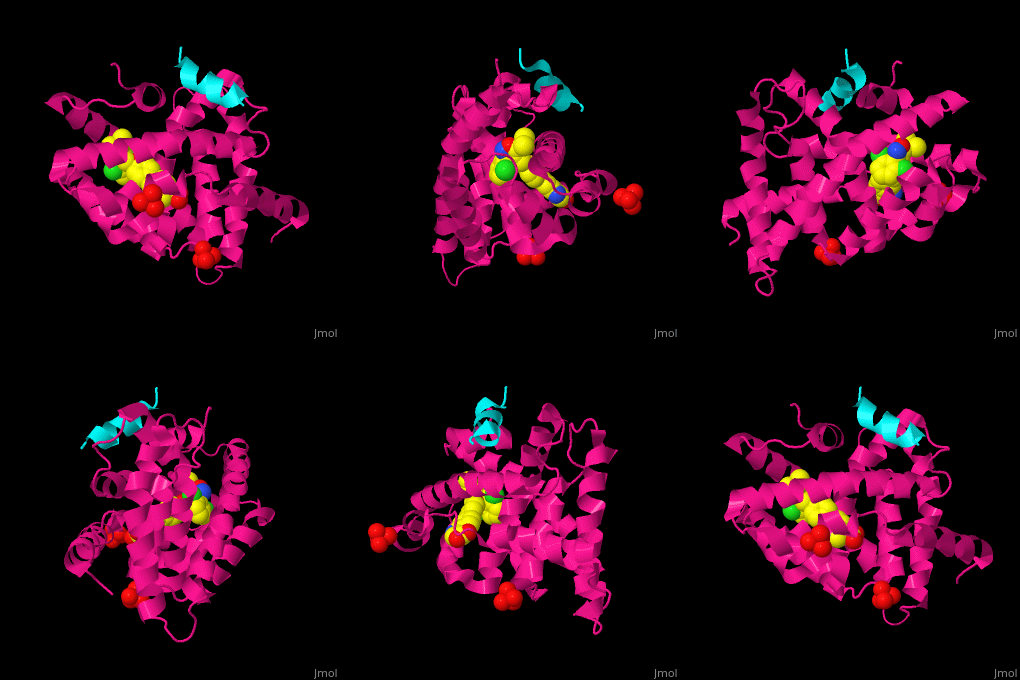
| - | <StructureSection load=' | + | <StructureSection load='' size='350' side='right' caption='Structure of human FXR ligand-binding domain (magenta) complex with non-steroidal agonist, nuclear receptor coactivator 1 peptide (cyan) and sulfate ions (PDB entry [[3ruu]])' scene='54/545859/Cv/1'> |
== Function == | == Function == | ||
| - | '''Bile acid receptor or farnesoid X receptor''' (FXR) binds bile acids, then translocates to the nucleus, forms a dimer and binds to hormone response elements. This causes up- or down-regulation of certain genes involved in cholesterol metabolism, lipid homeostasis and absorption of fats and vitamins. FXR ligand-binding domain (LBD) binds chenodeoxycholic acid (CDC), lithocholic acid and deoxycholic acid. | + | '''Bile acid receptor or farnesoid X receptor''' (FXR) binds bile acids, then translocates to the nucleus, forms a dimer and binds to hormone response elements (see [[Nuclear receptors]]). This causes up- or down-regulation of certain genes involved in cholesterol metabolism, lipid homeostasis and absorption of fats and vitamins. FXR ligand-binding domain (LBD) binds chenodeoxycholic acid (CDC), lithocholic acid and deoxycholic acid. <ref>PMID:23982684</ref> |
| + | |||
| + | See also [[Intracellular receptors]] | ||
== Disease == | == Disease == | ||
| Line 13: | Line 15: | ||
FXR and other bile acid receptors are targets for the treatment of dyslipidemia, diabetes and cardiovascular disease. | FXR and other bile acid receptors are targets for the treatment of dyslipidemia, diabetes and cardiovascular disease. | ||
| - | == | + | == Structural highlights == |
| - | + | <scene name='54/545859/Cv/3'>Structure</scene> of human FXR ligand-binding domain (deeppink) complex with non-steroidal agonist, nuclear receptor coactivator 1 peptide (cyan) and sulfate ions (PDB entry [[3ruu]]). <ref>PMID:21890356</ref> | |
| + | |||
| + | ==3D structures of bile acid receptor== | ||
| + | [[Bile acid receptor 3D structures]] | ||
| - | + | </StructureSection> | |
| - | + | == References == | |
| - | + | <references/> | |
| - | + | ||
| - | + | ||
| - | + | ||
| - | + | ||
[[Category:Topic Page]] | [[Category:Topic Page]] | ||
Current revision
| |||||||||||
References
- ↑ Schaap FG, Trauner M, Jansen PL. Bile acid receptors as targets for drug development. Nat Rev Gastroenterol Hepatol. 2014 Jan;11(1):55-67. doi:, 10.1038/nrgastro.2013.151. Epub 2013 Aug 27. PMID:23982684 doi:http://dx.doi.org/10.1038/nrgastro.2013.151
- ↑ Akwabi-Ameyaw A, Caravella JA, Chen L, Creech KL, Deaton DN, Madauss KP, Marr HB, Miller AB, Navas F 3rd, Parks DJ, Spearing PK, Todd D, Williams SP, Wisely GB. Conformationally constrained farnesoid X receptor (FXR) agonists: Alternative replacements of the stilbene. Bioorg Med Chem Lett. 2011 Aug 11. PMID:21890356 doi:10.1016/j.bmcl.2011.08.034
