We apologize for Proteopedia being slow to respond. For the past two years, a new implementation of Proteopedia has been being built. Soon, it will replace this 18-year old system. All existing content will be moved to the new system at a date that will be announced here.

Ephrin receptor

From Proteopedia

(Difference between revisions)
Jump to: navigation, search
Current revision (10:34, 18 June 2024) (edit) (undo)
 
(23 intermediate revisions not shown.)
Line 1: Line 1:
-
[[Image:3hei.png|left|200px|thumb|Crystal Structure of ephrin A2 receptor complex with ephrin, [[3hei]]]]
+
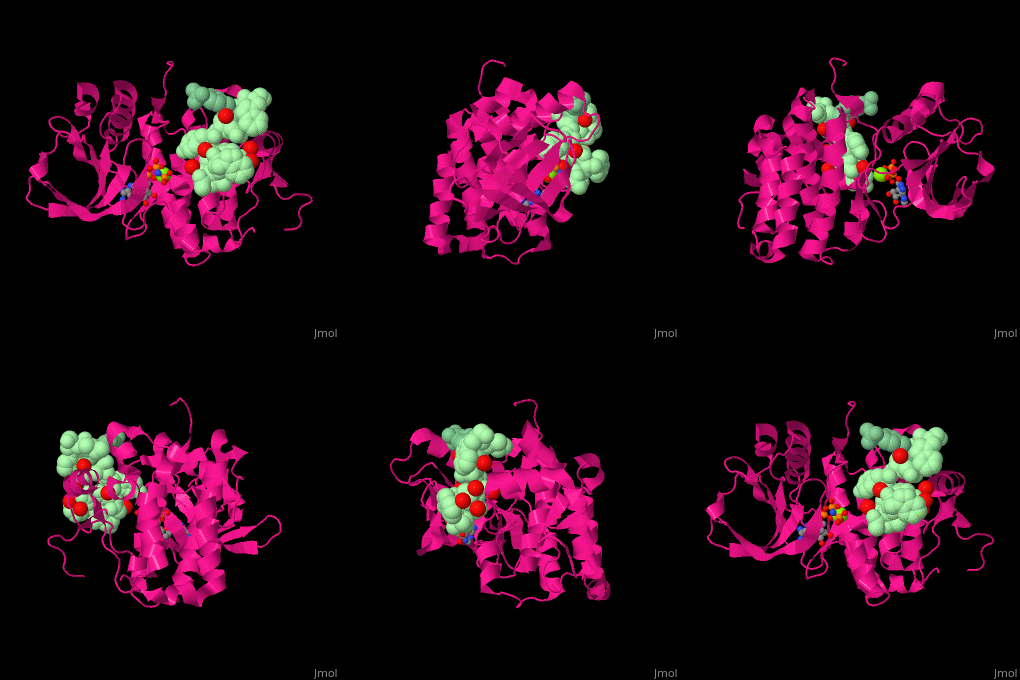
<StructureSection load='' size='350' side='right' scene='45/450911/Cv/1' caption='Human ephrin A3 receptor (magenta) complex with peptide substrate (green), nucleotide derivative and Mg+2 ion [[3fxx]]'>
-
{{STRUCTURE_3fxx| PDB=3fxx | SIZE=300| SCENE= |right|CAPTION=Human ephrin A3 receptor (grey) complex with peptide substrate (green), nucleotide derivative (stick model) and Mg+2 ion [[3fxx]] }}
+
-
 
+
-
 
+
-
 
+
-
 
+
-
 
+
-
 
+
-
 
+
-
 
+
-
 
+
-
 
+
-
 
+
-
 
+
-
 
+
-
 
+
-
 
+
-
 
+
-
 
+
-
 
+
-
 
+
-
 
+
-
 
+
-
 
+
-
 
+
== Function ==
== Function ==
-
'''Ephrin receptors''' (EPHR) are components of the cell signaling pathways. They belong to the receptor tyrosine kinases. The extracellular ligand-binding domain (LBD) interacts with ephrin<ref>PMID:21078817</ref>. For more details see [[ Ephrin Type-A Receptor]].
+
'''Ephrin receptors''' (EPHR) are components of the cell signaling pathways. They belong to the [[receptor tyrosine kinases]]. The extracellular ligand-binding domain (LBD) interacts with ephrin<ref>PMID:21078817</ref>.
 +
*'''Ephrin receptor A2''' functions in entry of Epstein-Barr virus to epithelial cells<ref>PMID:29292384</ref>.
 +
*'''Ephrin receptor A4''' functions in entry of Kaposi's sarcoma-associated herpesvirus to cells<ref>PMID:30782663</ref>.
 +
*'''Ephrin receptor A5''' is expressed in the nervous system and plays a role in synaptogenesis<ref>PMID:20824214</ref>.
 +
*'''Ephrin receptor A7''' functions in corticogenesis<ref>PMID:34176129</ref>.
 +
*'''Ephrin receptor A8''' has a role in short-range contact-mediated axonal guidance.
 +
*'''Ephrin receptor B4''' determine the molecular distinction between veins and arteries in the early embryo<ref>PMID:26817610</ref>.
 +
*'''Ephrin receptor B6''' functions in cold immune microenvironment and promotes the immune escape in BLCA<ref>PMID:37637034</ref>.
 +
For more details see [[Ephrin Type-A Receptor]] and [[Kinase-linked, enzyme-linked and related receptors]].
 +
.
==Relevance ==
==Relevance ==
Line 37: Line 22:
EPHR domains include an ectodomain (residues 23-435) containing the LBD (residues 23-326), a second fibronectin III domain (fn3) (residues 446-539), a transmembrane domain (residues 539-563), a kinase domain (residues 596-900) and a sterile-α-motif (SAM) domain (residues 908-972).
 +
<scene name='45/450911/Cv/8'>Ephrin A3 receptor with peptide substrate, nucleotide derivative and Mg+2 ion</scene>. Water molecules are shown as red spheres.
 +
<scene name='45/450911/Cv/9'>Nucleotide derivative and Mg+2 ion binding site</scene>.
 +
<scene name='45/450911/Cv/10'>Peptide substrate binding site</scene> ([[3fxx]]).<ref>PMID:19678838</ref>
 +
== 3D Structures of ephrin receptor ==
 +
[[Ephrin receptor 3D structures]]
-
 
+
</StructureSection>
-
 
+
-
 
+
-
 
+
-
 
+
-
 
+
-
 
+
-
 
+
-
 
+
-
 
+
-
 
+
-
== 3D Structures of ephrin receptors ==
+
-
 
+
-
Updated on {{REVISIONDAY2}}-{{MONTHNAME|{{REVISIONMONTH}}}}-{{REVISIONYEAR}}
+
-
{{#tree:id=OrganizedByTopic|openlevels=0|
+
-
 
+
-
*Ephrin A1 receptor
+
-
**[[3kka]] - hEPHR A1 SAM+ hEPH A2 SAM – human<BR />
+
-
**[[3hil]] - hEPHR A1 SAM<br />
+
-
**[[2k1l]] - hEPHR A1 transmembrane domain – NMR<BR />
+
-
**[[1x5a]] - hEPHR A1 fn3 domain – NMR<BR />
+
-
*Ephrin A2 receptor
+
-
**[[3hpn]], [[3c8x]] - hEPHR A2 LBD<BR />
+
-
**[[2x10]], [[3fl7]] - hEPHR A2 ectodomain<BR />
+
-
**[[2k9y]], [[2e8n]] - hEPHR A2 transmembrane domain – NMR<BR />
+
-
**[[1mqb]], [[4p2k]], [[4pdo]], [[4trl]] - hEPHR A2 kinase domain<BR />
+
-
 
+
-
*''Ephrin A2 receptor binary complex''<br />
+
-
 
+
-
**[[3mx0]], [[2x11]] - hEPHR A2 ectodomain + ephrin A5<BR />
+
-
**[[3hei]], [[3czu]] - hEPHR A2 LBD + ephrin A1<BR />
+
-
**[[3mbw]] - hEPHR A2 LBD + carbohydrate-recognition domain + ephrin A1<br />
+
-
**[[2kso]] - hEPHR A2 SAM + SHIP2<br />
+
-
*Ephrin A3 receptor
+
-
**[[2qo2]], [[2qob]], [[2gsf]] - hEPHR A3 kinase domain<BR />
+
-
**[[2qok]], [[2qol]], [[2qon]], [[2qoo]], [[2qod]], [[2qof]], [[2qoi]] - hEPHR A3 kinase domain (mutant) <BR />
+
-
**[[3fxx]], [[3fy2]] – hEPHR A3 kinase domain + peptide substrate<BR />
+
-
**[[2qoq]], [[2qo7]], [[2qo9]], [[2qoc]] - hEPHR A3 kinase domain + AMP-PNP<BR />
+
-
**[[3dzq]], [[4gk2]], [[4gk3]], [[4gk4]], [[4p5q]], [[4p5z]] - hEPHR A3 kinase domain + inhibitor<br />
+
-
**[[4g2f]] - hEPHR A3 kinase domain (mutant) + inhibitor<br />
+
-
*Ephrin A4 receptor
+
-
**[[2wo1]], [[3ckh]] - hEPHR A4 LBD<BR />
+
-
**[[4bk4]], [[4m4p]] - hEPHR A4 ectodomain<br />
+
-
**[[2lw8]] - hEPHR A4 LBD – NMR<br />
+
-
**[[2hel]] – mEPHR A4 membrane and kinase domains – mouse<br />
+
-
**[[2y6m]] – mEPHR A4 kinase domain<br />
+
-
 
+
-
*''Ephrin A4 receptor binary complex''<br />
+
-
 
+
-
**[[2wo3]] - hEPHR A4 LBD + ephrin A2 receptor-binding domain<BR />
+
-
**[[4w4z]], [[4w50]] - hEPHR A4 LBD (mutant) + peptide<br />
+
-
**[[2wo2]], [[3gxu]] - hEPHR A4 LBD + ephrin B2 receptor-binding domain<br />
+
-
**[[4bk5]], [[4bka]], [[4m4r]] - hEPHR A4 ectodomain + ephrin A5 LBD<br />
+
-
**[[4bkf]] - hEPHR A4 ectodomain + ephrin B3 LBD<br />
+
-
**[[2xyu]] – mEPHR A4 kinase domain + inhibitor<br />
+
-
**[[2y6o]] – mEPHR A4 kinase domain + cancer drug<br />
+
-
*Ephrin A5 receptor
+
-
**[[2r2p]] - hEPHR A5 kinase domain<BR />
+
-
**[[1shx]] - mEPHR A5 <br />
+
-
**[[4et7]] – hEPHR A5 (mutant)<br />
+
-
*Ephrin A7 receptor
+
-
**[[3nru]] – hEPHR A7 LBD<BR />
+
-
**[[3h8m]] – hEPHR A7 SAM<BR />
+
-
**[[2rei]] - hEPHR A7 kinase domain<BR />
+
-
**[[3dko]] – hEPHR A7 kinase domain + inhibitor
+
-
*Ephrin A8 receptor
+
-
**[[3kul]] - hEPHR A8 kinase domain<BR />
+
-
**[[1x5l]] – hEPHR A8 fn3 domain – NMR<BR />
+
-
**[[1ucv]] - hEPHR A8 SAM – NMR<BR />
+
-
*Ephrin B1 receptor
+
-
**[[2eao]] – hEPHR B1 SAM – NMR<BR />
+
-
**[[2djs]] - hEPHR B1 fn3 domain – NMR<BR />
+
-
**[[3zfx]] - hEPHR B1 kinase domain<br />
+
-
*Ephrin B2 receptor
+
-
**[[3etp]] – hEPHR B2<BR />
+
-
**[[1b4f]] - hEPHR B2 SAM<br />
+
-
**[[1f0m]] – mEPHR B2 SAM<BR />
+
-
**[[1iko]] - mEPHR B2 ectodomain<br />
+
-
**[[2i85]] - hEPHR B2 ectodomain<br />
+
-
**[[1sgg]] - mEPHR B2 SAM – chicken - NMR<BR />
+
-
 
+
-
*''Ephrin B2 receptor binary complex''<br />
+
-
 
+
-
**[[2vsk]], [[2vsm]] – hEPHR B2 + Viral Hemagglutinin-neuraminidase<BR />
+
-
**[[2qbx]] – hEPHR B2 + peptide agonist<BR />
+
-
**[[2hen]] - hEPHR B2 kinase domain + ADP<BR />
+
-
**[[1shw]] - mEPHR B2 LBD + ephrin A5<BR />
+
-
**[[1kgy]] - mEPHR B2 LBD + ephrin B2 extracellular domain<BR />
+
-
 
+
-
*Ephrin B3 receptor
+
-
**[[3p1i]] – hEPHR B3 LBD<BR />
+
-
**[[3zfy]] - hEPHR B3 kinase domain<br />
+
-
*Ephrin B4 receptor
+
-
**[[2qkq]] – hEPHR B4 SAM<BR />
+
-
**[[2e7h]] – hEPHR B4 fn3 domain - NMR<BR />
+
-
**[[2x9f]], [[2vwy]] - hEPHR B4 kinase domain (mutant) <BR />
+
-
 
+
-
*''Ephrin B4 receptor binary complex''<br />
+
-
 
+
-
**[[2vwx]], [[2vwz]], [[2vx0]], [[2vx1]], [[2vwu]], [[2vwv]], [[2vww]], [[4aw5]] – hEPHR B4 kinase domain + inhibitor <BR />
+
-
**[[3zew]] - hEPHR B4 + staurosporine<br />
+
-
**[[2xvd]], [[2yn8]], [[4bb4]] - hEPHR B4 kinase domain (mutant) + inhibitor<br />
+
-
**[[2hle]], [[2bba]] - hEPHR B4 LBD + ephrin B2
+
-
}}
+
-
 
+
== References ==
== References ==
<references/>
<references/>
- 
-
 
- 
[[Category:Topic Page]]
[[Category:Topic Page]]

Current revision

Human ephrin A3 receptor (magenta) complex with peptide substrate (green), nucleotide derivative and Mg+2 ion 3fxx

Drag the structure with the mouse to rotate

References

  1. Pitulescu ME, Adams RH. Eph/ephrin molecules--a hub for signaling and endocytosis. Genes Dev. 2010 Nov 15;24(22):2480-92. doi: 10.1101/gad.1973910. PMID:21078817 doi:http://dx.doi.org/10.1101/gad.1973910
  2. Chen J, Sathiyamoorthy K, Zhang X, Schaller S, Perez White BE, Jardetzky TS, Longnecker R. Ephrin receptor A2 is a functional entry receptor for Epstein-Barr virus. Nat Microbiol. 2018 Feb;3(2):172-180. PMID:29292384 doi:10.1038/s41564-017-0081-7
  3. Chen J, Zhang X, Schaller S, Jardetzky TS, Longnecker R. Ephrin Receptor A4 is a New Kaposi's Sarcoma-Associated Herpesvirus Virus Entry Receptor. mBio. 2019 Feb 19;10(1):e02892-18. PMID:30782663 doi:10.1128/mBio.02892-18
  4. Akaneya Y, Sohya K, Kitamura A, Kimura F, Washburn C, Zhou R, Ninan I, Tsumoto T, Ziff EB. Ephrin-A5 and EphA5 interaction induces synaptogenesis during early hippocampal development. PLoS One. 2010 Aug 31;5(8):e12486. PMID:20824214 doi:10.1371/journal.pone.0012486
  5. Lévy J, Schell B, Nasser H, Rachid M, Ruaud L, Couque N, Callier P, Faivre L, Marle N, Engwerda A, van Ravenswaaij-Arts CMA, Plutino M, Karmous-Benailly H, Benech C, Redon S, Boute O, Boudry Labis E, Rama M, Kuentz P, Assoumani J, Maldergem LV, Dupont C, Verloes A, Tabet AC. EPHA7 haploinsufficiency is associated with a neurodevelopmental disorder. Clin Genet. 2021 Oct;100(4):396-404. PMID:34176129 doi:10.1111/cge.14017
  6. Wang M, Collins MJ, Foster TR, Bai H, Hashimoto T, Santana JM, Shu C, Dardik A. Eph-B4 mediates vein graft adaptation by regulation of endothelial nitric oxide synthase. J Vasc Surg. 2017 Jan;65(1):179-189. PMID:26817610 doi:10.1016/j.jvs.2015.11.041
  7. Jia X, Zhang D, Zhou C, Yan Z, Jiang Z, Xie L, Jiang J. Eph receptor B6 shapes a cold immune microenvironment, inhibiting anti-cancer immunity and immunotherapy response in bladder cancer. Front Oncol. 2023 Aug 9;13:1175183. PMID:37637034 doi:10.3389/fonc.2023.1175183
  8. Genander M, Frisen J. Ephrins and Eph receptors in stem cells and cancer. Curr Opin Cell Biol. 2010 Oct;22(5):611-6. doi: 10.1016/j.ceb.2010.08.005. PMID:20810264 doi:http://dx.doi.org/10.1016/j.ceb.2010.08.005
  9. Davis TL, Walker JR, Allali-Hassani A, Parker SA, Turk BE, Dhe-Paganon S. Structural recognition of an optimized substrate for the ephrin family of receptor tyrosine kinases. FEBS J. 2009 Aug;276(16):4395-404. PMID:19678838 doi:http://dx.doi.org/10.1111/j.1742-4658.2009.07147.x

Proteopedia Page Contributors and Editors (what is this?)

Michal Harel, Alexander Berchansky, Joel L. Sussman

Personal tools