This old version of Proteopedia is provided for student assignments while the new version is undergoing repairs. Content and edits done in this old version of Proteopedia after March 1, 2026 will eventually be lost when it is retired in about June of 2026.
Apply for new accounts at the new Proteopedia. Your logins will work in both the old and new versions.
Profilin
From Proteopedia
(Difference between revisions)
| (5 intermediate revisions not shown.) | |||
| Line 1: | Line 1: | ||
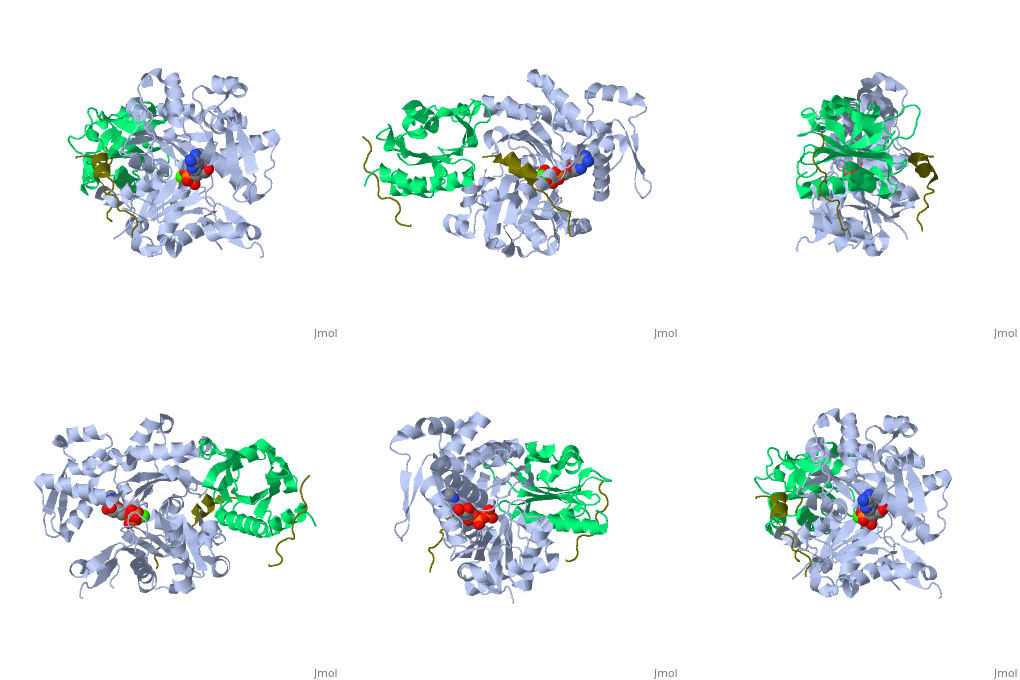
| - | <StructureSection load='2pbd' size='340' side='right' caption='Human profilin I (green) complex with α-actin ( | + | <StructureSection load='2pbd' size='340' side='right' caption='Human profilin I (green) complex with α-actin (grey), VASP protein poly-Pro peptide (olive), ATP and Ca+2 ion (PDB code [[2pbd]])' scene=''> |
== Function == | == Function == | ||
'''Profilin''' (PFN) enhances actin growth by binding to monomeric actin, thus becoming profilactin. PFN catalyzes the exchange of poorly polymerizing ADP-actin to readily polymerizing ATP-actin<ref>PMID:27307590</ref>. PFN binds to poly-L-proline, thus it recruits the actin monomers to proline-rich proteins like VASP, which enhance the growing of actin polymers. '''PFN-I''' is expressed in most tissues while '''PFN-II''' is expressed in brain and kidney. PFN was found in all eukaryotes. | '''Profilin''' (PFN) enhances actin growth by binding to monomeric actin, thus becoming profilactin. PFN catalyzes the exchange of poorly polymerizing ADP-actin to readily polymerizing ATP-actin<ref>PMID:27307590</ref>. PFN binds to poly-L-proline, thus it recruits the actin monomers to proline-rich proteins like VASP, which enhance the growing of actin polymers. '''PFN-I''' is expressed in most tissues while '''PFN-II''' is expressed in brain and kidney. PFN was found in all eukaryotes. | ||
| Line 6: | Line 6: | ||
PFN from birch, peanut and other plants is a major allergen<ref>PMID:25123397</ref>. | PFN from birch, peanut and other plants is a major allergen<ref>PMID:25123397</ref>. | ||
| - | |||
| - | </StructureSection> | ||
== 3D Structures of profilin == | == 3D Structures of profilin == | ||
| + | [[Profilin 3D Structures]] | ||
| - | + | </StructureSection> | |
| - | + | ||
| - | + | ||
| - | + | ||
| - | + | ||
| - | + | ||
| - | + | ||
| - | + | ||
| - | + | ||
| - | + | ||
| - | + | ||
| - | + | ||
| - | + | ||
| - | + | ||
| - | + | ||
| - | + | ||
| - | + | ||
| - | + | ||
| - | + | ||
| - | + | ||
| - | + | ||
| - | + | ||
| - | + | ||
| - | + | ||
| - | + | ||
| - | + | ||
| - | + | ||
| - | + | ||
| - | + | ||
| - | + | ||
| - | + | ||
| - | + | ||
| - | + | ||
| - | + | ||
| - | + | ||
| - | + | ||
| - | }} | ||
== References == | == References == | ||
<references/> | <references/> | ||
| + | [[Category:Topic Page]] | ||
Current revision
| |||||||||||
References
- ↑ Nejedla M, Sara S, Sulimenko V, de Almeida FN, Blom H, Draber P, Aspenstrom P, Karlsson R. Profilin connects Actin Assembly with Microtubule dynamics. Mol Biol Cell. 2016 Jun 15. pii: mbc.E15-11-0799. PMID:27307590 doi:http://dx.doi.org/10.1091/mbc.E15-11-0799
- ↑ Alvarado MI, Jimeno L, De La Torre F, Boissy P, Rivas B, Lazaro MJ, Barber D. Profilin as a severe food allergen in allergic patients overexposed to grass pollen. Allergy. 2014 Dec;69(12):1610-6. doi: 10.1111/all.12509. Epub 2014 Oct 3. PMID:25123397 doi:http://dx.doi.org/10.1111/all.12509
