This old version of Proteopedia is provided for student assignments while the new version is undergoing repairs. Content and edits done in this old version of Proteopedia after March 1, 2026 will eventually be lost when it is retired in about June of 2026.
Apply for new accounts at the new Proteopedia. Your logins will work in both the old and new versions.
Proline utilization A
From Proteopedia
(Difference between revisions)
| (5 intermediate revisions not shown.) | |||
| Line 1: | Line 1: | ||
| - | <StructureSection load='' size=' | + | <StructureSection load='' size='350' side='right' caption='E. coli PutA proline dehydrogenase domain with cofactor FAD complex with hydroxyproline (PDB code [[3e2q]])' scene='70/706260/Cv/1'> |
== Function == | == Function == | ||
| - | '''Proline utilization A (PutA)''' is a bifunctional flavoprotein which acts as a transcriptional repressor of the put regulon or as a membrane-bound enzyme which catalyzes the oxidation of proline to glutamate. PutA domains include the DNA-binding domain (PRODH), the FAD-dependent proline dehydrogenase domain and the D-pyrroline-5-carboxylate dehydrogenase domain. The binding of proline to the PRODH active site and subsequent reduction of FAD causes a conformation change in PutA and enhance its membrane affinity. As a membrane-bound protein PutA switches from its repressor activity to its enzymatic role<ref>PMID:19994913</ref>. | + | '''Proline utilization A (PutA)''' or '''bifunctional protein PutA''' is a bifunctional flavoprotein which acts as a transcriptional repressor of the put regulon or as a membrane-bound enzyme which catalyzes the oxidation of proline to glutamate. PutA domains include the DNA-binding domain (PRODH), the FAD-dependent proline dehydrogenase domain and the D-pyrroline-5-carboxylate dehydrogenase domain. The binding of proline to the PRODH active site and subsequent reduction of FAD causes a conformation change in PutA and enhance its membrane affinity. As a membrane-bound protein PutA switches from its repressor activity to its enzymatic role<ref>PMID:19994913</ref>. |
== Structural highlights == | == Structural highlights == | ||
| - | The <scene name='70/706260/Cv/ | + | The <scene name='70/706260/Cv/5'>active site residue Tyr540 helps in substrate preference for proline over hydroxyproline</scene>. Water molecules are shown as red spheres. The [[3e2q]] structure displayed here contains the <scene name='70/706260/Cv/6'>Tyr540Ser mutant</scene><ref>PMID:19140736</ref>. |
</StructureSection> | </StructureSection> | ||
| Line 11: | Line 11: | ||
Updated on {{REVISIONDAY2}}-{{MONTHNAME|{{REVISIONMONTH}}}}-{{REVISIONYEAR}} | Updated on {{REVISIONDAY2}}-{{MONTHNAME|{{REVISIONMONTH}}}}-{{REVISIONYEAR}} | ||
{{#tree:id=OrganizedByTopic|openlevels=0| | {{#tree:id=OrganizedByTopic|openlevels=0| | ||
| + | |||
*PutA | *PutA | ||
**[[4nm9]] – GsPutA + FAD – ''Geobacter sulfurreducens'' <br /> | **[[4nm9]] – GsPutA + FAD – ''Geobacter sulfurreducens'' <br /> | ||
| + | **[[7na0]] – GsPutA (mutant) + FAD <br /> | ||
**[[4nma]] – GsPutA + FAD + tetrahydrofuran derivative <br /> | **[[4nma]] – GsPutA + FAD + tetrahydrofuran derivative <br /> | ||
**[[2gpe]] – EcPutA DNA-binding domain <br /> | **[[2gpe]] – EcPutA DNA-binding domain <br /> | ||
**[[2ay0]] – EcPutA DNA-binding domain (mutant)<br /> | **[[2ay0]] – EcPutA DNA-binding domain (mutant)<br /> | ||
| - | **[[4q71]], [[4q72]], [[4q73]] – | + | **[[4q71]], [[4q72]], [[4q73]] – BdPutA (mutant) + FAD – ''Bradyrhizobium diazoefficiens''<br /> |
**[[4h6r]] – DrPutA + FAD – ''Deinococcus radiodurans''<br /> | **[[4h6r]] – DrPutA + FAD – ''Deinococcus radiodurans''<br /> | ||
**[[2gpe]] - EcPutA DNA-binding domain - ''Escherichia coli''<br /> | **[[2gpe]] - EcPutA DNA-binding domain - ''Escherichia coli''<br /> | ||
**[[2jxg]], [[2jxh]] - PpPutA DNA-binding domain - ''Pseudomonas putida'' - NMR<br /> | **[[2jxg]], [[2jxh]] - PpPutA DNA-binding domain - ''Pseudomonas putida'' - NMR<br /> | ||
| - | **[[ | + | **[[6ufp]], [[6vz9]] – SmPutA (mutant) + FAD – ''Sinorhizobium melioli''<br /> |
*PutA complex | *PutA complex | ||
| Line 43: | Line 45: | ||
**[[3haz]] - PutA + FAD + NAD - ''Bradyrhyzobium japonicum''<br /> | **[[3haz]] - PutA + FAD + NAD - ''Bradyrhyzobium japonicum''<br /> | ||
**[[5ux5]] - PutA + FAD + NAD - ''Corynebacterium freiburgense''<br /> | **[[5ux5]] - PutA + FAD + NAD - ''Corynebacterium freiburgense''<br /> | ||
| - | **[[5kf6]], [[5kf7]] - PutA + FAD + NAD + THF - ''Sinorhizobium meliloti''<br /> | + | **[[5kf6]], [[5kf7]], [[6ufp]], [[6vz9]] - PutA + FAD + NAD + THF - ''Sinorhizobium meliloti''<br /> |
**[[2jxi]] - PpPutA DNA-binding domain + DNA<br /> | **[[2jxi]] - PpPutA DNA-binding domain + DNA<br /> | ||
| + | **[[5ur2]] - PutA + FAD derivative + inhibitor - ''Bdellovibrio bacteriovorus''<br /> | ||
| + | **[[6x9a]], [[6x9b]], [[6x9c]], [[6x9d]] – SmPutA + FAD + proline derivative <br /> | ||
| + | **[[6x99]] – SmPutA + FAD + Glu derivative <br /> | ||
| + | **[[7my9]], [[7mya]], [[7myb]], [[7myc]] – SmPutA + FAD + dithiolane <br /> | ||
| + | **[[6bsn]] – BdPutA + FAD + proline<br /> | ||
}} | }} | ||
== References == | == References == | ||
<references/> | <references/> | ||
| + | [[Category:Topic Page]] | ||
Current revision
| |||||||||||
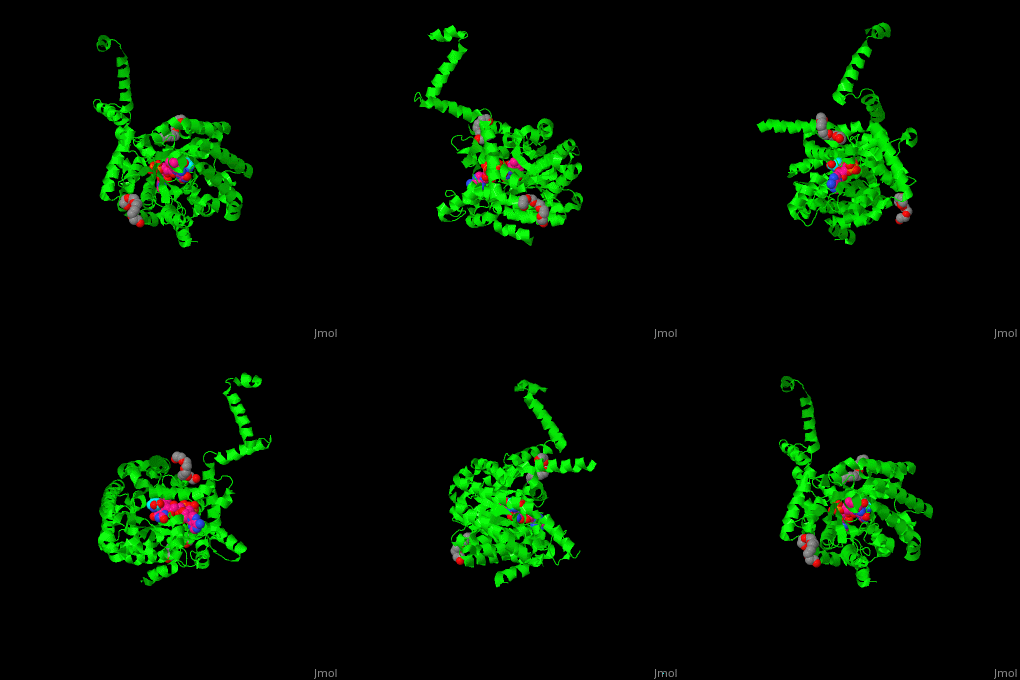
3D Structures of proline utilization A
Updated on 01-February-2022
References
- ↑ Srivastava D, Zhu W, Johnson WH, Whitman CP, Becker DF, Tanner JJ. The Structure of the Proline Utilization A Proline Dehydrogenase Domain Inactivated by N-Propargylglycine Provides Insight into Conformational Changes Induced by Substrate Binding and Flavin Reduction (,). Biochemistry. 2009 Dec 29. PMID:19994913 doi:10.1021/bi901717s
- ↑ Ostrander EL, Larson JD, Schuermann JP, Tanner JJ. A Conserved Active Site Tyrosine Residue of Proline Dehydrogenase Helps Enforce the Preference for Proline over Hydroxyproline as the Substrate (dagger) (double dagger). Biochemistry. 2009 Feb 10;48(5):951-9. PMID:19140736 doi:10.1021/bi802094k
