We apologize for Proteopedia being slow to respond. For the past two years, a new implementation of Proteopedia has been being built. Soon, it will replace this 18-year old system. All existing content will be moved to the new system at a date that will be announced here.
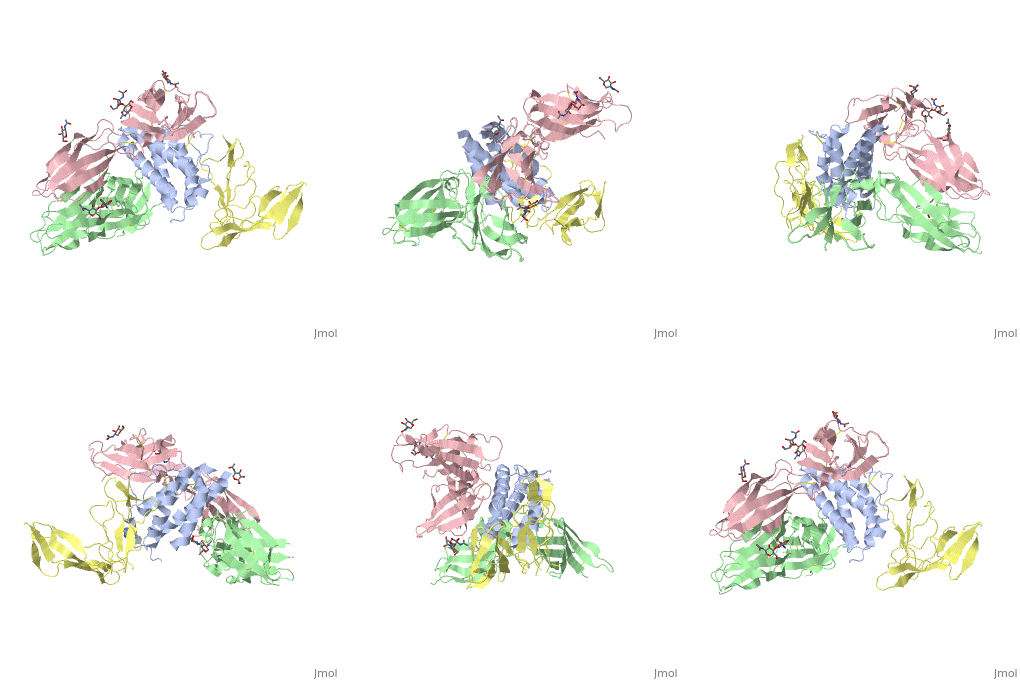
2b5i
From Proteopedia
(Difference between revisions)
| (2 intermediate revisions not shown.) | |||
| Line 1: | Line 1: | ||
==cytokine receptor complex== | ==cytokine receptor complex== | ||
| - | <StructureSection load='2b5i' size='340' side='right' caption='[[2b5i]], [[Resolution|resolution]] 2.30Å' scene=''> | + | <StructureSection load='2b5i' size='340' side='right'caption='[[2b5i]], [[Resolution|resolution]] 2.30Å' scene=''> |
== Structural highlights == | == Structural highlights == | ||
| - | <table><tr><td colspan='2'>[[2b5i]] is a 4 chain structure with sequence from [ | + | <table><tr><td colspan='2'>[[2b5i]] is a 4 chain structure with sequence from [https://en.wikipedia.org/wiki/Homo_sapiens Homo sapiens]. Full crystallographic information is available from [http://oca.weizmann.ac.il/oca-bin/ocashort?id=2B5I OCA]. For a <b>guided tour on the structure components</b> use [https://proteopedia.org/fgij/fg.htm?mol=2B5I FirstGlance]. <br> |
| - | </td></tr><tr id=' | + | </td></tr><tr id='method'><td class="sblockLbl"><b>[[Empirical_models|Method:]]</b></td><td class="sblockDat" id="methodDat">X-ray diffraction, [[Resolution|Resolution]] 2.3Å</td></tr> |
| - | <tr id=' | + | <tr id='ligand'><td class="sblockLbl"><b>[[Ligand|Ligands:]]</b></td><td class="sblockDat" id="ligandDat"><scene name='pdbligand=NAG:N-ACETYL-D-GLUCOSAMINE'>NAG</scene></td></tr> |
| - | <tr id='resources'><td class="sblockLbl"><b>Resources:</b></td><td class="sblockDat"><span class='plainlinks'>[ | + | <tr id='resources'><td class="sblockLbl"><b>Resources:</b></td><td class="sblockDat"><span class='plainlinks'>[https://proteopedia.org/fgij/fg.htm?mol=2b5i FirstGlance], [http://oca.weizmann.ac.il/oca-bin/ocaids?id=2b5i OCA], [https://pdbe.org/2b5i PDBe], [https://www.rcsb.org/pdb/explore.do?structureId=2b5i RCSB], [https://www.ebi.ac.uk/pdbsum/2b5i PDBsum], [https://prosat.h-its.org/prosat/prosatexe?pdbcode=2b5i ProSAT]</span></td></tr> |
</table> | </table> | ||
| - | == Disease == | ||
| - | [[http://www.uniprot.org/uniprot/IL2RA_HUMAN IL2RA_HUMAN]] Genetic variations in IL2RA are associated with susceptibility to diabetes mellitus insulin-dependent type 10 (IDDM10) [MIM:[http://omim.org/entry/601942 601942]]. A multifactorial disorder of glucose homeostasis that is characterized by susceptibility to ketoacidosis in the absence of insulin therapy. Clinical fetaures are polydipsia, polyphagia and polyuria which result from hyperglycemia-induced osmotic diuresis and secondary thirst. These derangements result in long-term complications that affect the eyes, kidneys, nerves, and blood vessels.<ref>PMID:17676041</ref> [[http://www.uniprot.org/uniprot/IL2_HUMAN IL2_HUMAN]] Note=A chromosomal aberration involving IL2 is found in a form of T-cell acute lymphoblastic leukemia (T-ALL). Translocation t(4;16)(q26;p13) with involves TNFRSF17. [[http://www.uniprot.org/uniprot/IL2RG_HUMAN IL2RG_HUMAN]] Defects in IL2RG are the cause of severe combined immunodeficiency X-linked T-cell-negative/B-cell-positive/NK-cell-negative (XSCID) [MIM:[http://omim.org/entry/300400 300400]]; also known as agammaglobulinemia Swiss type. A form of severe combined immunodeficiency (SCID), a genetically and clinically heterogeneous group of rare congenital disorders characterized by impairment of both humoral and cell-mediated immunity, leukopenia, and low or absent antibody levels. Patients present in infancy recurrent, persistent infections by opportunistic organisms. The common characteristic of all types of SCID is absence of T-cell-mediated cellular immunity due to a defect in T-cell development.<ref>PMID:8401490</ref> <ref>PMID:8299698</ref> <ref>PMID:8088810</ref> <ref>PMID:8027558</ref> <ref>PMID:7937790</ref> <ref>PMID:7668284</ref> <ref>PMID:7557965</ref> <ref>PMID:7860773</ref> <ref>PMID:8900089</ref> <ref>PMID:9150740</ref> Defects in IL2RG are the cause of X-linked combined immunodeficiency (XCID) [MIM:[http://omim.org/entry/312863 312863]]. XCID is a less severe form of X-linked immunodeficiency with a less severe degree of deficiency in cellular and humoral immunity than that seen in XSCID.<ref>PMID:7883965</ref> <ref>PMID:9399950</ref> | ||
== Function == | == Function == | ||
| - | [ | + | [https://www.uniprot.org/uniprot/IL2RB_HUMAN IL2RB_HUMAN] Receptor for interleukin-2. This beta subunit is involved in receptor mediated endocytosis and transduces the mitogenic signals of IL2. |
== Evolutionary Conservation == | == Evolutionary Conservation == | ||
[[Image:Consurf_key_small.gif|200px|right]] | [[Image:Consurf_key_small.gif|200px|right]] | ||
| Line 17: | Line 15: | ||
<jmolCheckbox> | <jmolCheckbox> | ||
<scriptWhenChecked>; select protein; define ~consurf_to_do selected; consurf_initial_scene = true; script "/wiki/ConSurf/b5/2b5i_consurf.spt"</scriptWhenChecked> | <scriptWhenChecked>; select protein; define ~consurf_to_do selected; consurf_initial_scene = true; script "/wiki/ConSurf/b5/2b5i_consurf.spt"</scriptWhenChecked> | ||
| - | <scriptWhenUnchecked>script /wiki/extensions/Proteopedia/spt/ | + | <scriptWhenUnchecked>script /wiki/extensions/Proteopedia/spt/initialview03.spt</scriptWhenUnchecked> |
<text>to colour the structure by Evolutionary Conservation</text> | <text>to colour the structure by Evolutionary Conservation</text> | ||
</jmolCheckbox> | </jmolCheckbox> | ||
| Line 33: | Line 31: | ||
==See Also== | ==See Also== | ||
| - | *[[Interleukin|Interleukin]] | + | *[[Interleukin 3D structures|Interleukin 3D structures]] |
*[[Interleukin receptor|Interleukin receptor]] | *[[Interleukin receptor|Interleukin receptor]] | ||
| + | *[[Interleukin receptor 3D structures|Interleukin receptor 3D structures]] | ||
== References == | == References == | ||
<references/> | <references/> | ||
__TOC__ | __TOC__ | ||
</StructureSection> | </StructureSection> | ||
| - | [[Category: | + | [[Category: Homo sapiens]] |
| - | [[Category: | + | [[Category: Large Structures]] |
| - | [[Category: | + | [[Category: Garcia KC]] |
| - | [[Category: | + | [[Category: Rickert M]] |
| - | [[Category: | + | [[Category: Wang X]] |
| - | + | ||
| - | + | ||
Current revision
cytokine receptor complex
| |||||||||||