We apologize for Proteopedia being slow to respond. For the past two years, a new implementation of Proteopedia has been being built. Soon, it will replace this 18-year old system. All existing content will be moved to the new system at a date that will be announced here.
2pa2
From Proteopedia
(Difference between revisions)
| Line 3: | Line 3: | ||
<StructureSection load='2pa2' size='340' side='right'caption='[[2pa2]], [[Resolution|resolution]] 2.50Å' scene=''> | <StructureSection load='2pa2' size='340' side='right'caption='[[2pa2]], [[Resolution|resolution]] 2.50Å' scene=''> | ||
== Structural highlights == | == Structural highlights == | ||
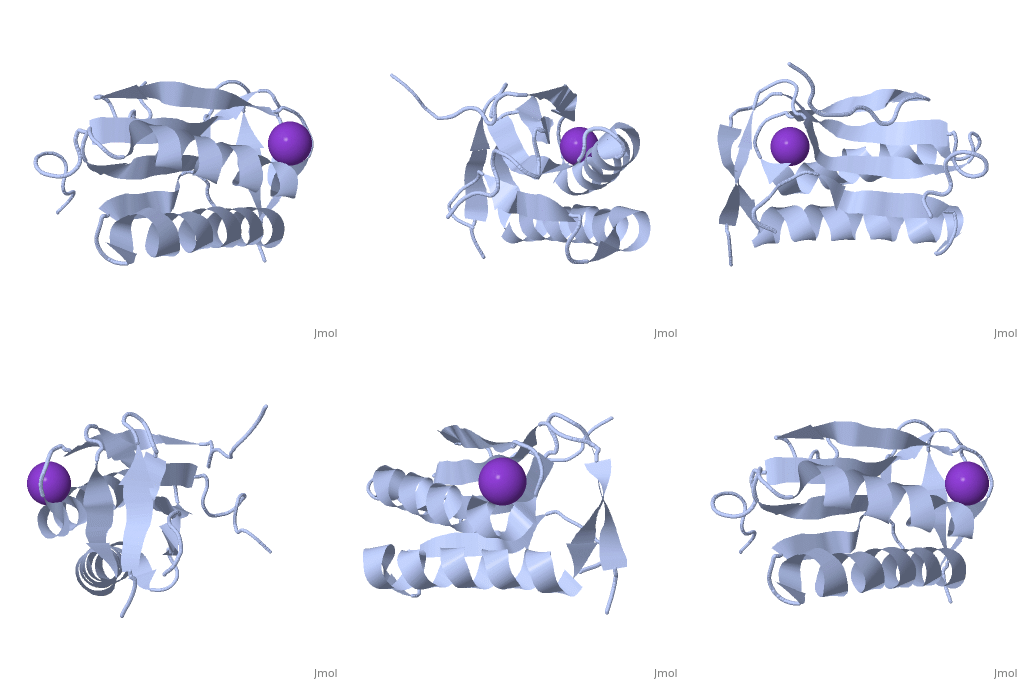
| - | <table><tr><td colspan='2'>[[2pa2]] is a 2 chain structure with sequence from [https://en.wikipedia.org/wiki/ | + | <table><tr><td colspan='2'>[[2pa2]] is a 2 chain structure with sequence from [https://en.wikipedia.org/wiki/Homo_sapiens Homo sapiens]. Full crystallographic information is available from [http://oca.weizmann.ac.il/oca-bin/ocashort?id=2PA2 OCA]. For a <b>guided tour on the structure components</b> use [https://proteopedia.org/fgij/fg.htm?mol=2PA2 FirstGlance]. <br> |
| - | </td></tr><tr id='ligand'><td class="sblockLbl"><b>[[Ligand|Ligands:]]</b></td><td class="sblockDat" id="ligandDat"><scene name='pdbligand=K:POTASSIUM+ION'>K</scene></td></tr> | + | </td></tr><tr id='method'><td class="sblockLbl"><b>[[Empirical_models|Method:]]</b></td><td class="sblockDat" id="methodDat">X-ray diffraction, [[Resolution|Resolution]] 2.5Å</td></tr> |
| + | <tr id='ligand'><td class="sblockLbl"><b>[[Ligand|Ligands:]]</b></td><td class="sblockDat" id="ligandDat"><scene name='pdbligand=K:POTASSIUM+ION'>K</scene></td></tr> | ||
<tr id='resources'><td class="sblockLbl"><b>Resources:</b></td><td class="sblockDat"><span class='plainlinks'>[https://proteopedia.org/fgij/fg.htm?mol=2pa2 FirstGlance], [http://oca.weizmann.ac.il/oca-bin/ocaids?id=2pa2 OCA], [https://pdbe.org/2pa2 PDBe], [https://www.rcsb.org/pdb/explore.do?structureId=2pa2 RCSB], [https://www.ebi.ac.uk/pdbsum/2pa2 PDBsum], [https://prosat.h-its.org/prosat/prosatexe?pdbcode=2pa2 ProSAT], [https://www.topsan.org/Proteins/RSGI/2pa2 TOPSAN]</span></td></tr> | <tr id='resources'><td class="sblockLbl"><b>Resources:</b></td><td class="sblockDat"><span class='plainlinks'>[https://proteopedia.org/fgij/fg.htm?mol=2pa2 FirstGlance], [http://oca.weizmann.ac.il/oca-bin/ocaids?id=2pa2 OCA], [https://pdbe.org/2pa2 PDBe], [https://www.rcsb.org/pdb/explore.do?structureId=2pa2 RCSB], [https://www.ebi.ac.uk/pdbsum/2pa2 PDBsum], [https://prosat.h-its.org/prosat/prosatexe?pdbcode=2pa2 ProSAT], [https://www.topsan.org/Proteins/RSGI/2pa2 TOPSAN]</span></td></tr> | ||
</table> | </table> | ||
== Disease == | == Disease == | ||
| - | + | [https://www.uniprot.org/uniprot/RL10_HUMAN RL10_HUMAN] Defects in RPL10 are a cause of susceptibility to autism X-linked type 5 (AUTSX5) [MIM:[https://omim.org/entry/300847 300847]. A complex multifactorial, pervasive developmental disorder characterized by impairments in reciprocal social interaction and communication, restricted and stereotyped patterns of interests and activities, and the presence of developmental abnormalities by 3 years of age. Most individuals with autism also manifest moderate mental retardation. Note=RPL10 is involved in autism only in rare cases. Two hypomorphic variants affecting the translation process have been found in families with autism spectrum disorders, suggesting that aberrant translation may play a role in disease mechanisms.<ref>PMID:16940977</ref> <ref>PMID:21567917</ref> | |
| + | == Function == | ||
| + | [https://www.uniprot.org/uniprot/RL10_HUMAN RL10_HUMAN] | ||
== Evolutionary Conservation == | == Evolutionary Conservation == | ||
[[Image:Consurf_key_small.gif|200px|right]] | [[Image:Consurf_key_small.gif|200px|right]] | ||
| Line 35: | Line 38: | ||
__TOC__ | __TOC__ | ||
</StructureSection> | </StructureSection> | ||
| - | [[Category: | + | [[Category: Homo sapiens]] |
[[Category: Large Structures]] | [[Category: Large Structures]] | ||
| - | [[Category: Kaminishi | + | [[Category: Kaminishi T]] |
| - | [[Category: Kawazoe | + | [[Category: Kawazoe M]] |
| - | [[Category: Kobayashi | + | [[Category: Kobayashi Y]] |
| - | [[Category: Nishimura | + | [[Category: Nishimura M]] |
| - | [[Category: Ohkubo | + | [[Category: Ohkubo T]] |
| - | + | [[Category: Shirouzu M]] | |
| - | [[Category: Shirouzu | + | [[Category: Sugano S]] |
| - | [[Category: Sugano | + | [[Category: Takemoto C]] |
| - | [[Category: Takemoto | + | [[Category: Tanaka A]] |
| - | [[Category: Tanaka | + | [[Category: Yokoyama S]] |
| - | [[Category: Yokoyama | + | [[Category: Yoshida T]] |
| - | [[Category: Yoshida | + | |
| - | + | ||
| - | + | ||
| - | + | ||
| - | + | ||
| - | + | ||
| - | + | ||
Current revision
Crystal structure of human Ribosomal protein L10 core domain
| |||||||||||

Categories: Homo sapiens | Large Structures | Kaminishi T | Kawazoe M | Kobayashi Y | Nishimura M | Ohkubo T | Shirouzu M | Sugano S | Takemoto C | Tanaka A | Yokoyama S | Yoshida T
