This old version of Proteopedia is provided for student assignments while the new version is undergoing repairs. Content and edits done in this old version of Proteopedia after March 1, 2026 will eventually be lost when it is retired in about June of 2026.
Apply for new accounts at the new Proteopedia. Your logins will work in both the old and new versions.
1kcg
From Proteopedia
(Difference between revisions)
| (10 intermediate revisions not shown.) | |||
| Line 1: | Line 1: | ||
| - | [[Image:1kcg.gif|left|200px]] | ||
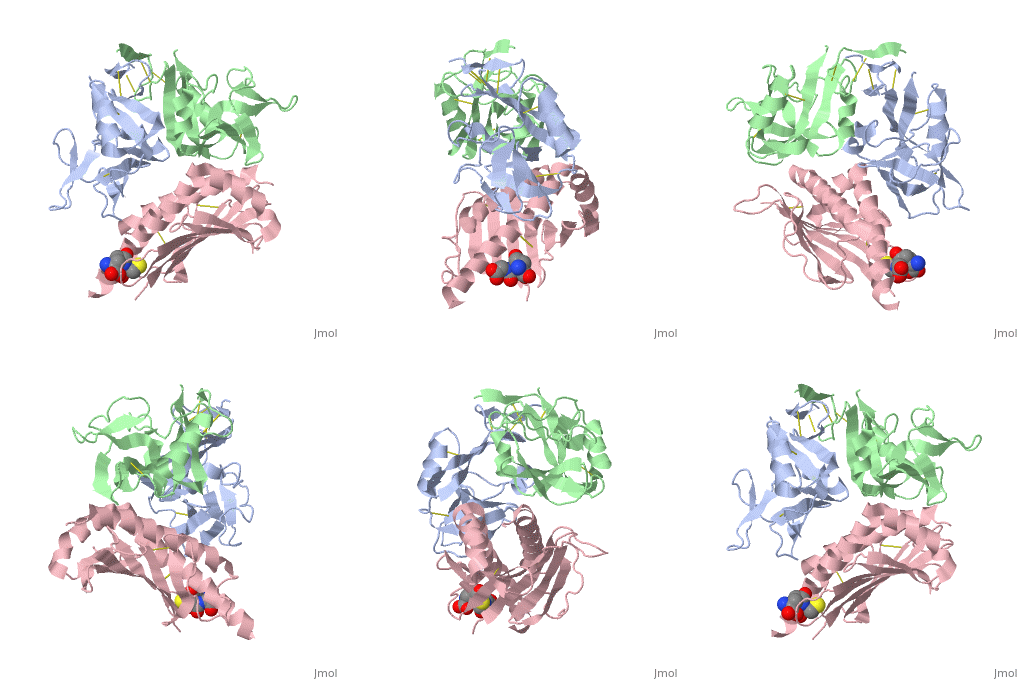
| - | < | + | ==NKG2D in complex with ULBP3== |
| - | + | <StructureSection load='1kcg' size='340' side='right'caption='[[1kcg]], [[Resolution|resolution]] 2.60Å' scene=''> | |
| - | + | == Structural highlights == | |
| - | + | <table><tr><td colspan='2'>[[1kcg]] is a 3 chain structure with sequence from [https://en.wikipedia.org/wiki/Homo_sapiens Homo sapiens]. Full crystallographic information is available from [http://oca.weizmann.ac.il/oca-bin/ocashort?id=1KCG OCA]. For a <b>guided tour on the structure components</b> use [https://proteopedia.org/fgij/fg.htm?mol=1KCG FirstGlance]. <br> | |
| - | + | </td></tr><tr id='method'><td class="sblockLbl"><b>[[Empirical_models|Method:]]</b></td><td class="sblockDat" id="methodDat">X-ray diffraction, [[Resolution|Resolution]] 2.6Å</td></tr> | |
| - | --> | + | <tr id='ligand'><td class="sblockLbl"><b>[[Ligand|Ligands:]]</b></td><td class="sblockDat" id="ligandDat"><scene name='pdbligand=GSH:GLUTATHIONE'>GSH</scene></td></tr> |
| - | + | <tr id='resources'><td class="sblockLbl"><b>Resources:</b></td><td class="sblockDat"><span class='plainlinks'>[https://proteopedia.org/fgij/fg.htm?mol=1kcg FirstGlance], [http://oca.weizmann.ac.il/oca-bin/ocaids?id=1kcg OCA], [https://pdbe.org/1kcg PDBe], [https://www.rcsb.org/pdb/explore.do?structureId=1kcg RCSB], [https://www.ebi.ac.uk/pdbsum/1kcg PDBsum], [https://prosat.h-its.org/prosat/prosatexe?pdbcode=1kcg ProSAT]</span></td></tr> | |
| + | </table> | ||
| + | == Function == | ||
| + | [https://www.uniprot.org/uniprot/NKG2D_HUMAN NKG2D_HUMAN] Receptor for MICA, MICB, ULBP1, ULBP2, ULBP3 (ULBP2>ULBP1>ULBP3) and ULBP4. Plays a role as a receptor for the recognition of MHC class I HLA-E molecules by NK cells and some cytotoxic T-cells. Involved in the immune surveillance exerted by T- and B-lymphocytes. | ||
| + | == Evolutionary Conservation == | ||
| + | [[Image:Consurf_key_small.gif|200px|right]] | ||
| + | Check<jmol> | ||
| + | <jmolCheckbox> | ||
| + | <scriptWhenChecked>; select protein; define ~consurf_to_do selected; consurf_initial_scene = true; script "/wiki/ConSurf/kc/1kcg_consurf.spt"</scriptWhenChecked> | ||
| + | <scriptWhenUnchecked>script /wiki/extensions/Proteopedia/spt/initialview01.spt</scriptWhenUnchecked> | ||
| + | <text>to colour the structure by Evolutionary Conservation</text> | ||
| + | </jmolCheckbox> | ||
| + | </jmol>, as determined by [http://consurfdb.tau.ac.il/ ConSurfDB]. You may read the [[Conservation%2C_Evolutionary|explanation]] of the method and the full data available from [http://bental.tau.ac.il/new_ConSurfDB/main_output.php?pdb_ID=1kcg ConSurf]. | ||
| + | <div style="clear:both"></div> | ||
| - | + | ==See Also== | |
| - | + | *[[NK cell receptor|NK cell receptor]] | |
| - | + | __TOC__ | |
| - | == | + | </StructureSection> |
| - | + | ||
| - | + | ||
| - | + | ||
| - | + | ||
| - | + | ||
| - | + | ||
| - | + | ||
[[Category: Homo sapiens]] | [[Category: Homo sapiens]] | ||
| - | [[Category: | + | [[Category: Large Structures]] |
| - | [[Category: Radaev | + | [[Category: Radaev S]] |
| - | [[Category: Sun | + | [[Category: Sun P]] |
| - | + | ||
| - | + | ||
| - | + | ||
| - | + | ||
Current revision
NKG2D in complex with ULBP3
| |||||||||||