This old version of Proteopedia is provided for student assignments while the new version is undergoing repairs. Content and edits done in this old version of Proteopedia after March 1, 2026 will eventually be lost when it is retired in about June of 2026.
Apply for new accounts at the new Proteopedia. Your logins will work in both the old and new versions.
Sandbox 39
From Proteopedia
| Line 9: | Line 9: | ||
It is known for damaging bacterial cell walls by catalyzing the hydrolysis of 1,4-beta-linkages between N-acetylmuramic acid and N-acetyl-D-glucosamine residues in a peptidoglycan and between N-acetyl-D-glucosamine residues in chitodextrins. In this way, lysozyme is efficient in lysing the cell walls of both bacteria and fungi. | It is known for damaging bacterial cell walls by catalyzing the hydrolysis of 1,4-beta-linkages between N-acetylmuramic acid and N-acetyl-D-glucosamine residues in a peptidoglycan and between N-acetyl-D-glucosamine residues in chitodextrins. In this way, lysozyme is efficient in lysing the cell walls of both bacteria and fungi. | ||
| + | A simple cartoon structure of lysozyme can be seen to the right. The secondary structures can be seen in blue, and the salt bridges are highlighted in yellow. The following sections will highlight different subsections of the lysozyme protein using colors and labels through the program Jmol. | ||
| Line 18: | Line 19: | ||
== Secondary Structure == | == Secondary Structure == | ||
| - | The structure of lysozyme with its secondary structures highlighted in yellow and pink can be seen to your left by clicking on: <scene name='Sandbox_39/Secondary_structure/1'>Secondary Structure</scene>. The | + | The structure of lysozyme with its secondary structures highlighted in yellow and pink can be seen to your left by clicking on: <scene name='Sandbox_39/Secondary_structure/1'>Secondary Structure</scene>. The structures highlight the alpha helicies, and the yellow lines highlight the beta-pleated sheets. Lysozyme contains five alpha helicies and five beta-pleated sheets. Three of the beta-pleated sheets are antiparallel to one another, and the other two are separate from each other. |
Revision as of 21:10, 24 October 2010
| Please do NOT make changes to this Sandbox. Sandboxes 30-60 are reserved for use by Biochemistry 410 & 412 at Messiah College taught by Dr. Hannah Tims during Fall 2012 and Spring 2013. |
|
LYSOZYME
Lysozyme is a powerful enzyme of biological significance found in abundance in tears, saliva, and human milk. It is also known as muramidase, or glycocide hydrolase. It is known for damaging bacterial cell walls by catalyzing the hydrolysis of 1,4-beta-linkages between N-acetylmuramic acid and N-acetyl-D-glucosamine residues in a peptidoglycan and between N-acetyl-D-glucosamine residues in chitodextrins. In this way, lysozyme is efficient in lysing the cell walls of both bacteria and fungi.
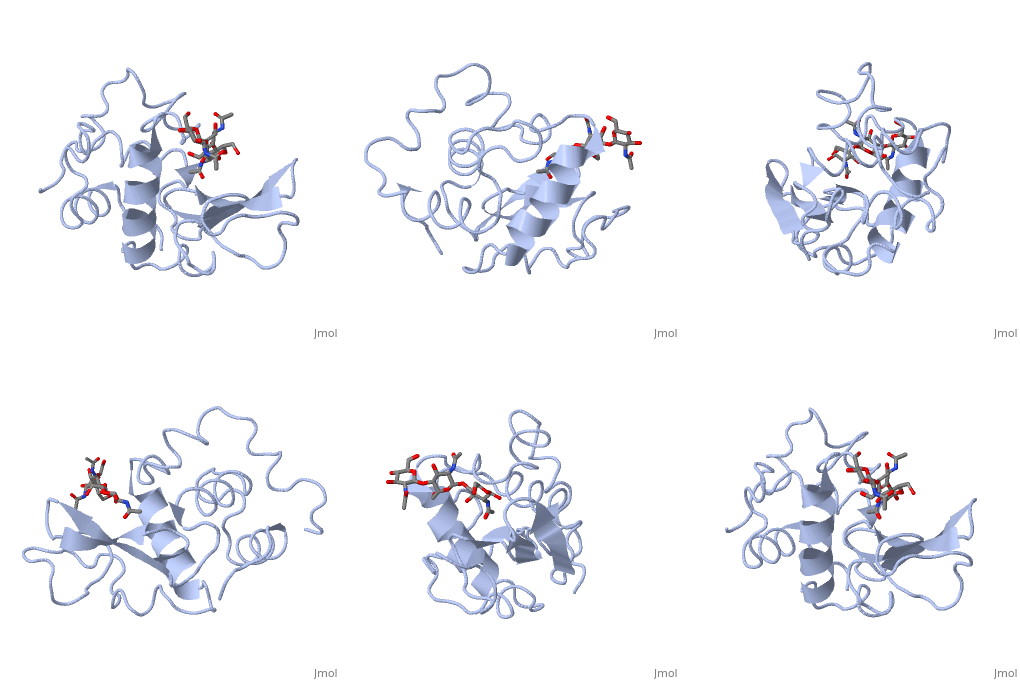
A simple cartoon structure of lysozyme can be seen to the right. The secondary structures can be seen in blue, and the salt bridges are highlighted in yellow. The following sections will highlight different subsections of the lysozyme protein using colors and labels through the program Jmol.
|
Secondary Structure
The structure of lysozyme with its secondary structures highlighted in yellow and pink can be seen to your left by clicking on: . The structures highlight the alpha helicies, and the yellow lines highlight the beta-pleated sheets. Lysozyme contains five alpha helicies and five beta-pleated sheets. Three of the beta-pleated sheets are antiparallel to one another, and the other two are separate from each other.
|
