This old version of Proteopedia is provided for student assignments while the new version is undergoing repairs. Content and edits done in this old version of Proteopedia after March 1, 2026 will eventually be lost when it is retired in about June of 2026.
Apply for new accounts at the new Proteopedia. Your logins will work in both the old and new versions.
Sandbox 39
From Proteopedia
| Line 3: | Line 3: | ||
<!-- PLEASE ADD YOUR CONTENT BELOW HERE --> | <!-- PLEASE ADD YOUR CONTENT BELOW HERE --> | ||
| - | == ''' | + | == '''Lysozyme''' == |
Lysozyme is a powerful [[enzyme]] of biological significance found in abundance in tears, saliva, and human milk. It is also known as muramidase, or [[glycocide hydrolase]]. | Lysozyme is a powerful [[enzyme]] of biological significance found in abundance in tears, saliva, and human milk. It is also known as muramidase, or [[glycocide hydrolase]]. | ||
It is known for damaging bacterial cell walls by catalyzing the hydrolysis of 1,4-beta-linkages between N-acetylmuramic acid and N-acetyl-D-glucosamine residues in a peptidoglycan and between N-acetyl-D-glucosamine residues in chitodextrins. In this way, lysozyme is efficient in lysing the cell walls of both bacteria and fungi. Due to its antibacterial effects, it is a strong component of the innate immune system, and is an important part of an infant's diet to ward off diarrheal diseases. | It is known for damaging bacterial cell walls by catalyzing the hydrolysis of 1,4-beta-linkages between N-acetylmuramic acid and N-acetyl-D-glucosamine residues in a peptidoglycan and between N-acetyl-D-glucosamine residues in chitodextrins. In this way, lysozyme is efficient in lysing the cell walls of both bacteria and fungi. Due to its antibacterial effects, it is a strong component of the innate immune system, and is an important part of an infant's diet to ward off diarrheal diseases. | ||
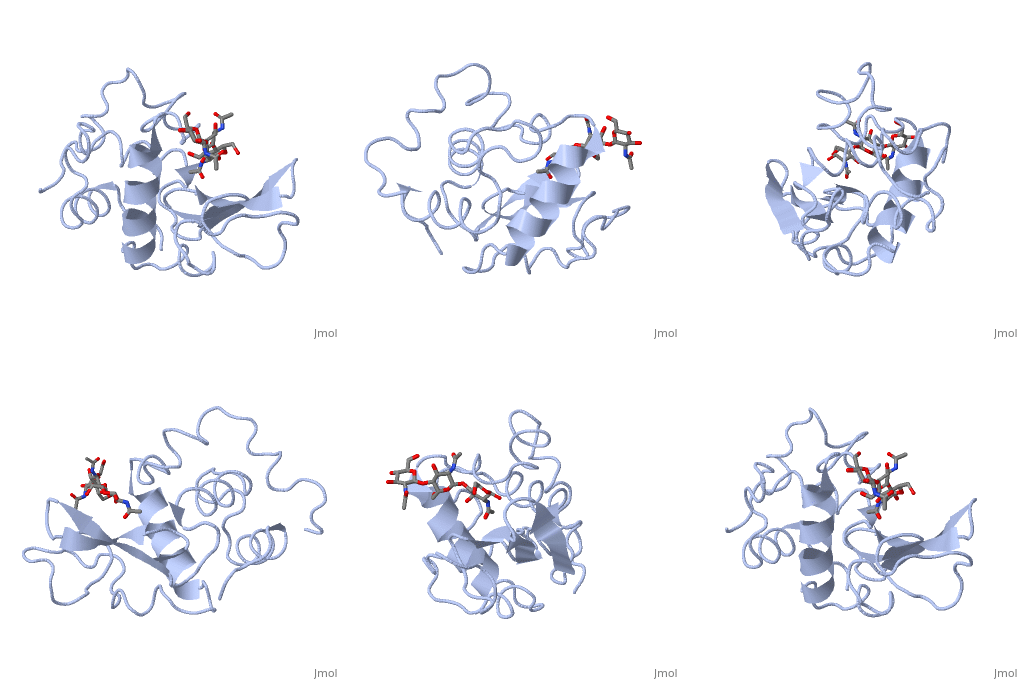
| - | A simple cartoon structure of lysozyme can be seen below. The secondary structures can be seen in blue, and the | + | A simple cartoon structure of lysozyme can be seen below. The secondary structures can be seen in blue, and the disulfide bonds are highlighted in yellow. The following sections will highlight different subsections of the lysozyme protein using colors and labels through the program Jmol. |
| Line 16: | Line 16: | ||
<applet load='1hew' size='350' frame='true' align='left' caption='' /> | <applet load='1hew' size='350' frame='true' align='left' caption='' /> | ||
| - | = Secondary Structure = | + | === Secondary Structure === |
The structure of lysozyme with its <scene name='Sandbox_39/Secondary_structure/1'>Secondary Structure</scene> highlighted in yellow and pink can be seen to your left. The structures highlight the alpha helicies, and the yellow lines highlight the beta-pleated sheets. Lysozyme contains five alpha helicies and five beta-pleated sheets. Three of the beta-pleated sheets are antiparallel to one another, and the other two are separate from each other. | The structure of lysozyme with its <scene name='Sandbox_39/Secondary_structure/1'>Secondary Structure</scene> highlighted in yellow and pink can be seen to your left. The structures highlight the alpha helicies, and the yellow lines highlight the beta-pleated sheets. Lysozyme contains five alpha helicies and five beta-pleated sheets. Three of the beta-pleated sheets are antiparallel to one another, and the other two are separate from each other. | ||
| Line 23: | Line 23: | ||
| - | = Ligands = | + | === Ligands === |
A <scene name='Sandbox_39/Ligands_1/1'>ligand</scene> is a protein that is able to bind to the active site of an enzyme to form a biologically relevant complex. The model to your left shows a space-filling model of lysozyme, with the protein distinguishable in brown and the ligand distinguishable in green. | A <scene name='Sandbox_39/Ligands_1/1'>ligand</scene> is a protein that is able to bind to the active site of an enzyme to form a biologically relevant complex. The model to your left shows a space-filling model of lysozyme, with the protein distinguishable in brown and the ligand distinguishable in green. | ||
| Line 39: | Line 39: | ||
<applet load='1hew' size='350' frame='true' align='right' caption='' /> | <applet load='1hew' size='350' frame='true' align='right' caption='' /> | ||
| - | = Hydrophobicity = | + | === Hydrophobicity === |
Lysozyme contain both hydrophobic, or water-hating, regions and hydrophillic, or water-loving, regions, referred to overall as <scene name='Sandbox_39/Hydrophobicity/2'>Hydrophobicity</scene> . The hydrophilic effect, or the desire for proteins to be at a specific position regarding water, is the single most important determinant of protein folding. These regions can be displayed with the hydrophobic regions in gray and the polar, hydrophillic regions in purple. This coloration highlights the location of these regions, showing the majority of the hydrophobic regions are inside of the protein and the majority of the hydrophillic regions are on the outside of the molecule. | Lysozyme contain both hydrophobic, or water-hating, regions and hydrophillic, or water-loving, regions, referred to overall as <scene name='Sandbox_39/Hydrophobicity/2'>Hydrophobicity</scene> . The hydrophilic effect, or the desire for proteins to be at a specific position regarding water, is the single most important determinant of protein folding. These regions can be displayed with the hydrophobic regions in gray and the polar, hydrophillic regions in purple. This coloration highlights the location of these regions, showing the majority of the hydrophobic regions are inside of the protein and the majority of the hydrophillic regions are on the outside of the molecule. | ||
| Line 53: | Line 53: | ||
| - | = Charged Residues = | + | === Charged Residues === |
The charged residues, or the most polar portions of the molecule, are seen highlighted to the right in the space-filling model. The blue <scene name='Sandbox_39/Charges/1'>charges</scene> represent cations, and the red charges represent anions. The <scene name='Sandbox_39/Charged_and_polar_residues/1'>charged and polar residues</scene> can also be seen, with the charged residues the same as above and the polar residues in purple. It is important to note that these residues are found almost exclusively on the outside of the protein to increase its interaction of water. | The charged residues, or the most polar portions of the molecule, are seen highlighted to the right in the space-filling model. The blue <scene name='Sandbox_39/Charges/1'>charges</scene> represent cations, and the red charges represent anions. The <scene name='Sandbox_39/Charged_and_polar_residues/1'>charged and polar residues</scene> can also be seen, with the charged residues the same as above and the polar residues in purple. It is important to note that these residues are found almost exclusively on the outside of the protein to increase its interaction of water. | ||
| Line 68: | Line 68: | ||
Lysozyme, like all proteins, also contains a <scene name='Sandbox_39/C_and_n_terminal_residues/1'> 3'C and 5'N terminal </scene>, and these can be seen by following the colors of the rainbow across the molecule. Starting at the red end, the 3' C terminal end, one can work the entire way through to the 5' N terminal end, showing the folding pattern and chain of the protein. | Lysozyme, like all proteins, also contains a <scene name='Sandbox_39/C_and_n_terminal_residues/1'> 3'C and 5'N terminal </scene>, and these can be seen by following the colors of the rainbow across the molecule. Starting at the red end, the 3' C terminal end, one can work the entire way through to the 5' N terminal end, showing the folding pattern and chain of the protein. | ||
| + | |||
| + | === Disulfide Bonding in Lysozeme === | ||
| + | |||
| + | Lysozyme contains four <scene name='Sandbox_39/Disulfide_bonds/1'>disulfide bonds</scene> involving eight cystine residues, which are highlighted in yellow on the left. Disulfide bonds are intramolecular forces that stabalize the tertiary structure of many proteins, and in this case, Lysozyme. | ||
Revision as of 20:58, 29 October 2010
| Please do NOT make changes to this Sandbox. Sandboxes 30-60 are reserved for use by Biochemistry 410 & 412 at Messiah College taught by Dr. Hannah Tims during Fall 2012 and Spring 2013. |
Contents |
Lysozyme
Lysozyme is a powerful enzyme of biological significance found in abundance in tears, saliva, and human milk. It is also known as muramidase, or glycocide hydrolase. It is known for damaging bacterial cell walls by catalyzing the hydrolysis of 1,4-beta-linkages between N-acetylmuramic acid and N-acetyl-D-glucosamine residues in a peptidoglycan and between N-acetyl-D-glucosamine residues in chitodextrins. In this way, lysozyme is efficient in lysing the cell walls of both bacteria and fungi. Due to its antibacterial effects, it is a strong component of the innate immune system, and is an important part of an infant's diet to ward off diarrheal diseases.
A simple cartoon structure of lysozyme can be seen below. The secondary structures can be seen in blue, and the disulfide bonds are highlighted in yellow. The following sections will highlight different subsections of the lysozyme protein using colors and labels through the program Jmol.
|
Secondary Structure
The structure of lysozyme with its highlighted in yellow and pink can be seen to your left. The structures highlight the alpha helicies, and the yellow lines highlight the beta-pleated sheets. Lysozyme contains five alpha helicies and five beta-pleated sheets. Three of the beta-pleated sheets are antiparallel to one another, and the other two are separate from each other.
Ligands
A is a protein that is able to bind to the active site of an enzyme to form a biologically relevant complex. The model to your left shows a space-filling model of lysozyme, with the protein distinguishable in brown and the ligand distinguishable in green.
Lysozyme reaction is hydrolysis of the beta (1-4) glycosidic bond between N-acetylglucosamine sugar (NAG) and N-acetylmuramic acid sugar (NAM). Lysozyme very specific active site, which can bind only six sugar rings from a polysaccharide chain and hydrolyze them, so these six sugar rings represent the ligand of lysozyme. The lysozyme then distorts the fourth sugar in the six membered sugar, producing stress on the molecule and breaking the glycosidic bond.
The amino acid side-chains glutamic acid 35 (Glu35) and aspartate 52 (Asp52) have been found to be critical to the activity of this enzyme. Glu35 acts as a proton donor to the glycosidic bond, cleaving the C-O bond in the substrate, whereas Asp52 acts as a nucleophile to generate a glycosyl enzyme intermediate. The glycosyl enzyme intermediate then reacts with a water molecule, to give the product of hydrolysis and leaving the enzyme unchanged.
|
Hydrophobicity
Lysozyme contain both hydrophobic, or water-hating, regions and hydrophillic, or water-loving, regions, referred to overall as . The hydrophilic effect, or the desire for proteins to be at a specific position regarding water, is the single most important determinant of protein folding. These regions can be displayed with the hydrophobic regions in gray and the polar, hydrophillic regions in purple. This coloration highlights the location of these regions, showing the majority of the hydrophobic regions are inside of the protein and the majority of the hydrophillic regions are on the outside of the molecule.
Here, lysozyme can also be seen interacting with , demonstrating how water remains almost exclusively on the outside of the molecule where the polar residues reside.
Charged Residues
The charged residues, or the most polar portions of the molecule, are seen highlighted to the right in the space-filling model. The blue represent cations, and the red charges represent anions. The can also be seen, with the charged residues the same as above and the polar residues in purple. It is important to note that these residues are found almost exclusively on the outside of the protein to increase its interaction of water.
|
Composition of Lysozyme
All proteins consist of carbon, hydrogen, nitrogen, oxygen, and sulfur, as do most organic molecules. Enzymes are composed in such a way as to maximize their reactivity with their desired substrate, increasing the efficiency of biological reactions. The can be seen on the left, with the carbon atoms outlined in gray, oxygen atoms in red, nitrogen atoms in blue, sulfur atoms in yellow, and the three-letter abbreviation for the in purple.
Lysozyme, like all proteins, also contains a , and these can be seen by following the colors of the rainbow across the molecule. Starting at the red end, the 3' C terminal end, one can work the entire way through to the 5' N terminal end, showing the folding pattern and chain of the protein.
Disulfide Bonding in Lysozeme
Lysozyme contains four involving eight cystine residues, which are highlighted in yellow on the left. Disulfide bonds are intramolecular forces that stabalize the tertiary structure of many proteins, and in this case, Lysozyme.
