This old version of Proteopedia is provided for student assignments while the new version is undergoing repairs. Content and edits done in this old version of Proteopedia after March 1, 2026 will eventually be lost when it is retired in about June of 2026.
Apply for new accounts at the new Proteopedia. Your logins will work in both the old and new versions.
User:David Canner/Sandbox good
From Proteopedia
(Difference between revisions)
| Line 6: | Line 6: | ||
==Scene Transitions== | ==Scene Transitions== | ||
===Smooth Transitions=== | ===Smooth Transitions=== | ||
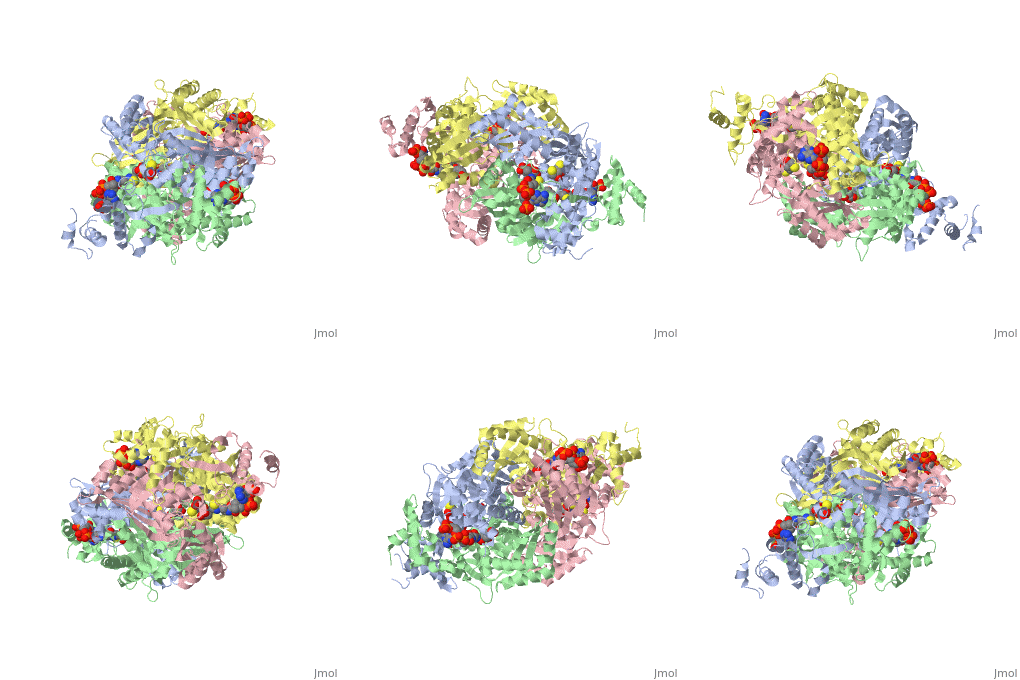
| - | <StructureSection load='1dq8' size='500' side='right' caption='Structure of HMG-CoA reductase (PDB entry [[1dq8]])' | + | <StructureSection load='1dq8' size='500' side='right' caption='Structure of HMG-CoA reductase (PDB entry [[1dq8]])'> |
Example from the page [[HMG-CoA Reductase]]: | Example from the page [[HMG-CoA Reductase]]: | ||
| Line 13: | Line 13: | ||
Compared with: | Compared with: | ||
The HMG binding pocket is the site of catalysis in HMGR. <scene name='HMG-CoA_Reductase/1dqa_cis_loop2/3'> The“cis-loop” that bends over the top of HMG </scene> is a critical structural element of this binding site. Residues <scene name='HMG-CoA_Reductase/1dqa_e_and_d/3'>E559 and D767</scene> and are positioned in the active site as is <scene name='HMG-CoA_Reductase/1dqa_k691/3'>K691 which is only 2.7 angstroms from the HMG O2 carbonyl oxygen</scene>. Etc… | The HMG binding pocket is the site of catalysis in HMGR. <scene name='HMG-CoA_Reductase/1dqa_cis_loop2/3'> The“cis-loop” that bends over the top of HMG </scene> is a critical structural element of this binding site. Residues <scene name='HMG-CoA_Reductase/1dqa_e_and_d/3'>E559 and D767</scene> and are positioned in the active site as is <scene name='HMG-CoA_Reductase/1dqa_k691/3'>K691 which is only 2.7 angstroms from the HMG O2 carbonyl oxygen</scene>. Etc… | ||
| + | </StructureSection> | ||
Revision as of 08:33, 21 November 2010
How to make excellent scenes:
This is a list of tips and tricks to develop effective scenes for your pages.
Tip #1: When developing a series of scenes illustrating related parts of a protein, use the “transition options” to create smooth transitions void of peculiar zoom-outs, etc.
Scene Transitions
Smooth Transitions
| |||||||||||