This old version of Proteopedia is provided for student assignments while the new version is undergoing repairs. Content and edits done in this old version of Proteopedia after March 1, 2026 will eventually be lost when it is retired in about June of 2026.
Apply for new accounts at the new Proteopedia. Your logins will work in both the old and new versions.
Sandbox 50
From Proteopedia
(Difference between revisions)
| Line 1: | Line 1: | ||
| - | <!-- PLEASE | + | <!-- PLEASE DO NOT DELETE THIS TEMPLATE --> |
| - | < | + | {{Template:Oberholser_Sandbox_Reservation}} |
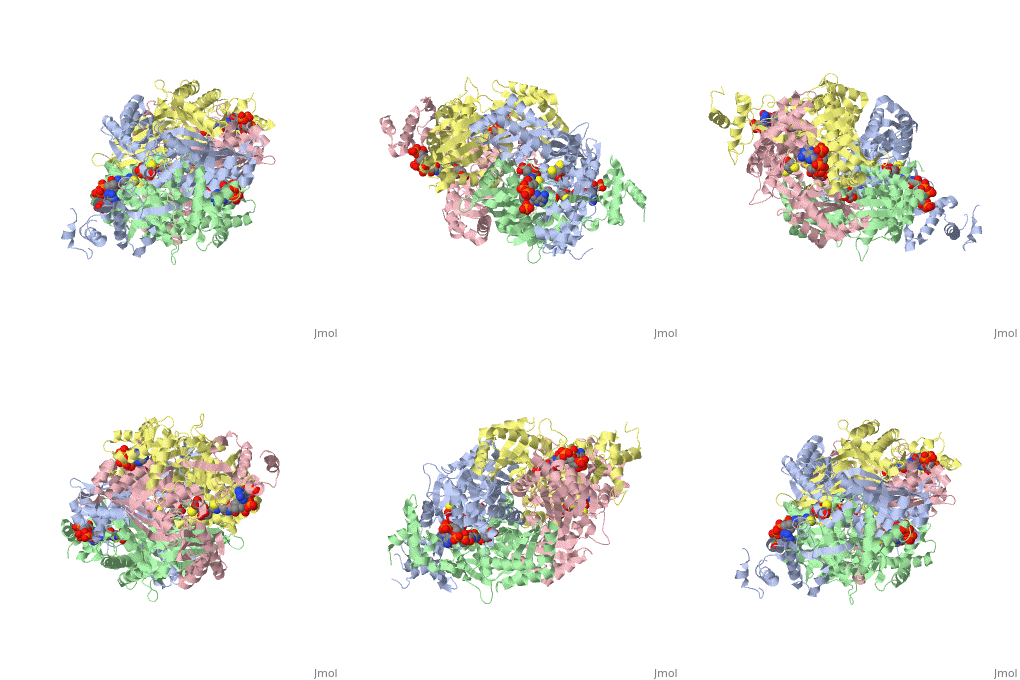
| - | + | <StructureSection load='1dq8' size='500' side='right' caption='Structure of HMG-CoA reductase (PDB entry [[1hpl]])' scene=''> | |
| - | + | ||
| - | + | ||
| - | Trypsin was first named by Kuhne in 1876, when discovered trypsin differed from pepsin in its proteolytic activity at different optimal pHs. The optimal pH for trypsin is 7.5-8.5. In 1974, trypsin's three dimensional strucutre was determined, and in the late 1980s and early 1990s, site-directed mutagenesis was performed on recombinant trypsin to determine the role of specific amino acids<ref>[Trypsin. 2010. 30 Oct. 2010. http://www.worthington-biochem.com/try/default.html]</ref>. | ||
| - | ==Structure== | ||
| - | Trypsin's primary structure is a polypeptide chain of amino acids. These amino acids interact with each other mostly through hydrogen bonding to form trypsin's secondary structural units. Trypsin has many important <scene name='Sandbox_50/Secondarystructure/1'>secondary structural elements</scene>, including two alpha helices (blue), an anti-parallel beta sheet (green), and random coils (gray). The arrows on these elements point toward the carboxy terminus of the protein. These secondary structures interact together to form the fully folded, native trypsin. | ||
| - | ===Polar and Nonpolar Residues=== | ||
| - | Trypsin's distribution of <scene name='Sandbox_50/Nonpolarandpolar/1'>polar and nonpolar residues</scene> follow the rules of the hydrophobic effect. The nonpolar (gray) residues are located on the interior of the protein so they can be shielded from water, while the polar (purple) residues are distributed on the exterior of the protein because they can interact with water. This <scene name='Sandbox_50/Nonpolarandpolarspacefilled/1'>spacefill</scene> model shows the distribution of the hydrophilic and hydrophobic residues and the actual space they occupy. Again the hydrophobic, nonpolar residues are shown in gray, and the hydrophilic, polar residues are purple. This type of residue distribution in trypsin is entropically favorable becuase the water surrounding the protein does not become ordered. In this figure the <scene name='Sandbox_50/Polarwater/1'>polar residue interaction with water</scene> can be seen. The puprle polar residues are the residues that are interacting with the red water molecules. | ||
| - | ==Attractions Between Structural Components and the Remainder of the Protein== | ||
| - | ===Disulfide Bonds=== | ||
| - | Trypsin contains three <scene name='Sandbox_50/Disulfidebonds/1'>disulfide bonds</scene> involving six cysteine residues. These disulfide bonds are intramolecular forces that stabalize the tertiary structure of Trypsin<ref>[Gorga, F. (2007, March 12). Disulfide bonds. http://webhost.bridgew.edu/fgorga/proteins/disulfide.htm]</ref> | ||
| - | . The figure shows the yellow disulfide bonds between the cysteine residues connecting two random coils, connecting one of the alpha helices to the beta sheet, and the other disulfide connecting the two alpha helices. | ||
| - | ===Residue Charge=== | ||
| - | This <scene name='Sandbox_50/Charged/1'>charge figure</scene> shows the different charges of the amino acid residues that make up Trypsin. The blue residues have cationic side chains, the red residues have anionic side chains, the light purple are the polar, uncharged residues, and the gray residues are hydrophobic. When compared to the spacefilled figure above, the direct correlation between polarity of the side chain and charge of the side chain can be seen. Those residues with charged (blue and red) side chains as well as the polar, uncharged residues are the residues on the exterior of the protein, while the hydrophobic residues remain at the protein's core. Those residues that are cationic and anionic are able to participate in salt bridges. | ||
| - | ==Ion Contacts== | ||
| - | Trypsin interacts with four <scene name='Sandbox_50/Ioncontact/2'>ions</scene>. The red and yellow atoms are the ions. The yellow atoms are sulfur and the red atoms are oxygen. | ||
| - | ==Catalytic Mechanism== | ||
| - | [[Image:Serine_protease_mechanism_by_snellios.png |thumb]] | ||
| - | ===Active Site=== | ||
| - | Trypsin's active site is composed of its catalytic triad, three amino acid residues that are crucial to the enzymes proteolytic function. The catalytic triad consists of Asp 102, His 57, and Ser 195<ref>[Department of Chemistry, University of Maine. The Serine Proteases. http://chemistry.umeche.maine.edu/CHY252/Peptidase3.html]</ref> | ||
| - | . Serine is the major player in the cleaveage of the peptide bond, thus the name serine protease. His 57 aids in the cleavage of the peptide bond through hydrogen bonds, and Asp 102 aids in the cleavage by electrostatically stabalizing the positively charged form of His 57 in the transition state. Ser 195 performs a nucleophilic attack on the substrate's peptide carbonyl. This causes the oxyanion hole to form. The formation of the oxyanion hole is stabalizing because the carbonyl oxygen that has accepted electrons during the nucleophilic attack fits nicely into this hole, and is stabalized by hydrogen bonds to the backbone NH groups of Gly 193 and Ser 195<ref>[Pratt, C.W., Voet, D., Voet, J.G. Fundamentals of Biochemistry - Life at the Molecular Level - Third Edition. Voet, Voet and Pratt, 2008.]</ref> | ||
| - | . A figure of the oxyanion hole can be seen in greater detail in the thumbnail on the left<ref>[Williams, Loren. Georgia Tech. http://ww2.chemistry.gatech.edu/~lw26/bCourse_Information/6521/protein/serine_protease/triad_1.html]</ref>. | ||
| - | + | <scene name='Sandbox_50/Hphobic_residues/1'>hydrophobic residues</scene> | |
| - | + | ||
| - | + | ||
| - | + | ||
| - | + | ||
| - | + | <scene name='Sandbox_50/Polar_residues/1'>Polar Residues</scene> | |
| - | + | <scene name='Sandbox_50/Nonpolar_residues/1'>Non-polar residues</scene> | |
| - | + | ||
| - | + | ||
| - | + | ||
| - | + | ||
| - | + | ||
| - | + | ||
| - | + | ||
| - | + | <scene name='Sandbox_50/Nonpolar_and_polar_combined/1'>Polar (purple) and nonpolar (green) residues</scene> | |
| - | = | + | |
| - | + | <scene name='Sandbox_50/Helix/1'>helix in purple</scene> | |
| - | + | </StructureSection> | |
| - | + | ||
| - | + | ||
| - | + | ||
| - | + | ||
| - | < | + | |
| - | < | + | |
| - | + | ||
Revision as of 01:46, 7 November 2011
| Please do NOT make changes to this Sandbox. Sandboxes 30-60 are reserved for use by Biochemistry 410 & 412 at Messiah College taught by Dr. Hannah Tims during Fall 2012 and Spring 2013. |
| |||||||||||