This old version of Proteopedia is provided for student assignments while the new version is undergoing repairs. Content and edits done in this old version of Proteopedia after March 1, 2026 will eventually be lost when it is retired in about June of 2026.
Apply for new accounts at the new Proteopedia. Your logins will work in both the old and new versions.
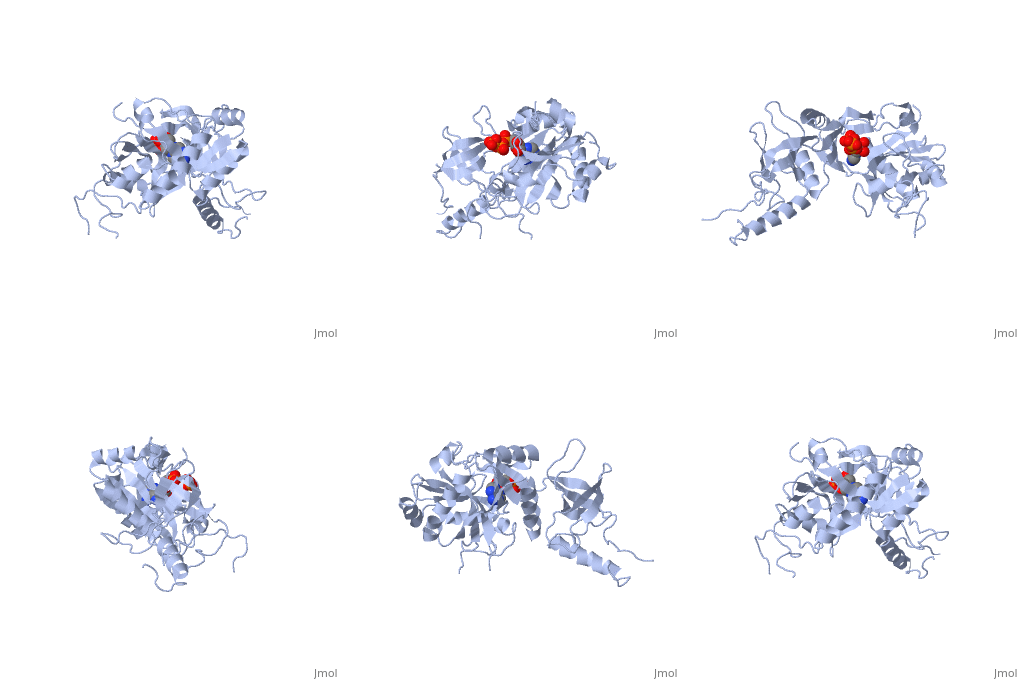
ATP-dependent DNA ligase from bacteriophage T7
From Proteopedia
(Difference between revisions)
| Line 3: | Line 3: | ||
==Overview (General Function)== | ==Overview (General Function)== | ||
| - | ATP-dependent DNA ligase from bacteriophage T7 (Caudovirales Podoviridae) is used to catalyze a phosphodiester bond between single-strand nicks in double-stranded DNA. This occurs in replication (connecting okazaki fragments)<ref name="Berg">Berg, Jeremy M, Stryer, Lubert, Tymoczko, John L. ''Biochemistry.'' Sixth edition. New York: W.H. Freeman and Company, 2007: 796. Print.</ref>, DNA repair (excision repair), and recombination. DNA ligases require either ATP (eukaryotes and viruses) or NAD+ (prokaryotes) as a cofactor. All ligases require a divalent cation for function. Bacteriophage T7 DNA ligase uses Magnesium in vivo. A range of pH 7.2-7.7 is ideal for enzymatic activity. T7 ligase has a molecular weight of 41 kDa<ref>PMID: 8653795</ref>. | + | ATP-dependent DNA ligase from bacteriophage T7 (Caudovirales Podoviridae<ref>McGrath S, van Sinderen D. Bacteriophage: ''Genetics and Molecular Biology.'' Norfolk: Caister Academic Press, 2007. Print.</ref>) is used to catalyze a phosphodiester bond between single-strand nicks in double-stranded DNA. This occurs in replication (connecting okazaki fragments)<ref name="Berg">Berg, Jeremy M, Stryer, Lubert, Tymoczko, John L. ''Biochemistry.'' Sixth edition. New York: W.H. Freeman and Company, 2007: 796. Print.</ref>, DNA repair (excision repair), and recombination. DNA ligases require either ATP (eukaryotes and viruses) or NAD+ (prokaryotes) as a cofactor. All ligases require a divalent cation for function. Bacteriophage T7 DNA ligase uses Magnesium in vivo. A range of pH 7.2-7.7 is ideal for enzymatic activity. T7 ligase has a molecular weight of 41 kDa<ref>PMID: 8653795</ref>. |
Revision as of 03:38, 7 November 2013
ATP-DEPENDENT DNA LIGASE FROM BACTERIOPHAGE T7
| |||||||||||
References
- ↑ McGrath S, van Sinderen D. Bacteriophage: Genetics and Molecular Biology. Norfolk: Caister Academic Press, 2007. Print.
- ↑ Berg, Jeremy M, Stryer, Lubert, Tymoczko, John L. Biochemistry. Sixth edition. New York: W.H. Freeman and Company, 2007: 796. Print.
- ↑ Subramanya HS, Doherty AJ, Ashford SR, Wigley DB. Crystal structure of an ATP-dependent DNA ligase from bacteriophage T7. Cell. 1996 May 17;85(4):607-15. PMID:8653795
- ↑ Doherty AJ, Ashford SR, Subramanya HS, Wigley DB. Bacteriophage T7 DNA ligase. Overexpression, purification, crystallization, and characterization. J Biol Chem. 1996 May 10;271(19):11083-9. PMID:8626651
Proteopedia Page Contributors and Editors (what is this?)
William Guthrie, Hunter Douglas, Jeremy A. Hammett, Jaime Prilusky
