This old version of Proteopedia is provided for student assignments while the new version is undergoing repairs. Content and edits done in this old version of Proteopedia after March 1, 2026 will eventually be lost when it is retired in about June of 2026.
Apply for new accounts at the new Proteopedia. Your logins will work in both the old and new versions.
Aminopeptidase
From Proteopedia
| Line 1: | Line 1: | ||
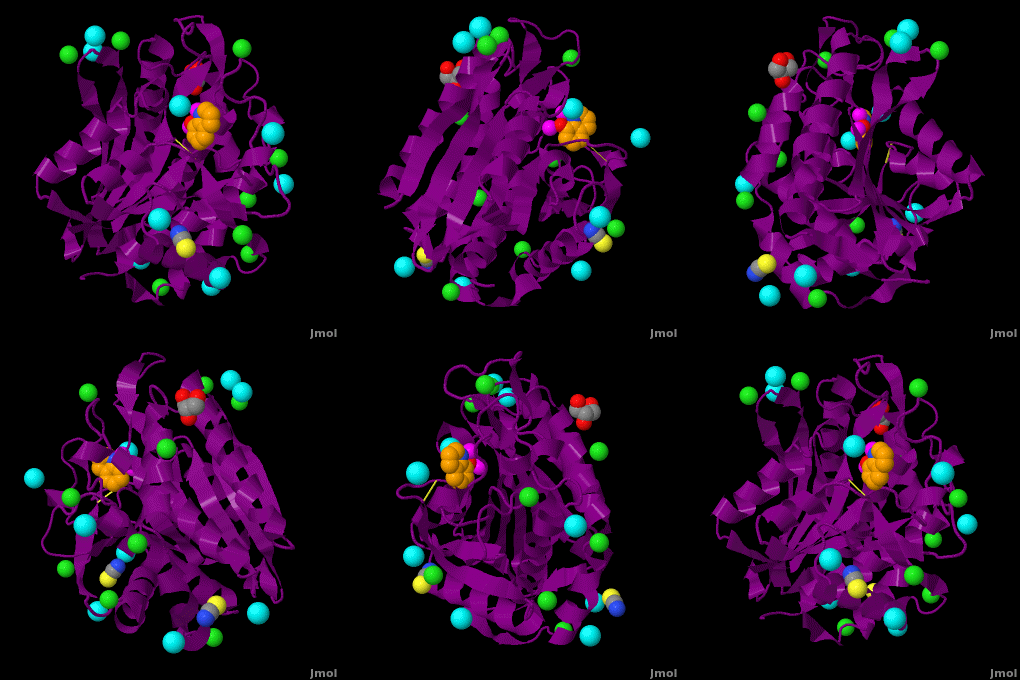
<StructureSection load='VH9.pdb' size='450' side='right' scene='Journal:JBIC:15/Cv/1' caption='Bacterial leucine aminopeptidase complex with 8-hydroxyquinoline, glycerol, SCN, Zn+2 (magenta), Na+ (cyan) and Cl- (green) ions (PDB code [[3vh9]])'>[[Aminopeptidase|Aminopeptidases]] (AP) ([[EC]] 3) are metal - mostly Zn-dependent enzymes involved in the digestion of proteins. Cytosol AP (Cyt-AP), deblocking AP (DAP) and AP N (APN) remove N-terminal amino acids. The AP are classified by the amino acid which they hydrolyze. Other types of AP are: Cold-activated AP (Col-AP), Heat stable AP from ''Thermus thermophilus'' (AmpT), AP from ''Staphylococcus aureus'' (AmpS) and SGAP from ''Stereomyces griseus''. Aminopeptidases catalyze a release of an N-terminal amino acid from a peptide, amide, or arylamide. See details of SGAP in [[Streptomyces griseus Aminopeptidase (SGAP)]]. Beta-peptidyl AP (BapA) cleaves N-terminal β-homoamino acid from peptides of length 2 to 6. | <StructureSection load='VH9.pdb' size='450' side='right' scene='Journal:JBIC:15/Cv/1' caption='Bacterial leucine aminopeptidase complex with 8-hydroxyquinoline, glycerol, SCN, Zn+2 (magenta), Na+ (cyan) and Cl- (green) ions (PDB code [[3vh9]])'>[[Aminopeptidase|Aminopeptidases]] (AP) ([[EC]] 3) are metal - mostly Zn-dependent enzymes involved in the digestion of proteins. Cytosol AP (Cyt-AP), deblocking AP (DAP) and AP N (APN) remove N-terminal amino acids. The AP are classified by the amino acid which they hydrolyze. Other types of AP are: Cold-activated AP (Col-AP), Heat stable AP from ''Thermus thermophilus'' (AmpT), AP from ''Staphylococcus aureus'' (AmpS) and SGAP from ''Stereomyces griseus''. Aminopeptidases catalyze a release of an N-terminal amino acid from a peptide, amide, or arylamide. See details of SGAP in [[Streptomyces griseus Aminopeptidase (SGAP)]]. Beta-peptidyl AP (BapA) cleaves N-terminal β-homoamino acid from peptides of length 2 to 6. | ||
| - | + | ||
== Aminopeptidase from ''Aeromonas proteolytica''<ref>DOI 10.1007/s00775-012-0873-4</ref> == | == Aminopeptidase from ''Aeromonas proteolytica''<ref>DOI 10.1007/s00775-012-0873-4</ref> == | ||
| - | |||
The selective inhibition of an <scene name='Journal:JBIC:15/Cv/2'>aminopeptidase from Aeromonas proteolytica (AAP)</scene>, a <scene name='Journal:JBIC:15/Cv/3'>dinuclear Zn2+</scene> hydrolase, by <scene name='Journal:JBIC:15/Cv/10'>8-quinolinol (8-hydroxyquinoline, 8-HQ)</scene> derivatives is reported. Based on our findings about 8-HQ-based Zn<sup>2+</sup> fluorophores, it was hypothesized that 8-HQ derivatives have the potential to function as specific inhibitors of Zn<sup>2+</sup> enzymes, especially dinuclear Zn<sup>2+</sup> hydrolases. Inhibitory assays of 8-HQ derivatives against AAP disclosed that the 8-HQ and 5-substituted 8-HQ′s are competitive inhibitors for AAP with inhibition constants (''K''i) of 0.16—29 μM at pH 8.0. <scene name='Journal:JBIC:15/Cv/11'>X-ray crystal structure analysis of an AAP with 8-HQ complex</scene> (1.3 Å resolution) as well as fluorescence titrations of these drugs with AAP confirmed that <scene name='Journal:JBIC:15/Cv/13'>8-hydroxyquinoline binds to AAP in the 'Pyr-out' mode</scene>, in which the <scene name='Journal:JBIC:15/Cv/15'>hydroxide anion of 8-HQ bridges two Zn2+ (Zn1 and Zn2)</scene> in the active site of AAP and the <scene name='Journal:JBIC:15/Cv/17'>nitrogen atom of 8-HQ coordinates to Zn1</scene> (PDB code: [[3vh9]]). <scene name='Journal:JBIC:15/Cv/18'>Overlap of active site</scene> of <span style="color:lime;background-color:black;font-weight:bold;">free AAP (colored green)</span> containing Zn<sup>2+</sup>-bound <font color='red'><b>water molecule (H2O or OH-; red sphere)</b></font> ([[1rtq]]) bridging two Zn<sup>2+</sup> and <font color='darkmagenta'><b>AAP–8-HQ complex (darkmagenta,</b></font> [[3vh9]]). <font color='magenta'><b>Two Zn<sup>2+</sup> are depicted as magenta spheres</b></font>. | The selective inhibition of an <scene name='Journal:JBIC:15/Cv/2'>aminopeptidase from Aeromonas proteolytica (AAP)</scene>, a <scene name='Journal:JBIC:15/Cv/3'>dinuclear Zn2+</scene> hydrolase, by <scene name='Journal:JBIC:15/Cv/10'>8-quinolinol (8-hydroxyquinoline, 8-HQ)</scene> derivatives is reported. Based on our findings about 8-HQ-based Zn<sup>2+</sup> fluorophores, it was hypothesized that 8-HQ derivatives have the potential to function as specific inhibitors of Zn<sup>2+</sup> enzymes, especially dinuclear Zn<sup>2+</sup> hydrolases. Inhibitory assays of 8-HQ derivatives against AAP disclosed that the 8-HQ and 5-substituted 8-HQ′s are competitive inhibitors for AAP with inhibition constants (''K''i) of 0.16—29 μM at pH 8.0. <scene name='Journal:JBIC:15/Cv/11'>X-ray crystal structure analysis of an AAP with 8-HQ complex</scene> (1.3 Å resolution) as well as fluorescence titrations of these drugs with AAP confirmed that <scene name='Journal:JBIC:15/Cv/13'>8-hydroxyquinoline binds to AAP in the 'Pyr-out' mode</scene>, in which the <scene name='Journal:JBIC:15/Cv/15'>hydroxide anion of 8-HQ bridges two Zn2+ (Zn1 and Zn2)</scene> in the active site of AAP and the <scene name='Journal:JBIC:15/Cv/17'>nitrogen atom of 8-HQ coordinates to Zn1</scene> (PDB code: [[3vh9]]). <scene name='Journal:JBIC:15/Cv/18'>Overlap of active site</scene> of <span style="color:lime;background-color:black;font-weight:bold;">free AAP (colored green)</span> containing Zn<sup>2+</sup>-bound <font color='red'><b>water molecule (H2O or OH-; red sphere)</b></font> ([[1rtq]]) bridging two Zn<sup>2+</sup> and <font color='darkmagenta'><b>AAP–8-HQ complex (darkmagenta,</b></font> [[3vh9]]). <font color='magenta'><b>Two Zn<sup>2+</sup> are depicted as magenta spheres</b></font>. | ||
| - | |||
{{Clear}} | {{Clear}} | ||
== ''S. griseus'' aminopeptidase == | == ''S. griseus'' aminopeptidase == | ||
| - | |||
''S. griseus'' aminopeptidase (SGAP) cleaves the N-terminal amino acid from a peptide or protein, and is specific for larger hydrophobic acids, especially leucine. No cleavage occurs if the next residue is proline.<br/> | ''S. griseus'' aminopeptidase (SGAP) cleaves the N-terminal amino acid from a peptide or protein, and is specific for larger hydrophobic acids, especially leucine. No cleavage occurs if the next residue is proline.<br/> | ||
| - | |||
The <scene name='Aminopeptidase/Active_site/1'>active site</scene> of the enzyme contains two Zn2+ ions with His85 and Asp160 as ligands for one ion, and Glu132 and His247 as ligands for the second ion. Asp97 is a common ligand to both ions. What appears to be a phosphate anion is bound to both zinc atoms, replacing the water molecule/hydroxide ion normally found in this class of enzyme. See details of SGAP in [[Streptomyces griseus Aminopeptidase (SGAP)]]. | The <scene name='Aminopeptidase/Active_site/1'>active site</scene> of the enzyme contains two Zn2+ ions with His85 and Asp160 as ligands for one ion, and Glu132 and His247 as ligands for the second ion. Asp97 is a common ligand to both ions. What appears to be a phosphate anion is bound to both zinc atoms, replacing the water molecule/hydroxide ion normally found in this class of enzyme. See details of SGAP in [[Streptomyces griseus Aminopeptidase (SGAP)]]. | ||
</StructureSection> | </StructureSection> | ||
| - | + | ||
== 3D Structures of Aminopeptidase == | == 3D Structures of Aminopeptidase == | ||
Revision as of 09:12, 14 August 2014
| |||||||||||
3D Structures of Aminopeptidase
Updated on 14-August-2014
Cysteine aminopeptidase
3pw3 – PdCys-AP – Parabacteroides distasonis
Glutamic acid aminopeptidase
2wyr – PhGlu-AP+Co – Pyrococcus horikoshii
3kl9 – SpGlu-AP – Streptococcus pneumoniae
4kx7 – hGlu-AP + Zn – human
4kx8, 4kxb – hGlu-AP + Zn + statin derivative
4kx9, 4kxa, 4kxc, 4kxd – hGlu-AP + Zn + amino acid
Alanine aminopeptidase
3ebg – PfAla-AP - Plasmodium falciparum
3ebh - PfAla-AP+bestatin
3ebi - PfAla-AP+dipeptide analog
4fke – pAla-AP + Zn – pig
4fkh – pAla-AP + Zn + alanine
4h5h, 4hol, 4naq, 4nz8 – pAla-AP + Zn + polyalanine
4hom – pAla-AP + Zn + substance P
4fkk – pAla-AP + Zn + bestatin
4f5c – pAla-AP + PRCV spike protein + Zn
4fyq - hAla-AP + Zn
4fyr - hAla-AP + Zn + bestatin
4fys - hAla-AP + Zn + angiotensin
4fyt - hAla-AP + Zn + amastatin
3ked – EcAPN+2,4-diaminobutyric acid – Escherichia coli
2hpo, 2dq6, 3puu – EcAPN
2hpt, 2dqm – EcAPN+bestatin
2zxg – EcAPN+transition state analog
3b2p, 3b2x, 3b34, 3b37, 3b3b, 3qjx – EcAPN+amino acid
2gtq – APN – Neisseria meningitides
Proline aminopeptidase
3ovk – Xaa Pro-AP – Streptococcus pyogenes
3il0 - Xaa Pro-AP – Streptococcus thermophilus
2v3x, 2v3y, 2v3z - Xaa EcPro-AP (mutant)+tripeptide
1w7v, 2bh3 - Xaa EcPro-AP+Zn+Mg+polypeptide
2bn7 - Xaa EcPro-AP+Zn+Mg+Mn+polypeptide
2bha, 2bhd - Xaa EcPro-AP+Mg+polypeptide
1a16 - Xaa EcPro-AP+Mn+polypeptide
1wbq, 2bhb - Xaa EcPro-AP+Zn+Mg
2bhc - Xaa EcPro-AP+Na+Mg
1wl6 - Xaa EcPro-AP+Mg
1wl9, 1m35, 1jaw - Xaa EcPro-AP+Mn
1wlr - Xaa EcPro-AP
2bws, 2bwt, 2bwu, 2bwv, 2bww, 2bwx, 2bwy - Xaa EcPro-AP (mutant)
1w2m - Xaa EcPro-AP+Ca
1n51 – Xaa EcPro-AP+apstatin
3ig4 - Xaa Pro-AP+ Mn – Bacillus anthracis
4fkc – Xaa Pro-AP + Cd – Thermococcus sibiricus
2zsg – X TmPro-AP – Thermatoga maritima
3ctz – X hPro-AP
1x2b, 1x2e, 1wm1 – SmPro-AP + inhibitor – Serratia marcescens
1qtr – SmPro-AP
1xqv – TaPro-AP (mutant) – Thermoplasma acidophilum
1xqw, 1xqx, 1xqy, 1xrl, 1xrm, 1xrn, 1xro, 1xrp, 1xrq, 1xrr – TaPro-AP+polypeptide
3azo – SmPro-AP – Streptomyces morookaensis
3azp - SmPro-AP (mutant)
3azq - SmPro-AP (mutant) + PGG
1lns – Pro-dipeptidyl-AP – Lactococcus lactis
2z3w – PgPro-tripeptidyl-AP (mutant) – Porphyromonas gingivalis
2z3z – PgPro-tripeptidyl-AP (mutant) + inhibitor
Leucine aminopeptidase
3jru – Leu-AP – Xanthomonas oryzae
2hc9, 2hb6 – Leu-AP – Caenorhabditis elegans
2ewb – bLeu-AP+zofenoprilat – bovine
1lam, 1lap – bLue-AP
1bpm, 1bpn – bLue-AP+Zn+Mg
2j9a - bLue-AP+Zn + inhibitor
1lan, 1lcp – bLue-AP+leucine derivative
1bll – bLue-AP+amastatin
2xdt, 2yd0 – hLeu-AP soluble domain
3rjo - hLeu-AP peptide-binding domain
3mdj - hLeu-AP soluble domain + inhibitor
3h8e, 3h8f, 3h8g – Leu-AP – Pseudomonas putida
3kqx, 3kqz, 3kr4, 3kr5 – PfLeu-AP
3fh4, 1rtq, 2dea – VpLeu-AP – Vibrio proteolyticus
3b35, 3b3t, 3b3v, 2anp - VpLeu-AP (mutant)
3b3c, 3b3s, 3b3w - VpLeu-AP (mutant)+Leu derivative
3b7i - VpLeu-AP (mutant)+Leu
1ft7 - VpLeu-AP +Leu derivative
3vh9 - VpLeu-AP + 8-quinolinol
2nyq, 2iq6 – VpLeu-AP+polypeptide
1lok – VpLeu-AP+Tris
2prq – VpLeu-AP+Co
1xry, 1txr – VpLeu-AP+bestatin
1gyt – EcLeu-AP
3qnf – hLeu-AP 1
3t8w, 4k3n – PfLeu-AP + Zn + inhibitor – Plasmodium falciparum
3tc8 - PdLeu-AP + Zn
4fuu - Leu-AP + Zn – Bacterioides thetaiotaomicron
4ksi – Leu-AP + Mg – tomato
Methionine aminopeptidase
3mr1, 3mx6 – Met-AP+Mn – Rickettsia prowazekii
2dfi, 1xgm, 1xgn, 1xgo, 1xgs – PfMet-AP+Co – Pyrococcus furiosus
1wkm - PfMet-AP+Mn
4fo7 - PaMet-AP+Mn – Pseudomonas aeruginosa
4fo8 - PaMet-AP+Mn + Met
4hxx, 4iu6 - hMet-AP+ Co + pyrimidine derivative
3iu7 – MtMet-AP+Mn +A02 – Mycobacterium tuberculosis
3iu8, 3iu9 - MtMet-AP+Ni + inhibitor
1yj3, 3ror - MtMet-AP+Co
3pka - MtMet-AP+Mn
3pkb, 3pkc, 3pkd, 3pke - MtMet-AP+bengamide inhibitor
3tav – Met-AP + Mg – Mycobacterium abscessus< br />
1y1n - MtMet-AP+K
4idy, 4iec - MtMet-AP+K + hydroxyethyl disulfide
4if7 - MtMet-AP+K + homocysteinemethyl disulfide
3fm3 – EncMet-AP – Encephalitozoon cuniculi
3fmq, 3fmr - EncMet-AP+angiogenesis inhibitor
3d27, 2q92, 2q93, 2q94, 2q95, 2q96, 2p98, 2p99, 2p9a, 2gu4, 2gu5, 2gu6, 2evc, 2evm, 2evo, 2bbv, 1xnz, 4a6v, 4a6w, 2bb7 – EcMet-AP+Mn+inhibitor
2gg0, 2gg2, 2gg3, 2gg5, 2gg7, 2gg8, 2gg9, 2ggb, 2ggc - EcMet-AP+Co+inhibitor
1c21, 1c22, 1c23, 1c24 - EcMet-AP +Co + methionine derivative
1c27 - EcMet-AP +Co +norleucine
3tb5 – Met-AP – Enterococcus faecalis
2ea2, 2ea4, 2ga2, 2nq6, 2nq7, 1yw7, 1yw8, 1yw9 - hMet-AP+Mn+inhibitor
2gtx, 2gu7 – EcMet-AP
1yvm – EcMet-AP (mutant)+Co+thiabendazole
1mat – EcMet-AP+Co
2mat, 4mat - EcMet-AP (mutant)+Co
3mat - EcMet-AP (mutant)+Co+bestatin derivative
2b3h, 2b3k - hMet-AP+Co
1boa - hMet-AP+Co+ angiogenesis inhibitor
2b3l – hMet-AP
1kq0, 1kq9 – hMet-AP+methionine
2gz5, 2adu, 1qzy, 1b59, 1b6a, 1bn5, 2oaz, 4ikr, 4iks, 4ikt, 4iku – hMet-AP+Co+inhibitor
1r58, 1r5g, 1r5h, 4fli, 4flj, 4flk, 4fll - hMet-AP+Mn+inhibitor
2g6p - hMet-AP truncated+Mn+inhibitor
1qxw, 1qxy, 1qxz – Met-AP+Co+inhibitor - Staphylococcus aureus
1o0x – TmMet-AP
3s6b – PfMet-AP + Fe
4fuk – TbMet-AP + Zn – Trypanosoma brucei
4km3 – SpAP
Arginine aminopeptidase
4jbs – hArg-AP+ Zn + inhibitor
Aspartic acid aminopeptidase
3l6s, 4dyo – hAsp-AP+aspartic hydroxamate
3var, 3vat – bAsp-AP
4eme – PfAsp-AP + Zn
Asparagine aminopeptidase
3c17, 2zak – EcAsn-AP (mutant)
2zal – EcAsn-AP+Asp
2gez – Asn-AP – Lupinus luteus
Serine aminopeptidase
1b65 – OaSer-AP – Ochrobactrum anthropi
Cytosolic aminopeptidase
3pei – Cyt-AP – Francisella tularensis
3kzw – Cyt-AP – Staphylococcus aureus
3ij3 – Cyt-AP – Coxiella burnetii
Aminopeptidase 2
Non-specific aminopeptidase
2ek8 – AnAP – Aneurinibacillus
2ek9 – AnAP+bestatin
1y0r, 1xfo – PhAP
1y0y – PhAP+amastatin
1amp - VpAP
1cp6, 1igb – VpAP+inhibitor
1ei5 – OaAP
3edy, 3ee6 – hTripeptidyl-AP
3zn8 – Dipeptidyl-AP B + signal recognition particle protein + signal recognition particle receptor + RNA – yeast
4efd – TbAP M17 + Mn
4fgm – AP N + Zn – Idiomarina loihiensis
4icq – SpAP Peps + Zn
4icr – SpAP Peps (mutant) + Zn
4ics – SpAP Peps (mutant) + Zn + Trp + Gly
Cold-activated aminopeptidase
3cia – Col-AP – Colwellia psychrerythraea
Deblocking aminopeptidase
2gre – DAP – Bacillus cereus
Heat stable aminopeptidase
2ayi – AmpT – Thermus thermophilus
Aminopeptidase from Staphylococcus aureus
1zjc - AmpS
Metalloaminopeptidase
3q43, 3q44 – PfPFAP (mutant) + bestatin derivative
Stereomyces griesus aminopeptidase
1xjo, 1cp7 - SGAP
1qq9, 1f2o, 1f2p, 1tf8, 1tf9, 1tkf, 1tkh, 1tkj, 1xbu - SGAP + amino acid
β-peptidyl AP
3n2w – SxBapA – Sphingosinicella xenopeptidilytica
3n5i – SxBapA (mutant)
3n33 – SxBapA + AEBSF
3ndv, 3nfb – SxBapA + ampicillin
M1 family AP
4j3b – PfAP (mutant)
3t8v – PfAP M1
4k5l, 4k5m, 4k5n, 4k5p, 4k5o - PfLeu-AP (mutant) + Zn + inhibitor
AP C
4k7c – AP – Lactobacillus rahmnosis
Additional Resources
For additional information, see:
Amino Acid Synthesis & Metabolism
Streptomyces griseus Aminopeptidase (SGAP)
References
- ↑ Hanaya K, Suetsugu M, Saijo S, Yamato I, Aoki S. Potent inhibition of dinuclear zinc(II) peptidase, an aminopeptidase from Aeromonas proteolytica, by 8-quinolinol derivatives: inhibitor design based on Zn(2+) fluorophores, kinetic, and X-ray crystallographic study. J Biol Inorg Chem. 2012 Feb 5. PMID:22311113 doi:10.1007/s00775-012-0873-4
Proteopedia Page Contributors and Editors (what is this?)
Michal Harel, Alexander Berchansky, David Canner, Joel L. Sussman, Eran Hodis
