This old version of Proteopedia is provided for student assignments while the new version is undergoing repairs. Content and edits done in this old version of Proteopedia after March 1, 2026 will eventually be lost when it is retired in about June of 2026.
Apply for new accounts at the new Proteopedia. Your logins will work in both the old and new versions.
Protein Kinase A
From Proteopedia
| Line 1: | Line 1: | ||
==Protein kinase A (PKA)== | ==Protein kinase A (PKA)== | ||
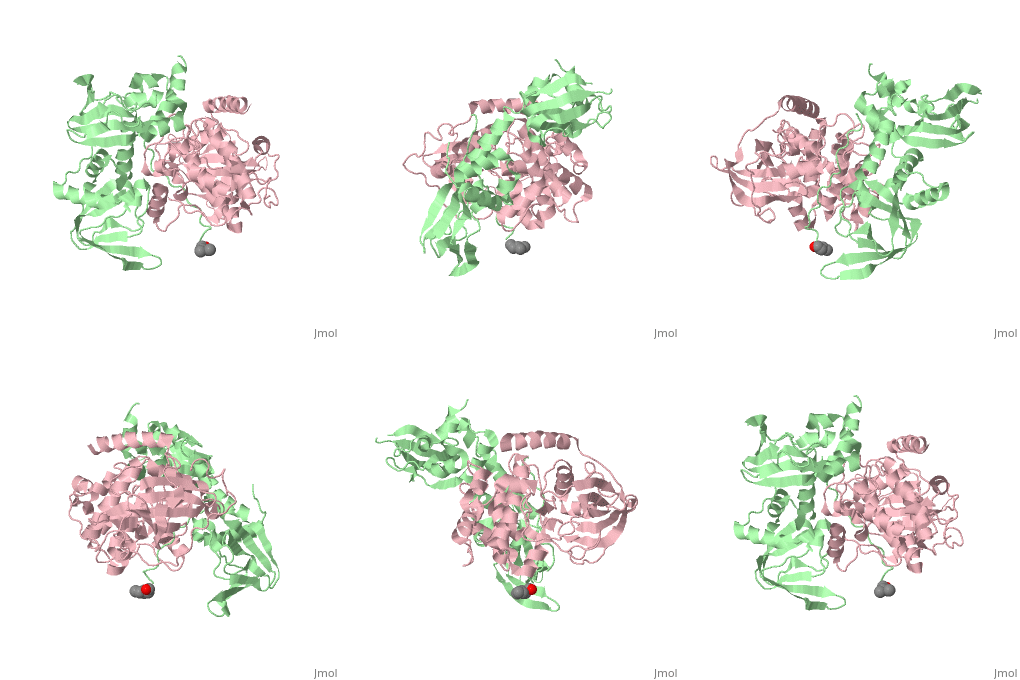
| - | <StructureSection load='3tnp' size='340' side='right' caption=' | + | <StructureSection load='3tnp' size='340' side='right' caption='Mouse protein kinase A (PKA) catalytic subunit (pink and cyan) and regulatory subunit (green and magenta) (PDB code [[3tnp]]).' scene=''> |
'''Protein kinase A (PKA)''' is a group of enzymes whose activity is dependent on the concentration of cAMP, and is also known as cAMP-dependent protein kinase. | '''Protein kinase A (PKA)''' is a group of enzymes whose activity is dependent on the concentration of cAMP, and is also known as cAMP-dependent protein kinase. | ||
| - | + | __TOC__ | |
== Function == | == Function == | ||
Protein kinase A phosphorylates specific serine or threonine residues, which activates or deactivates the protein. Depending on the cell type, different proteins are available for phosphorylation. When activated with cAMP, PKA catalyzes the breakdown of glycogen, inhibits the synthesis of glucose, and promotes the increase of heart rate.In the "flight or fight" response, muscles become ready for action as a result of the activity of PKA. Overall, this enzyme helps regulate glucose levels,glycogen levels, sugar levels, and lipid metabolism. | Protein kinase A phosphorylates specific serine or threonine residues, which activates or deactivates the protein. Depending on the cell type, different proteins are available for phosphorylation. When activated with cAMP, PKA catalyzes the breakdown of glycogen, inhibits the synthesis of glucose, and promotes the increase of heart rate.In the "flight or fight" response, muscles become ready for action as a result of the activity of PKA. Overall, this enzyme helps regulate glucose levels,glycogen levels, sugar levels, and lipid metabolism. | ||
Revision as of 07:22, 1 January 2015
Protein kinase A (PKA)
| |||||||||||
References
[1]Herraez A. Biomolecules in the computer: Jmol to the rescue. Biochem Mol Biol Educ. 2006 Jul;34(4):255-61. doi: 10.1002/bmb.2006.494034042644. PMID:21638687 doi:10.1002/bmb.2006.494034042644 [2]C. Kim, N.-H. Xuong, and S.S. Taylor, "Crystal structure of a complex between catalytic and regulatory (Rlα) subunits of PKA,"Science 307, 690 (2005) doi:10.2210/rcsb_pdb/mom_2012_8
