This old version of Proteopedia is provided for student assignments while the new version is undergoing repairs. Content and edits done in this old version of Proteopedia after March 1, 2026 will eventually be lost when it is retired in about June of 2026.
Apply for new accounts at the new Proteopedia. Your logins will work in both the old and new versions.
Paired box protein
From Proteopedia
(Difference between revisions)
| Line 5: | Line 5: | ||
'''Paired box protein''' (PAX) are transcription factors which contain paired box domain and a paired-type homeodomain (60 amino acid helix-turn-helix). | '''Paired box protein''' (PAX) are transcription factors which contain paired box domain and a paired-type homeodomain (60 amino acid helix-turn-helix). | ||
| - | • '''PAX-6''' contain 2 DNA-binding domains. It is a regulatory factor in eye and brain development. | + | • '''PAX-6''' contain 2 DNA-binding domains. It is a regulatory factor in eye and brain development. <br /> |
• '''PAX-5''' is associated with B-cell differentiation.<br /> | • '''PAX-5''' is associated with B-cell differentiation.<br /> | ||
| - | • '''PAX-3''' | + | • '''PAX-3''' regulates cell fate in C. elegans<ref>PMID:26953187</ref><br /> |
• '''PAX-8''' is associated with thyroid follicular cell development and expression of thyroid-specific genes.<br /> | • '''PAX-8''' is associated with thyroid follicular cell development and expression of thyroid-specific genes.<br /> | ||
== Disease == | == Disease == | ||
| + | Mutations in PAX-6 are associated with aniridia and Peter’s anomaly. Mutations in PAX-3 are associated with Waardenburg syndrome, craniofacial-deafness-hand syndrome and alveolar rhabdomyosarcoma. | ||
== Relevance == | == Relevance == | ||
Revision as of 07:14, 14 June 2016
| |||||||||||
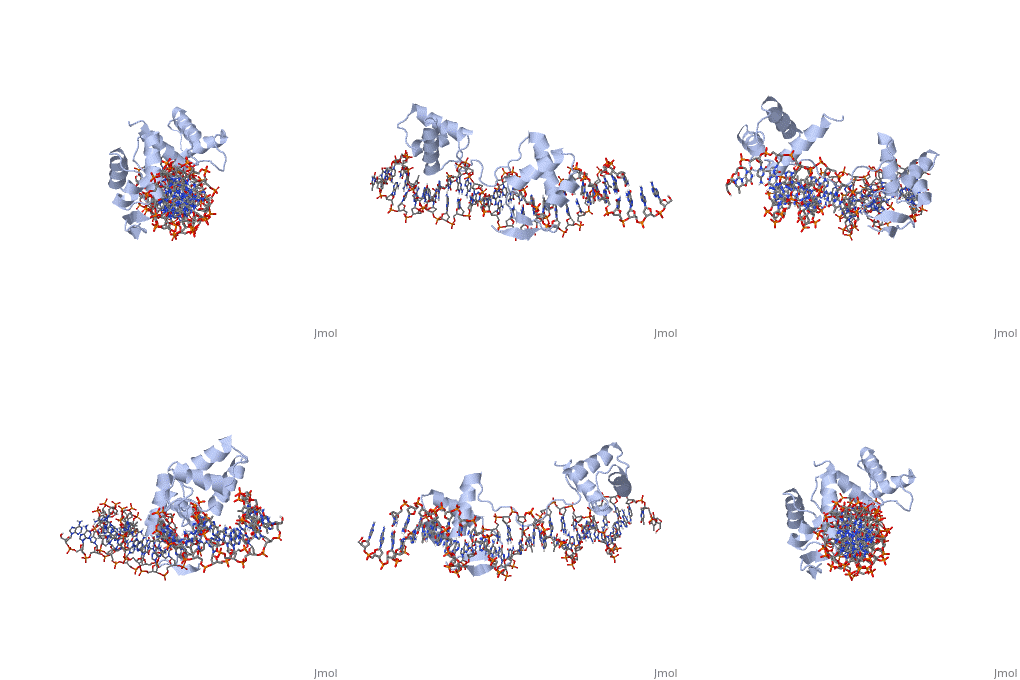
3D Structures of paired box protein
Updated on 14-June-2016
References
- ↑ Thompson KW, Joshi P, Dymond JS, Gorrepati L, Smith HE, Krause MW, Eisenmann DM. The Paired-box protein PAX-3 regulates the choice between lateral and ventral epidermal cell fates in C. elegans. Dev Biol. 2016 Apr 15;412(2):191-207. doi: 10.1016/j.ydbio.2016.03.002. Epub 2016, Mar 4. PMID:26953187 doi:http://dx.doi.org/10.1016/j.ydbio.2016.03.002
