This old version of Proteopedia is provided for student assignments while the new version is undergoing repairs. Content and edits done in this old version of Proteopedia after March 1, 2026 will eventually be lost when it is retired in about June of 2026.
Apply for new accounts at the new Proteopedia. Your logins will work in both the old and new versions.
Priyanka Basak/Sandbox
From Proteopedia
(Difference between revisions)
| Line 2: | Line 2: | ||
==Introduction== | ==Introduction== | ||
<StructureSection load='3tj8' size='340' side='right' caption='Caption for this structure' scene=''> | <StructureSection load='3tj8' size='340' side='right' caption='Caption for this structure' scene=''> | ||
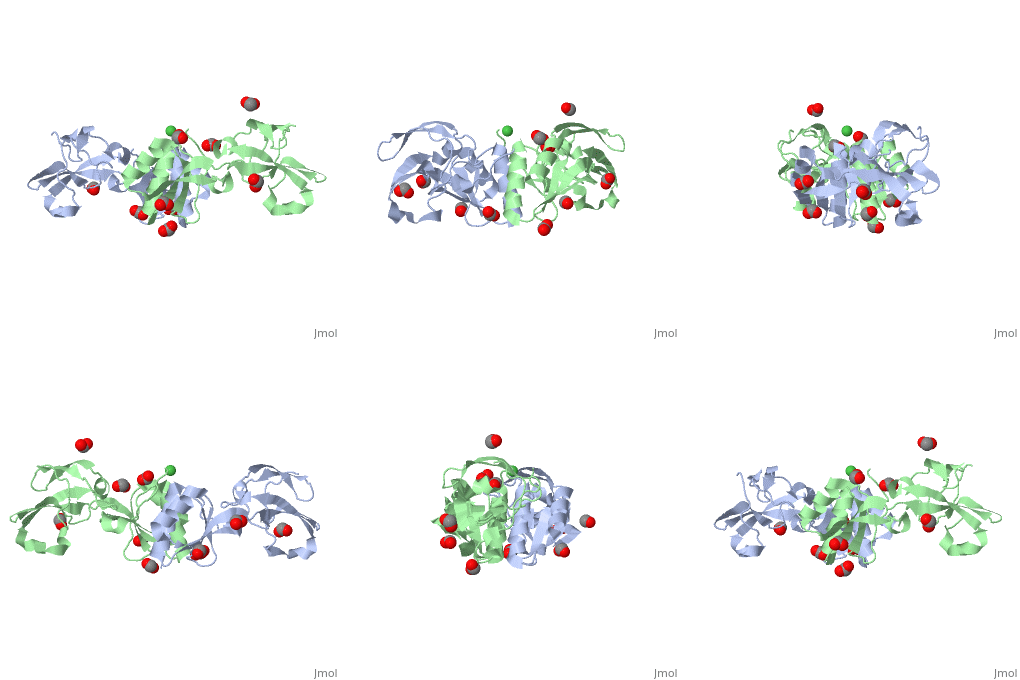
| - | ''Helicobacter pylori'' ('' | + | ''Helicobacter pylori'' (''H.pylori'') is a class I human pathogen that is involved in causing gastric ulcers and stomach cancers. Its two nickel dependent enzymes - Urease and NiFe-H2ase, provides it a unique ability to survive and colonize in acidic human stomach. Urease catalyzes the conversion of urea to ammonia and carbamate which neutralizes its local acidic environment. Several accessory proteins play a crucial role in the maturation of Urease. UreE is urease-specific Nickel metallochaperone that is involved in the delivery nickel to urease. |
== Function == | == Function == | ||
UreE delivers Nickel to urease. | UreE delivers Nickel to urease. | ||
| Line 10: | Line 10: | ||
== Structural highlights == | == Structural highlights == | ||
| + | Apo-UreE from ''H.pylori'' is a dimer which becomes tetrameric (dimer of dimer) when bound to metal and binds one Ni(II) per dimer. The nickel binding site is six-coordinate. | ||
== Headline text == | == Headline text == | ||
Revision as of 17:22, 2 December 2014
UreE: A Nickel Metallochaperone for Urease
Introduction
| |||||||||||
References
[http://]
