This old version of Proteopedia is provided for student assignments while the new version is undergoing repairs. Content and edits done in this old version of Proteopedia after March 1, 2026 will eventually be lost when it is retired in about June of 2026.
Apply for new accounts at the new Proteopedia. Your logins will work in both the old and new versions.
1cqj
From Proteopedia
(Difference between revisions)
| Line 8: | Line 8: | ||
<tr id='resources'><td class="sblockLbl"><b>Resources:</b></td><td class="sblockDat"><span class='plainlinks'>[http://oca.weizmann.ac.il/oca-docs/fgij/fg.htm?mol=1cqj FirstGlance], [http://oca.weizmann.ac.il/oca-bin/ocaids?id=1cqj OCA], [http://www.rcsb.org/pdb/explore.do?structureId=1cqj RCSB], [http://www.ebi.ac.uk/pdbsum/1cqj PDBsum]</span></td></tr> | <tr id='resources'><td class="sblockLbl"><b>Resources:</b></td><td class="sblockDat"><span class='plainlinks'>[http://oca.weizmann.ac.il/oca-docs/fgij/fg.htm?mol=1cqj FirstGlance], [http://oca.weizmann.ac.il/oca-bin/ocaids?id=1cqj OCA], [http://www.rcsb.org/pdb/explore.do?structureId=1cqj RCSB], [http://www.ebi.ac.uk/pdbsum/1cqj PDBsum]</span></td></tr> | ||
</table> | </table> | ||
| + | == Function == | ||
| + | [[http://www.uniprot.org/uniprot/SUCD_ECOLI SUCD_ECOLI]] During aerobic metabolism it functions in the citric acid cycle, coupling the hydrolysis of succinyl-CoA to the synthesis of ATP and thus represents an important site of substrate-level phosphorylation. It can also function in the other direction for anabolic purposes, and this may be particularly important for providing succinyl-CoA during anaerobic growth when the oxidative route from 2-oxoglutarate is severely repressed. The alpha-subunit binds CoA, as well as ATP and catalyzes phosphoryl transfer to one of its histidine residues. The complete active site is probably located in the region of alpha-beta contact. [[http://www.uniprot.org/uniprot/SUCC_ECOLI SUCC_ECOLI]] During aerobic metabolism it functions in the citric acid cycle, coupling the hydrolysis of succinyl-CoA to the synthesis of ATP and thus represents an important site of substrate-level phosphorylation. It can also function in the other direction for anabolic purposes, and this may be particularly important for providing succinyl-CoA during anaerobic growth when the oxidative route from 2-oxoglutarate is severely repressed. The beta-subunit contains the attachment sites for succinate. The complete active site is probably located in the region of alpha-beta contact. | ||
== Evolutionary Conservation == | == Evolutionary Conservation == | ||
[[Image:Consurf_key_small.gif|200px|right]] | [[Image:Consurf_key_small.gif|200px|right]] | ||
Revision as of 08:53, 25 December 2014
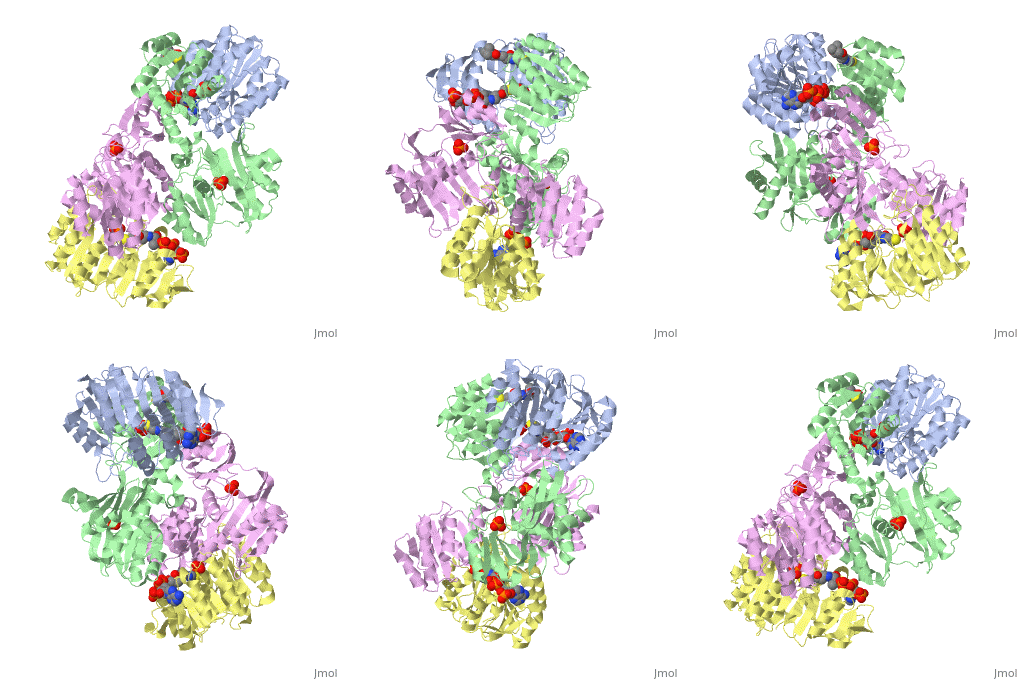
CRYSTAL STRUCTURE OF DEPHOSPHORYLATED E. COLI SUCCINYL-COA SYNTHETASE
| |||||||||||