This old version of Proteopedia is provided for student assignments while the new version is undergoing repairs. Content and edits done in this old version of Proteopedia after March 1, 2026 will eventually be lost when it is retired in about June of 2026.
Apply for new accounts at the new Proteopedia. Your logins will work in both the old and new versions.
Hepatocyte growth factor
From Proteopedia
(Difference between revisions)
| Line 1: | Line 1: | ||
<StructureSection load='1shy' size='350' side='right' caption='Structure of human HGF β chain (grey) complex with HGF receptor Sema and ψ domains (green) (PDB entry [[1shy]])' scene=''> | <StructureSection load='1shy' size='350' side='right' caption='Structure of human HGF β chain (grey) complex with HGF receptor Sema and ψ domains (green) (PDB entry [[1shy]])' scene=''> | ||
| + | == Function == | ||
| + | '''Hepatocyte growth factor''' (HGF) regulates cell growth, motility and morphogenesis. HGF binds to proto-oncogene c-Met receptor and activates a tyrosine kinase signaling cascade. HGF precursor is cleaved by serine protease to α (69 kD) and β (34 kD) chains which form a disulfide bond to produce the active heterodimer<ref>PMID:1838014</ref>. HGF α chain contains an N-terminal hairpin and 4 kringle domains. The kringle domain participates in protein-protein interaction and its structure is of a large loop which is stabilized by 3 Cys-Cys bonds. '''HGF NK1''' - a natural splice variant is comprised of residues 28-210 containing the N-terminus and the first kringle domain of HGF<ref>PMID:9488442</ref>. '''HGF NK2''' variant is comprised of residues 28-289 containing the N-terminus and the first 2 kringle domains of HGF. | ||
| - | + | == Relevance == | |
| + | High levels of HGF are associated with liver diseases<ref>PMID:7806142</ref>, lung diseases, acute cardiac infraction, vascular diseases, renal failure, neurologic diseases like Alzheimer Disease, pancreatic diseases, several types of cancer and diabetes type II<ref>PMID:19154948</ref><ref>PMID:7806142</ref>. HGF administration can reverse liver chirrosis<ref>PMID:12482615</ref>. | ||
</StructureSection> | </StructureSection> | ||
| Line 38: | Line 41: | ||
**[[4k3j]] – hHGF α (mutant) + β + antibody <br /> | **[[4k3j]] – hHGF α (mutant) + β + antibody <br /> | ||
| + | == References == | ||
| + | <references/> | ||
}} | }} | ||
[[Category:Topic Page]] | [[Category:Topic Page]] | ||
Revision as of 09:22, 21 March 2016
| |||||||||||
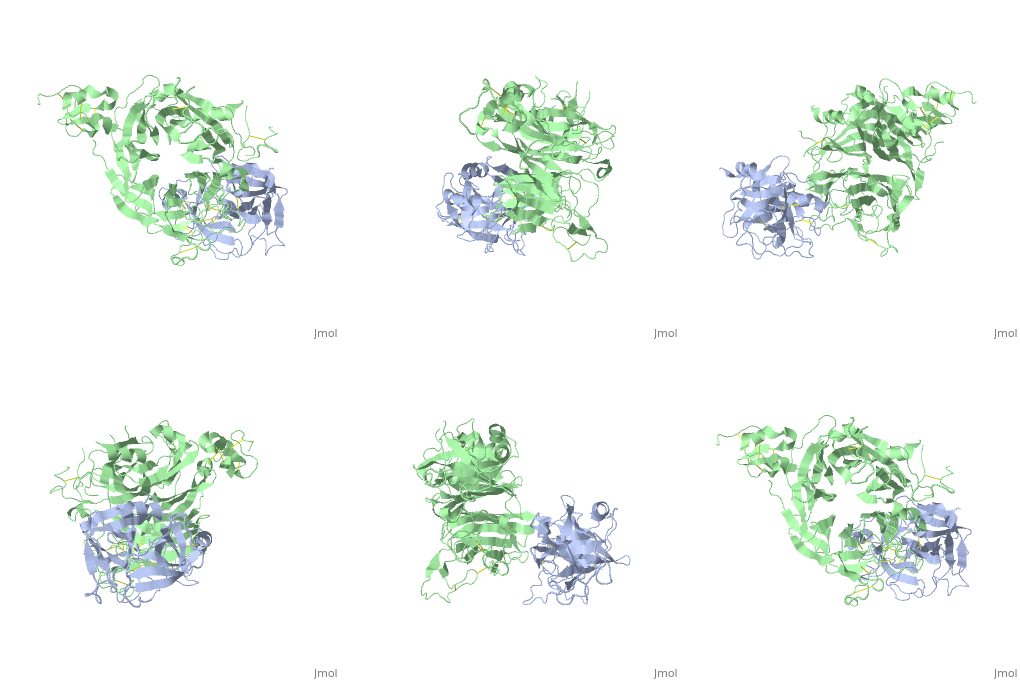
3D structures of hepatocyte growth factor
Updated on 21-March-2016
References
- ↑ Nakamura T. Structure and function of hepatocyte growth factor. Prog Growth Factor Res. 1991;3(1):67-85. PMID:1838014
- ↑ Jakubczak JL, LaRochelle WJ, Merlino G. NK1, a natural splice variant of hepatocyte growth factor/scatter factor, is a partial agonist in vivo. Mol Cell Biol. 1998 Mar;18(3):1275-83. PMID:9488442
- ↑ Shiota G, Okano J, Kawasaki H, Kawamoto T, Nakamura T. Serum hepatocyte growth factor levels in liver diseases: clinical implications. Hepatology. 1995 Jan;21(1):106-12. PMID:7806142
- ↑ Anan F, Masaki T, Yonemochi H, Takahashi N, Nakagawa M, Eshima N, Saikawa T, Yoshimatsu H. Hepatocyte growth factor levels are associated with the results of 123I-metaiodobenzylguanidine myocardial scintigraphy in patients with type 2 diabetes mellitus. Metabolism. 2009 Feb;58(2):167-73. doi: 10.1016/j.metabol.2008.09.009. PMID:19154948 doi:http://dx.doi.org/10.1016/j.metabol.2008.09.009
- ↑ Shiota G, Okano J, Kawasaki H, Kawamoto T, Nakamura T. Serum hepatocyte growth factor levels in liver diseases: clinical implications. Hepatology. 1995 Jan;21(1):106-12. PMID:7806142
- ↑ Funakoshi H, Nakamura T. Hepatocyte growth factor: from diagnosis to clinical applications. Clin Chim Acta. 2003 Jan;327(1-2):1-23. PMID:12482615
