We apologize for Proteopedia being slow to respond. For the past two years, a new implementation of Proteopedia has been being built. Soon, it will replace this 18-year old system. All existing content will be moved to the new system at a date that will be announced here.
Netrin receptor
From Proteopedia
(Difference between revisions)
| Line 1: | Line 1: | ||
<StructureSection load='4urt' size='340' side='right' caption='Glycosylated human netrin receptor DCC fibronectin type V-VI domains (green) complex with neutrin-1 (grey), sulfate, Ca+2 and Cl-1 ions (PDB code [[4urt]])' scene=''> | <StructureSection load='4urt' size='340' side='right' caption='Glycosylated human netrin receptor DCC fibronectin type V-VI domains (green) complex with neutrin-1 (grey), sulfate, Ca+2 and Cl-1 ions (PDB code [[4urt]])' scene=''> | ||
| - | '''Netrin receptors''' are cell surface proteins which bind netrins. Netrins direct cell and axon migration during development. Netrin attraction is mediated through DCC (Deleted in Colorectal Cancer) receptors while netrin repulsion is mediated through the UNC-5 receptor. | ||
| - | |||
== Function == | == Function == | ||
| + | '''Netrin receptors''' are cell surface proteins which bind netrins. Netrins direct cell and axon migration during development. Netrin attraction is mediated through '''DCC (Deleted in Colorectal Cancer) receptors''' while netrin repulsion is mediated through the '''UNC-5 receptor'''<ref>PMID:18269208</ref>. | ||
== Disease == | == Disease == | ||
| Line 9: | Line 8: | ||
== Structural highlights == | == Structural highlights == | ||
| + | Netrin DCC receptor extracellular domain contains 4 Ig repeats followed by 6 type III fibronectin repeats. Netrin UNC-5 receptor extracellular domain contains 2 Ig repeats followed by 2 type I thrombospondin repeats. | ||
</StructureSection> | </StructureSection> | ||
Revision as of 08:04, 8 May 2016
| |||||||||||
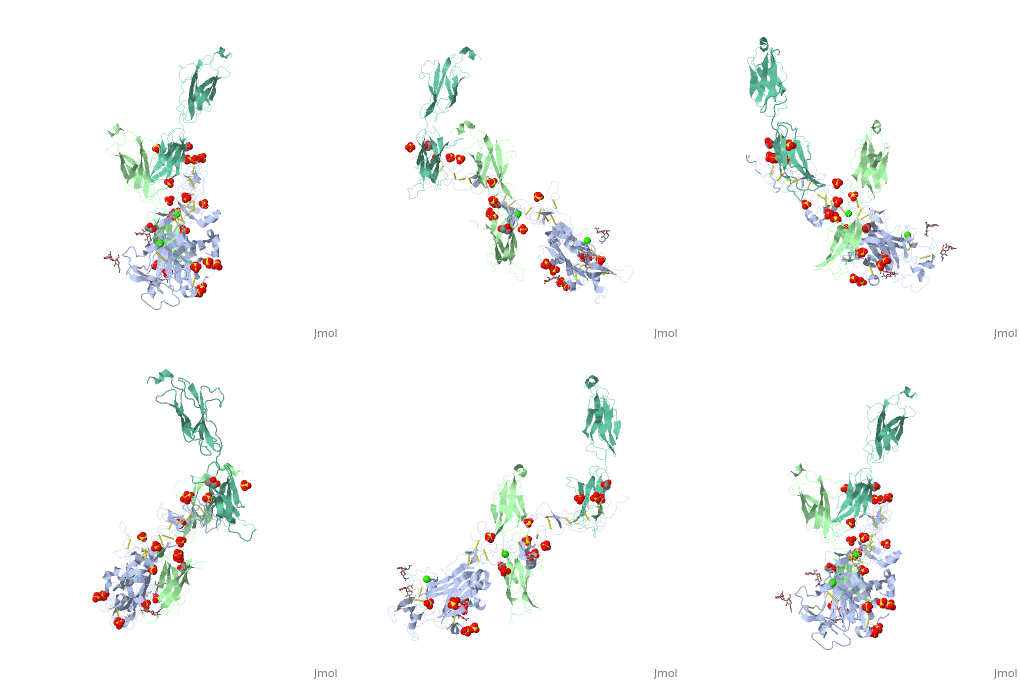
3D Structures of netrin receptor
Updated on 08-May-2016
References
- ↑ Moore SW, Tessier-Lavigne M, Kennedy TE. Netrins and their receptors. Adv Exp Med Biol. 2007;621:17-31. doi: 10.1007/978-0-387-76715-4_2. PMID:18269208 doi:http://dx.doi.org/10.1007/978-0-387-76715-4_2
