This old version of Proteopedia is provided for student assignments while the new version is undergoing repairs. Content and edits done in this old version of Proteopedia after March 1, 2026 will eventually be lost when it is retired in about June of 2026.
Apply for new accounts at the new Proteopedia. Your logins will work in both the old and new versions.
Cytochrome c 7
From Proteopedia
(Difference between revisions)
| Line 1: | Line 1: | ||
==General== | ==General== | ||
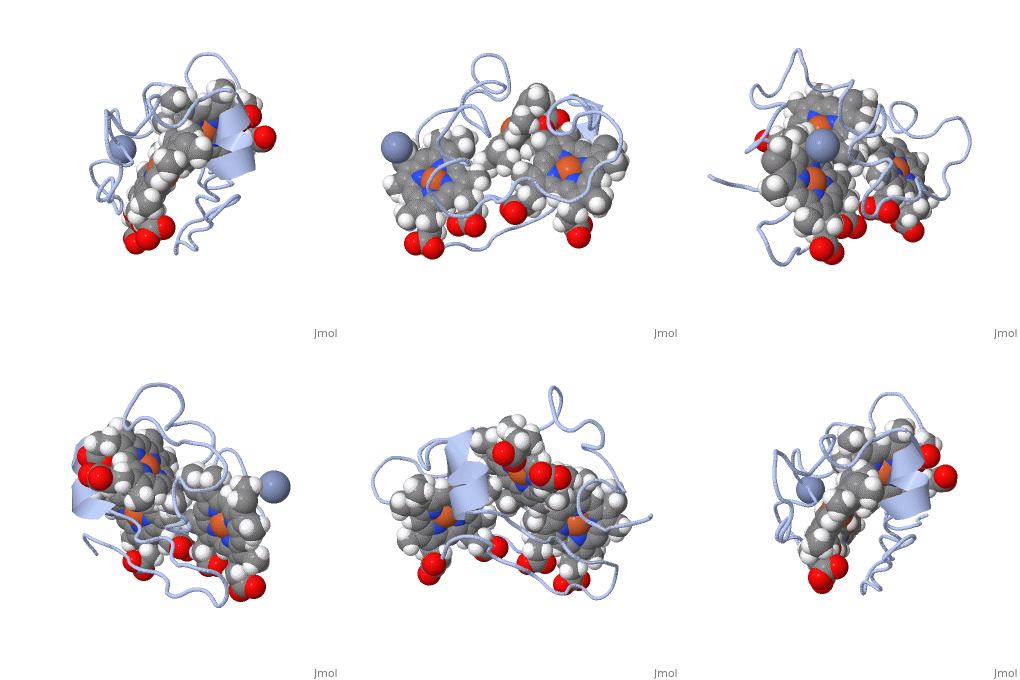
| - | <StructureSection load=' | + | <StructureSection load='1LM2.pdb' size='340' side='right' caption='3D Structure of Cytochrome c 7' scene=''> |
| - | Cytocrhome c 7 ( | + | '''Cytocrhome c 7''' (Cc7) is a three heme-containing protein derived from the sulfur-reducing bacterium ''Desulfuromonas acetoxidans''. Cc7 is located in the mitochondrial intermembrane space of the bacteria where it plays a role in the electron-transfer mechanism <ref>Assfalg M, Bertini I, Bruschi M, Michel C, Turano P. The metal reductase activity of some multiheme cytochromes c: NMR structural characterization of the reduction of chromium(VI) to chromium(III) by cytochrome c(7). 2002; 99(15):9750-4 '''[http://www.ncbi.nlm.nih.gov/pmc/articles/PMC125002/''' DOI: 10.1073/pnas.152290999''']'''</ref>. ''Desulfuromonas acetoxidans'' bacteria have evolved to obtain their energy from anaerobic sulfure respiration, thus requiring organic disulfide compounds as electron acceptors<ref>Pfennig N, Biebl H. Desulfuromonas acetoxidans gen. nov. and sp. nov., a new anaerobic, sulfur-reducing, acetate-oxidizing bacterium. 1976; 110(1): 3-12. DOI: 10.1007/BF00416962</ref>. |
==Structural Components== | ==Structural Components== | ||
== Function == | == Function == | ||
| - | As mentioned above, CcP7 converts hydrogen peroxide into water by... | ||
== Structural highlights == | == Structural highlights == | ||
Revision as of 07:01, 29 November 2015
General
| |||||||||||
References
- ↑ Assfalg M, Bertini I, Bruschi M, Michel C, Turano P. The metal reductase activity of some multiheme cytochromes c: NMR structural characterization of the reduction of chromium(VI) to chromium(III) by cytochrome c(7). 2002; 99(15):9750-4 DOI: 10.1073/pnas.152290999
- ↑ Pfennig N, Biebl H. Desulfuromonas acetoxidans gen. nov. and sp. nov., a new anaerobic, sulfur-reducing, acetate-oxidizing bacterium. 1976; 110(1): 3-12. DOI: 10.1007/BF00416962
