This old version of Proteopedia is provided for student assignments while the new version is undergoing repairs. Content and edits done in this old version of Proteopedia after March 1, 2026 will eventually be lost when it is retired in about June of 2026.
Apply for new accounts at the new Proteopedia. Your logins will work in both the old and new versions.
Acid phosphatase
From Proteopedia
(Difference between revisions)
| Line 2: | Line 2: | ||
== Function == | == Function == | ||
| - | '''Acid phosphatase''' (ACP, EC number [http://www.brenda-enzymes.info/php/result_flat.php4?ecno=3.1.3.2 3.1.3.2]) is an enzyme which removes phosphate from other molecules during digestion. It catalyzes the conversion of orthophosphoric monoester and H<sub>2</sub>O to alcohol and phosphoric acid. The enzyme is most effective in acidic environment, hence its name.<br /> | + | '''Acid phosphatase''' (ACP, EC number [http://www.brenda-enzymes.info/php/result_flat.php4?ecno=3.1.3.2 3.1.3.2]) is an enzyme which removes phosphate from other molecules during digestion. It catalyzes the conversion of orthophosphoric monoester and H<sub>2</sub>O to alcohol and phosphoric acid. The enzyme is most effective in acidic environment, hence its name.<ref>PMID:11877150</ref><br /> |
*'''Prostatic ACP''' (PSAP) is produced by the prostate.<br /> | *'''Prostatic ACP''' (PSAP) is produced by the prostate.<br /> | ||
*'''Purple ACP''' (PAP) or '''tartrate-resistant ACP''' contains a dinuclear Fe center and their oxidized form in solution maintains a purple color. <br /> | *'''Purple ACP''' (PAP) or '''tartrate-resistant ACP''' contains a dinuclear Fe center and their oxidized form in solution maintains a purple color. <br /> | ||
| Line 112: | Line 112: | ||
}} | }} | ||
| + | == References == | ||
| + | <references/> | ||
[[Category:Topic Page]] | [[Category:Topic Page]] | ||
Revision as of 12:07, 3 December 2015
| |||||||||||
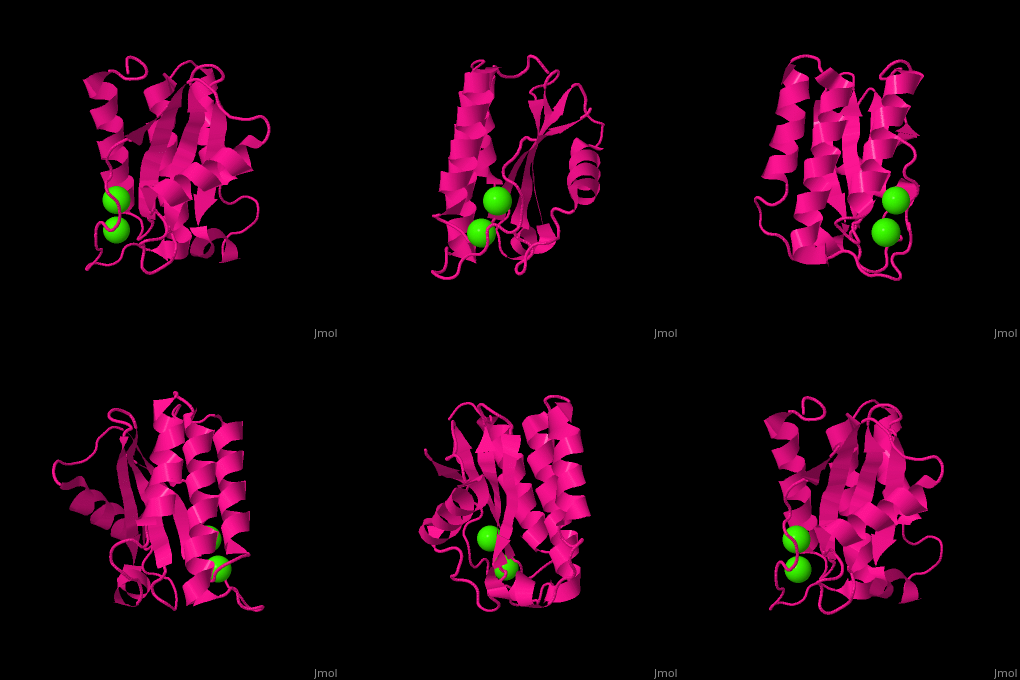
3D Structures of acid phosphatase
Updated on 03-December-2015
References
- ↑ Wang J, Wu D, Fitzke FW. [A study of motion perception in primary open-angle glaucoma]. Zhonghua Yan Ke Za Zhi. 1998 Jan;34(1):39-41. PMID:11877150
