This old version of Proteopedia is provided for student assignments while the new version is undergoing repairs. Content and edits done in this old version of Proteopedia after March 1, 2026 will eventually be lost when it is retired in about June of 2026.
Apply for new accounts at the new Proteopedia. Your logins will work in both the old and new versions.
Quinone reductase
From Proteopedia
(Difference between revisions)
| Line 8: | Line 8: | ||
Certain [http://en.wikipedia.org/wiki/Coumarin coumarins], [http://en.wikipedia.org/wiki/Flavones flavones] and the reactive dye cibacron blue are [http://en.wikipedia.org/wiki/Competitive_inhibition competitive inhibitors] of NQO1 activity, which compete with NAD(P)H for binding to NQO1. [[Dicoumarol]] (3-3’–methylene-bis (4-hydroxycoumarin)), | Certain [http://en.wikipedia.org/wiki/Coumarin coumarins], [http://en.wikipedia.org/wiki/Flavones flavones] and the reactive dye cibacron blue are [http://en.wikipedia.org/wiki/Competitive_inhibition competitive inhibitors] of NQO1 activity, which compete with NAD(P)H for binding to NQO1. [[Dicoumarol]] (3-3’–methylene-bis (4-hydroxycoumarin)), | ||
is the most potent competitive inhibitor of NQO1. Dicoumarol competes with NAD(P)H for binding to NQO1 and prevents the [http://en.wikipedia.org/wiki/Electron_transfer electron transfer] to FAD. | is the most potent competitive inhibitor of NQO1. Dicoumarol competes with NAD(P)H for binding to NQO1 and prevents the [http://en.wikipedia.org/wiki/Electron_transfer electron transfer] to FAD. | ||
| - | In addition to its role in the detoxification of quinones, NQO1 is also a 20S proteasome-associated protein that plays an important role in the stability of the [http://en.wikipedia.org/wiki/Tumor_suppressor_gene tumor suppressor] p53 and several other short-lived proteins including | + | In addition to its role in the detoxification of quinones, NQO1 is also a 20S proteasome-associated protein that plays an important role in the stability of the [http://en.wikipedia.org/wiki/Tumor_suppressor_gene tumor suppressor] p53 and several other short-lived proteins including p73α and ornithine decarboxylase (ODC, ''i.e.'' [[7odc]]). NQO1 binds and stabilizes [[p53]], protecting p53 from [http://en.wikipedia.org/wiki/Proteasome#Ubiquitin-independent_degradation ubiquitin-independent 20S proteasomal degradation]. Dicoumarol and several other inhibitors of NQO1 activity, which compete with NADH for binding to NQO1, disrupt the binding of NQO1 to p53 and induce ubiquitin-independent p53 degradation. |
{{Clear}} | {{Clear}} | ||
Revision as of 06:49, 3 August 2016
| |||||||||||
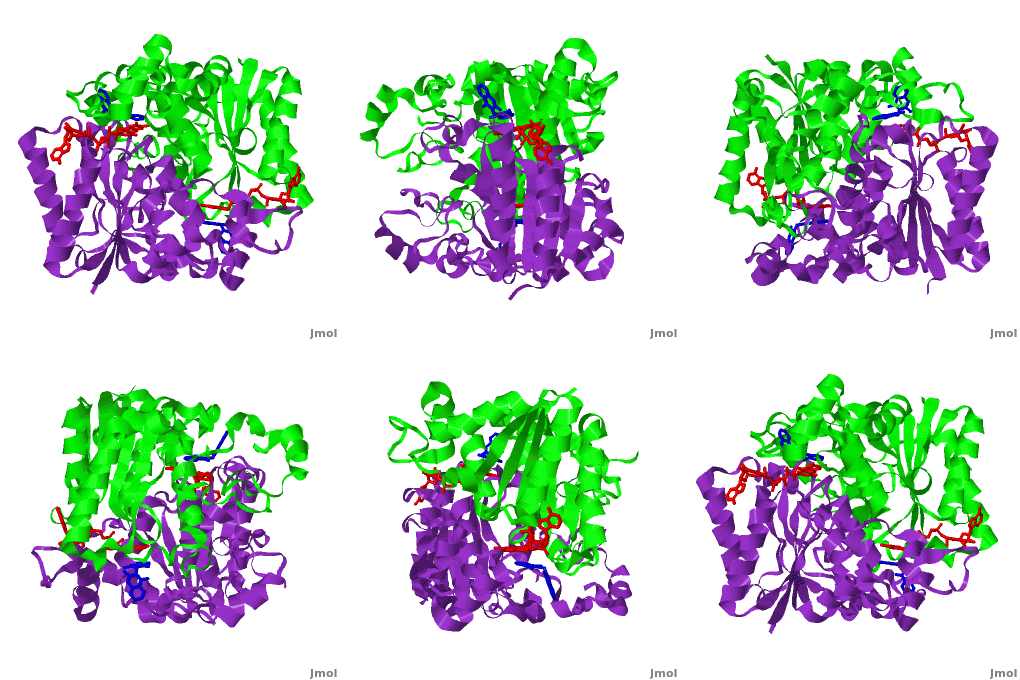
3D Structures of Quinone reductase
Updated on 03-August-2016
References
- Faig M, Bianchet MA, Talalay P, Chen S, Winski S, Ross D, Amzel LM. Structures of recombinant human and mouse NAD(P)H:quinone oxidoreductases: species comparison and structural changes with substrate binding and release. Proc Natl Acad Sci U S A. 2000 Mar 28;97(7):3177-82. PMID:10706635 doi:http://dx.doi.org/10.1073/pnas.050585797
- Asher G, Dym O, Tsvetkov P, Adler J, Shaul Y. The crystal structure of NAD(P)H quinone oxidoreductase 1 in complex with its potent inhibitor dicoumarol. Biochemistry. 2006 May 23;45(20):6372-8. PMID:16700548 doi:10.1021/bi0600087
