This old version of Proteopedia is provided for student assignments while the new version is undergoing repairs. Content and edits done in this old version of Proteopedia after March 1, 2026 will eventually be lost when it is retired in about June of 2026.
Apply for new accounts at the new Proteopedia. Your logins will work in both the old and new versions.
Glucose-dependent Insulinotropic Polypeptide Receptor
From Proteopedia
(Difference between revisions)
| Line 1: | Line 1: | ||
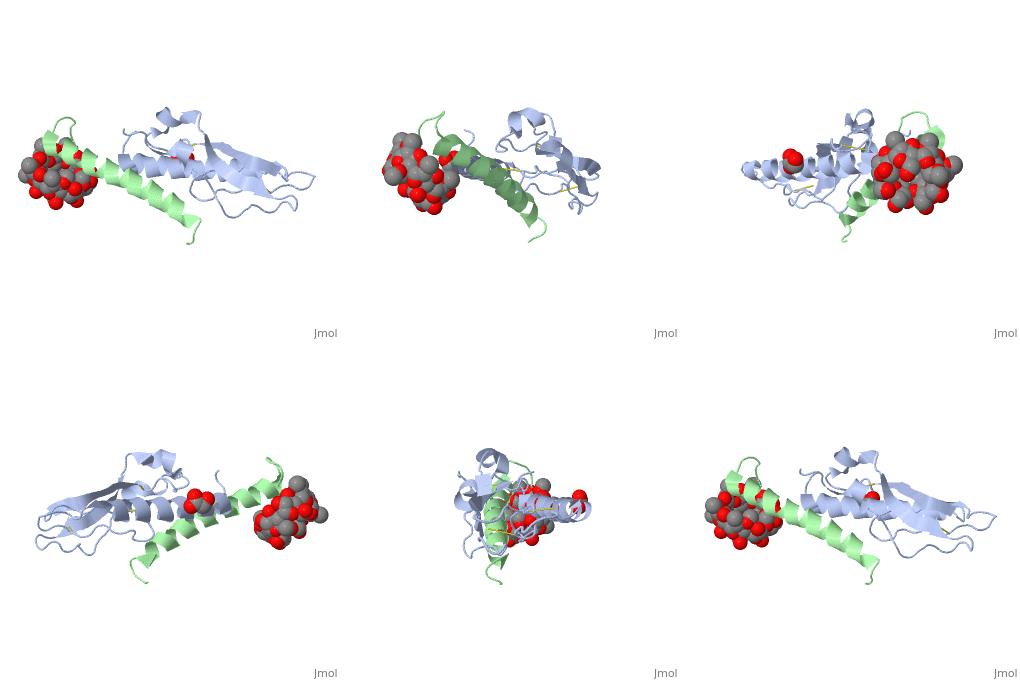
| - | < | + | <StructureSection load='2qkh' size='350' side='right' caption=Glucose-dependant insulinotropic polypeptide receptor (grey) complex with hormone GIP (green), methyl-cyclo-hepta-amylose and tartaric acid , [[2qkh]]' scene=''> |
[[Image:F3.large.jpg|thumb|300px|left|GIP-induced Pathway.<ref>PMID:12475913</ref>]] | [[Image:F3.large.jpg|thumb|300px|left|GIP-induced Pathway.<ref>PMID:12475913</ref>]] | ||
| Line 47: | Line 47: | ||
===Ongoing Research=== | ===Ongoing Research=== | ||
The significance of this receptor makes it a prime target for [[Diabetes]] research. Incretins are a class of biological molecules that act like gastrointestinal hormones. One such example is glucagon-like peptide-1 (GLP-1), which works with GIP to regulate the body's insulin levels. Synthetic versions of this peptide hormone have been made to treat people with type-2 diabetes. It works by stimulating GIP production as well as insulin secretion causing the body to properly regulate its blood glucose levels like someone without diabetes. The benefit of synthetic GLP-1 is that it is not protein and so would not be degraded as easily therefore prolonging the benefits of the drug. One such example is Byetta<ref>"Byetta." BYETTA (exenatide) Injection | Welcome to BYETTA.com. Amylin Pharmaceuticals, Inc., 2011. Web. 02 Dec. 2011. <http://www.byetta.com/Pages/index.aspx></ref>. | The significance of this receptor makes it a prime target for [[Diabetes]] research. Incretins are a class of biological molecules that act like gastrointestinal hormones. One such example is glucagon-like peptide-1 (GLP-1), which works with GIP to regulate the body's insulin levels. Synthetic versions of this peptide hormone have been made to treat people with type-2 diabetes. It works by stimulating GIP production as well as insulin secretion causing the body to properly regulate its blood glucose levels like someone without diabetes. The benefit of synthetic GLP-1 is that it is not protein and so would not be degraded as easily therefore prolonging the benefits of the drug. One such example is Byetta<ref>"Byetta." BYETTA (exenatide) Injection | Welcome to BYETTA.com. Amylin Pharmaceuticals, Inc., 2011. Web. 02 Dec. 2011. <http://www.byetta.com/Pages/index.aspx></ref>. | ||
| - | + | </StructureSection> | |
===3D structures of GIPR=== | ===3D structures of GIPR=== | ||
Revision as of 13:14, 1 April 2019
| |||||||||||

3D structures of GIPR
Updated on 01-April-2019
2qkh - GIPR + GIP - human
References
- ↑ Lynn FC, Thompson SA, Pospisilik JA, Ehses JA, Hinke SA, Pamir N, McIntosh CH, Pederson RA. A novel pathway for regulation of glucose-dependent insulinotropic polypeptide (GIP) receptor expression in beta cells. FASEB J. 2003 Jan;17(1):91-3. Epub 2002 Nov 15. PMID:12475913 doi:10.1096/fj.02-0243fje
- ↑ Lynn FC, Pamir N, Ng EH, McIntosh CH, Kieffer TJ, Pederson RA. Defective glucose-dependent insulinotropic polypeptide receptor expression in diabetic fatty Zucker rats. Diabetes. 2001 May;50(5):1004-11. PMID:11334402
- ↑ "Byetta." BYETTA (exenatide) Injection | Welcome to BYETTA.com. Amylin Pharmaceuticals, Inc., 2011. Web. 02 Dec. 2011. <http://www.byetta.com/Pages/index.aspx>
See Also
Proteopedia Page Contributors and Editors (what is this?)
Michal Harel, David Canner, Alexander Berchansky, Logan Brushart, Wayne Decatur
