This old version of Proteopedia is provided for student assignments while the new version is undergoing repairs. Content and edits done in this old version of Proteopedia after March 1, 2026 will eventually be lost when it is retired in about June of 2026.
Apply for new accounts at the new Proteopedia. Your logins will work in both the old and new versions.
User:Cody J Cubbage
From Proteopedia
(Difference between revisions)
| Line 1: | Line 1: | ||
*[[User:Your Name/Sandbox 1]] | *[[User:Your Name/Sandbox 1]] | ||
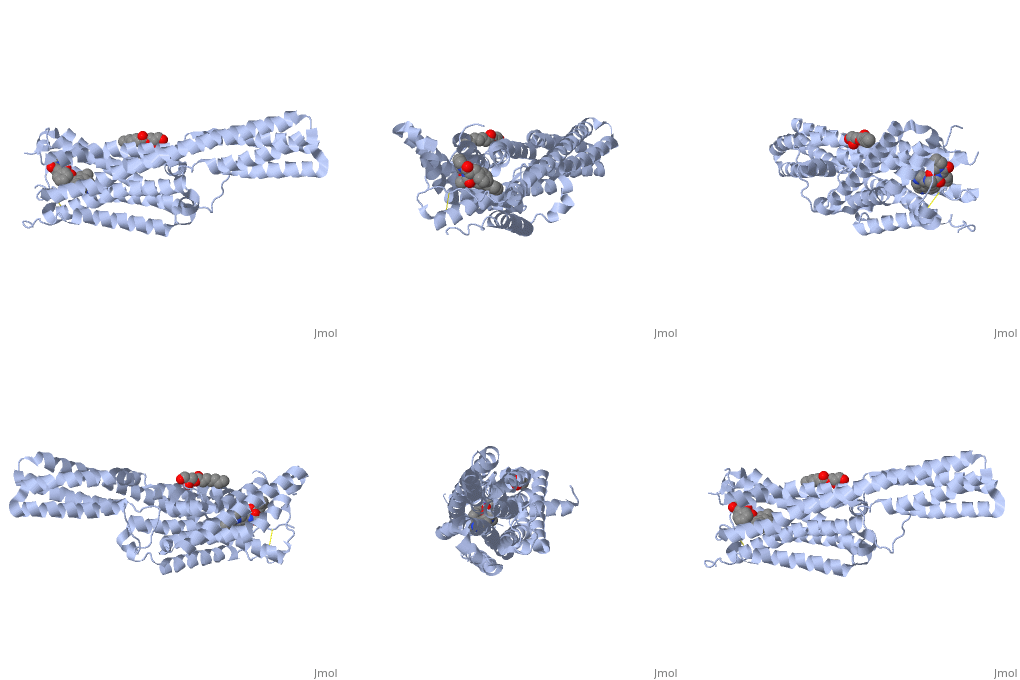
| - | <StructureSection load='4iar' size='350' side='right' scene='' caption=' | + | <StructureSection load='4iar' size='350' side='right' scene='' caption='N-(1,1-dimethylethyl)-3-oxo- |
| + | (5α,17β)-4-azaandrost-1-ene-17-carboxamide'> | ||
| Line 19: | Line 20: | ||
Typically 5 alpha-redcutase turns testosterone into Dihydrotestosterone(DHT), but the enzyme will accept Finasteride as an alternate substrate; turning it into dihydrofinasteride through an enzyme bound, NADP-dihydrofinasteride adduct. Finasteride is similar in structure to testosterone and 5alpha-reductase has almost the same affinity for both molecules. However, Finasteride , having a high affinity for 5 alpha-reductase, covalently binds to the enzyme as a Michael acceptor, through a functionally irreversible reaction. However, the NADP-dihydrofinasteride complex breaks down with a half life of about 1 month at 37˚C., which is why patients must continue taking the drug.(.....) | Typically 5 alpha-redcutase turns testosterone into Dihydrotestosterone(DHT), but the enzyme will accept Finasteride as an alternate substrate; turning it into dihydrofinasteride through an enzyme bound, NADP-dihydrofinasteride adduct. Finasteride is similar in structure to testosterone and 5alpha-reductase has almost the same affinity for both molecules. However, Finasteride , having a high affinity for 5 alpha-reductase, covalently binds to the enzyme as a Michael acceptor, through a functionally irreversible reaction. However, the NADP-dihydrofinasteride complex breaks down with a half life of about 1 month at 37˚C., which is why patients must continue taking the drug.(.....) | ||
| - | ==Medical Uses= | + | ==Medical Uses== |
Finasteride is used to shrink an enlarged prostate, also known as benign prostatic hyperplasia (BPH), in adult men. This medication works by inhibiting 5a-reductase, which prevents conversion of testosterone to the natural body hormone, dihydrosestosterone (DHT) that causes growth of the prostate. Finasteride is specific for type II isoenzymes, resulting in a decline in serum DHT levels by 65-70% and in prostate DHT levels by up to 80-90% (source). | Finasteride is used to shrink an enlarged prostate, also known as benign prostatic hyperplasia (BPH), in adult men. This medication works by inhibiting 5a-reductase, which prevents conversion of testosterone to the natural body hormone, dihydrosestosterone (DHT) that causes growth of the prostate. Finasteride is specific for type II isoenzymes, resulting in a decline in serum DHT levels by 65-70% and in prostate DHT levels by up to 80-90% (source). | ||
| + | |||
| + | </StructureSection> | ||
Revision as of 08:07, 16 November 2016
| |||||||||||