This old version of Proteopedia is provided for student assignments while the new version is undergoing repairs. Content and edits done in this old version of Proteopedia after March 1, 2026 will eventually be lost when it is retired in about June of 2026.
Apply for new accounts at the new Proteopedia. Your logins will work in both the old and new versions.
GP1 of Lassa Virus
From Proteopedia
(Difference between revisions)
| Line 1: | Line 1: | ||
<StructureSection load='4zjf' size='340' side='right' caption='4ZJF structure' scene='76/761695/4zjf_chaina/2'> | <StructureSection load='4zjf' size='340' side='right' caption='4ZJF structure' scene='76/761695/4zjf_chaina/2'> | ||
==Importance== | ==Importance== | ||
| - | Lassa virus (LASV), an Old World [ | + | Lassa virus (LASV), an Old World [http://en.wikipedia.org/wiki/Arenavirus arenavirus], is a notorious disease-causing agent primarily in West Africa that is able to spread to rodents, as well as humans. This deadly pathogen causes severe viral hemorrhagic fevers and significant mortality. So far, there are no available vaccines for LASV or any other viruses found in the ''Arenaviridae'' family. Determining the structure of the complete trimeric glycoprotein complex (GPC), composed of GP1, GP2, and SSP (stable signal peptide), will lay the foundation for a future discovery of novel antiviral drugs. This is the first representative structure for Old World arenaviruses. |
== Function == | == Function == | ||
'''GP1''' (Glycoprotein 1) is the receptor binding domain of LASV that mediates receptor recognition. Research thus far indicates that GP1 from LASV may undergo irreversible conformational changes that could serve as an immunological decoy mechanism. | '''GP1''' (Glycoprotein 1) is the receptor binding domain of LASV that mediates receptor recognition. Research thus far indicates that GP1 from LASV may undergo irreversible conformational changes that could serve as an immunological decoy mechanism. | ||
==Structural Highlights== | ==Structural Highlights== | ||
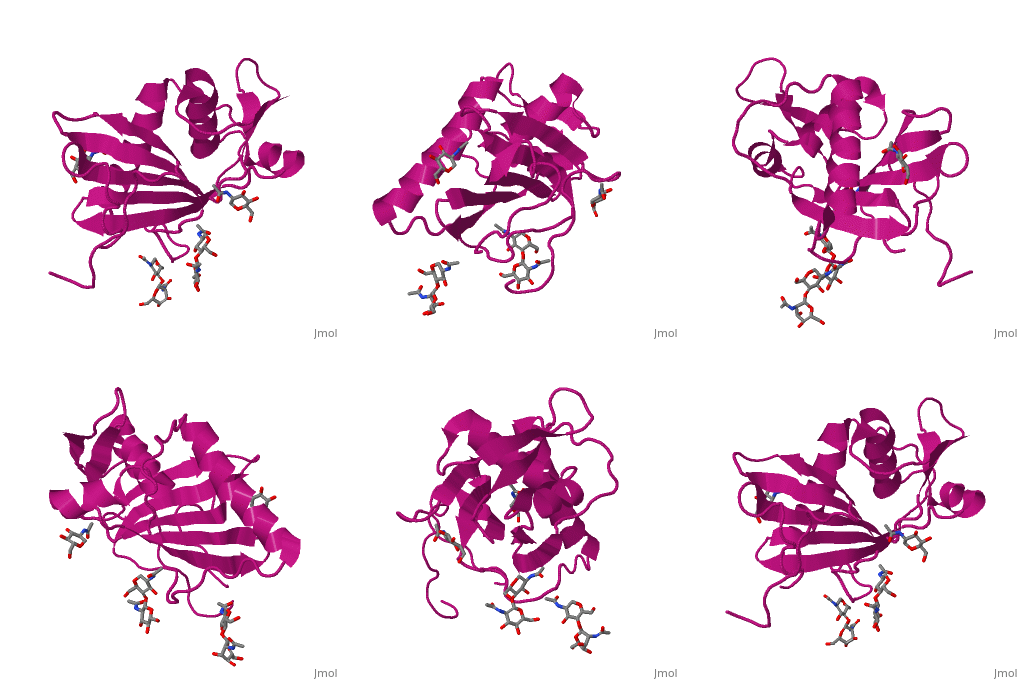
| - | GP1 of LASV is a 4 chain structure with <scene name='76/761695/Nag/1'>NAG</scene> ligands attached to each chain. The overall architecture of GP1 features a central β-sheet and two distinct halves: a glycosylated half containing the receptor-binding site that is made mostly by the central β-sheet and surrounding loops and a half that contains mostly helices and most likely faces the trimer axis)<ref name="PMID: 25972533">PMID: 25972533</ref>. The method used to determine this structure was [ | + | GP1 of LASV is a 4 chain structure with <scene name='76/761695/Nag/1'>NAG</scene> ligands attached to each chain. The overall architecture of GP1 features a central β-sheet and two distinct halves: a glycosylated half containing the receptor-binding site that is made mostly by the central β-sheet and surrounding loops and a half that contains mostly helices and most likely faces the trimer axis)<ref name="PMID: 25972533">PMID: 25972533</ref>. The method used to determine this structure was [http://en.wikipedia.org/wiki/X-ray_crystallography X-ray diffraction] |
=== Histidine Triad=== | === Histidine Triad=== | ||
Attached to this structure is a unique <scene name='76/761695/Histriad/6'>triad of histidines</scene> that is highly conserved among Old World arenaviruses. Located on the β-sheet face of GP1, the histidine triad is a structural element that directly interacts with [[LAMP1]] (Lysosome-associated membrane glycoprotein) and helps stabilize a LAMP1-"compatible" conformation by providing a molecular mechanism for the pH-dependent receptor switching<ref name="PMID: 25972533" />. The <scene name='76/761695/Lamp1bindingsite/4'>histidine triad</scene> is critical in forming a <scene name='76/761695/Lamp1bindingsite/3'>binding site</scene> for LAMP1. | Attached to this structure is a unique <scene name='76/761695/Histriad/6'>triad of histidines</scene> that is highly conserved among Old World arenaviruses. Located on the β-sheet face of GP1, the histidine triad is a structural element that directly interacts with [[LAMP1]] (Lysosome-associated membrane glycoprotein) and helps stabilize a LAMP1-"compatible" conformation by providing a molecular mechanism for the pH-dependent receptor switching<ref name="PMID: 25972533" />. The <scene name='76/761695/Lamp1bindingsite/4'>histidine triad</scene> is critical in forming a <scene name='76/761695/Lamp1bindingsite/3'>binding site</scene> for LAMP1. | ||
===LAMP1 Binding Site=== | ===LAMP1 Binding Site=== | ||
| - | The primary cellular receptor of LASV α-dystroglycan (α-DG)<ref name="PMID: 9851928">PMID: 9851928</ref><ref name="PMID: 15857984">PMID: 15857984</ref>, which is recognized by a trimeric class 1 viral GPC (spike complex) on the viral surface<ref name="PMID: 16731928">PMID: 16731928</ref><ref name="PMID: 26849049">PMID: 26849049</ref>. Following successful attachment to α-DG on cells, LASV is internalized via [ | + | The primary cellular receptor of LASV α-dystroglycan (α-DG)<ref name="PMID: 9851928">PMID: 9851928</ref><ref name="PMID: 15857984">PMID: 15857984</ref>, which is recognized by a trimeric class 1 viral GPC (spike complex) on the viral surface<ref name="PMID: 16731928">PMID: 16731928</ref><ref name="PMID: 26849049">PMID: 26849049</ref>. Following successful attachment to α-DG on cells, LASV is internalized via [http://en.wikipedia.org/wiki/Pinocytosis macropinocytosis]<ref name="PMID: 27147735">PMID: 27147735</ref>, and the GPC facilitates membrane fusion at the acidic environment of a late endosomal compartment<ref name="PMID: 16731928"><ref name="PMID: 21931550">PMID: 21931550 </ref>. Recent studies have shown that successful infection by LASV requires it to switch in a pH-dependent manner from α-DG to LAMP1. |
<scene name='76/761695/4zjf_chaina_hisandlampsite/1'>LAMP1 Binding sites with Histidine Triad</scene> | <scene name='76/761695/4zjf_chaina_hisandlampsite/1'>LAMP1 Binding sites with Histidine Triad</scene> | ||
Revision as of 12:43, 5 July 2017
| |||||||||||
References
- ↑ 1.0 1.1 Cohen-Dvashi H, Cohen N, Israeli H, Diskin R. Molecular mechanism for LAMP1 recognition by Lassa Virus. J Virol. 2015 May 13. pii: JVI.00651-15. PMID:25972533 doi:http://dx.doi.org/10.1128/JVI.00651-15
- ↑ Cao W, Henry MD, Borrow P, Yamada H, Elder JH, Ravkov EV, Nichol ST, Compans RW, Campbell KP, Oldstone MB. Identification of alpha-dystroglycan as a receptor for lymphocytic choriomeningitis virus and Lassa fever virus. Science. 1998 Dec 11;282(5396):2079-81. PMID:9851928
- ↑ Kunz S, Rojek JM, Perez M, Spiropoulou CF, Oldstone MB. Characterization of the interaction of lassa fever virus with its cellular receptor alpha-dystroglycan. J Virol. 2005 May;79(10):5979-87. PMID:15857984 doi:http://dx.doi.org/10.1128/JVI.79.10.5979-5987.2005
- ↑ 4.0 4.1 Eschli B, Quirin K, Wepf A, Weber J, Zinkernagel R, Hengartner H. Identification of an N-terminal trimeric coiled-coil core within arenavirus glycoprotein 2 permits assignment to class I viral fusion proteins. J Virol. 2006 Jun;80(12):5897-907. PMID:16731928 doi:http://dx.doi.org/10.1128/JVI.00008-06
- ↑ Li S, Sun Z, Pryce R, Parsy ML, Fehling SK, Schlie K, Siebert CA, Garten W, Bowden TA, Strecker T, Huiskonen JT. Acidic pH-Induced Conformations and LAMP1 Binding of the Lassa Virus Glycoprotein Spike. PLoS Pathog. 2016 Feb 5;12(2):e1005418. doi: 10.1371/journal.ppat.1005418., eCollection 2016 Feb. PMID:26849049 doi:http://dx.doi.org/10.1371/journal.ppat.1005418
- ↑ Oppliger J, Torriani G, Herrador A, Kunz S. Lassa Virus Cell Entry via Dystroglycan Involves an Unusual Pathway of Macropinocytosis. J Virol. 2016 Jun 24;90(14):6412-29. doi: 10.1128/JVI.00257-16. Print 2016 Jul, 15. PMID:27147735 doi:http://dx.doi.org/10.1128/JVI.00257-16
Categories: Cohen, N | Cohen-Dvashi, H | Diskin, R | Israeli, H | Arenavirus | Glycoprotein | Lassa | LASV | Receptor binding | Viral protein | 4zjf | GP1
