From Proteopedia
(Difference between revisions)
proteopedia linkproteopedia link
|
|
| Line 1: |
Line 1: |
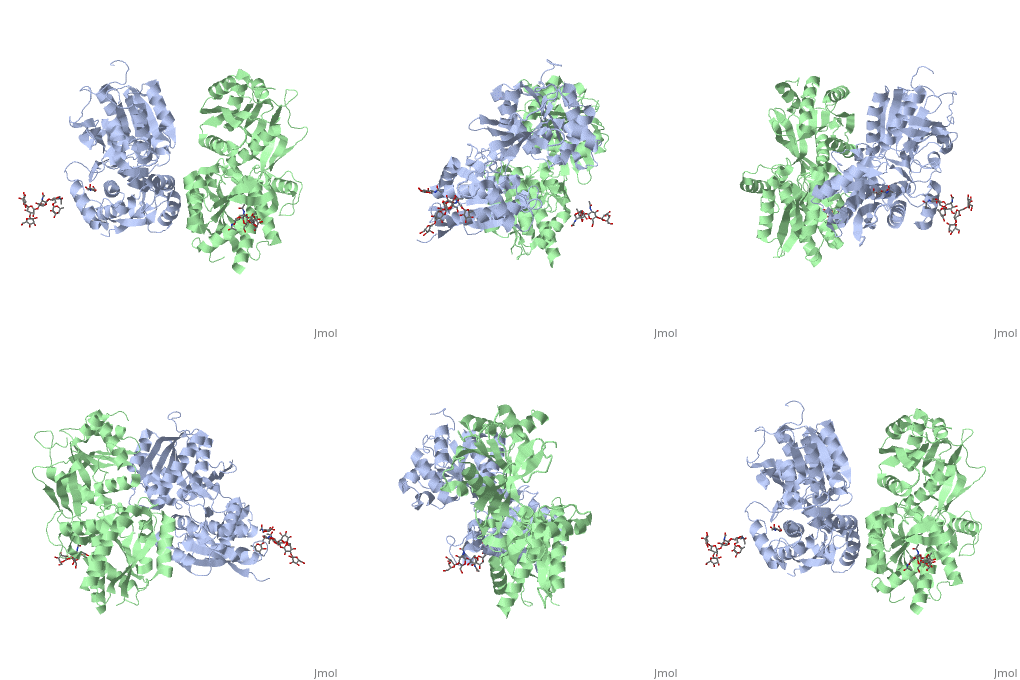
| - | <Structure load='4mqe' size='350' frame='true' align='right' caption='Glycosylated human GABAB receptor subunit 1(grey) and subunit 2 (green) (PDB code [[4mqe]])' scene=''> | + | <StructureSection load='4mqe' size='350' side='right' caption='Glycosylated human GABAB receptor subunit 1(grey) and subunit 2 (green) (PDB code [[4mqe]])' scene=''> |
| | + | |
| | == Introduction == | | == Introduction == |
| | | | |
| Line 19: |
Line 20: |
| | A possible therapeutic approach utilizing GABAB receptors would be for the treatment of substance use disorder (i.e. drug addiction). The GABAB receptor has been found to play a crucial role in mediating behavioral and molecular effects of drug abuse and could be used as a potential anti-addictive therapeutic strategy (Filip, 2015). Agonists of GABAB receptors can promote abstinence or decrease and control the reinforcing effects of drugs on the mind (Kerr 2005). | | A possible therapeutic approach utilizing GABAB receptors would be for the treatment of substance use disorder (i.e. drug addiction). The GABAB receptor has been found to play a crucial role in mediating behavioral and molecular effects of drug abuse and could be used as a potential anti-addictive therapeutic strategy (Filip, 2015). Agonists of GABAB receptors can promote abstinence or decrease and control the reinforcing effects of drugs on the mind (Kerr 2005). |
| | | | |
| | + | </StructureSection> |
| | == 3D structures of GABA receptor == | | == 3D structures of GABA receptor == |
| | Updated on {{REVISIONDAY2}}-{{MONTHNAME|{{REVISIONMONTH}}}}-{{REVISIONYEAR}} | | Updated on {{REVISIONDAY2}}-{{MONTHNAME|{{REVISIONMONTH}}}}-{{REVISIONYEAR}} |
Revision as of 11:14, 20 October 2017
|
Introduction
GABA (i.e. gamma-aminobutyric acid) is the primary inhibitory neurotransmitter of the vertebrate central nervous system (Kerr, 1995). GABA can bind one of two different receptor proteins, each using a discrete mechanism to elicit a cellular response. Upon binding with GABA, GABAB receptors utilize a second messenger amplification pathway that ultimately results in an inhibitory signal for neuronal transmission. This pathway for signal transmission differs from GABAA receptors, which are considered ligand-gated ion channels as the binding of GABA results in the opening of ion channels leading to the inhibition of a neuronal signal.
Structure
Ionotropic and metabotropic are the two major classes of GABA receptors abundant throughout neuronal cells (Cryan, 2005). Metabotropic GABAB receptors induce a change in membrane potential through the action of a second messenger pathway (Kerr, 1995). The GABAB receptor functions as a heterodimer of two subunits, GABAB1 (grey) and GABAB2 (green). Heterodimerization is accomplished through interactions of the coiled-coil motifs within the C-termini and interactions between the transmembrane and extracellular domains (Cryan, 2005). Additionally, there are two GABAB1 isoforms that differ at the N-termini where there are two sushi domains (Cryan, 2005). These sushi domains on the GABAB1 subunit are key to the receptor's interaction with other proteins as well as axonal signaling (Cryan, 2005). The two GABAB subunits link together as GABAB2 connects to GABAB1 via the on the intracellular C-termini to form the heterodimer GABAB receptor (Geng, 2013). These tyrosine residues are effective in linking the heterodimer as the base-stacking interactions and hydrogen bonding stabilize the quaternary structure (Geng, 2013). Lastly, the tyrosine residues, with adjacent , are able to participate in hydrophobic interactions that contribute to the heterodimer's stability (Geng, 2013).
The GABAB receptor exists in the (PDB: 4MQE) and the (PDB: 4MS3) (Geng, 2013). Using the GABAB crystal structures, Geng et al. found that both subunits exist in open conformations while at rest. Upon binding with the agonist the GABAB1 subunit closes (Geng, 2013). Additionally, it was found that the agonist (i.e. GABA) is bound to the , located at the interdomain crevice of the GABAB1 subunit due to an overlap of amino acid residues (Geng, 2013). This conformation change is noted by the visible reduction in space between GABAB subunits upon binding with GABA.
Function
GABAB receptors have been found to provide an inhibitory function through coupling to G-proteins and the recruitment of second messengers (Bettler, 2004). Presynaptic GABAB receptors effectively repress the influx of calcium ions (Ca2+) via the inhibition of voltage gated Ca2+ channels through the activation of the Gβγ subunits (Bettler, 2004). Postsynaptic GABAB receptors then activate the opening of potassium ion (K+) channels through the activation of Gβγ subunits (Bettler, 2004). The efflux of potassium ions results in hyperpolarization of the neuronal membrane due to the highly negative Nernst value of potassium common to cerebrospinal fluid. Hyperpolarization of the neuronal membrane is the decrease in the neuron’s membrane potential away from threshold which results in the inhibition of GABA neuronal function (Bettler, 2004). This functions in opposition of the GABAA receptor in order to control and slow the inhibitory postsynaptic potentials as the GABAA receptor activation causes a more transient inhibitory signal (Cryan, 2005). Besides interacting with ion channels, GABAB receptors also inhibit adenylyl cyclase through the Giα/Goα subunits and activate adenylyl cyclase through Gβγ subunits (Bettler, 2004). This control of adenylyl cyclase is thought to control neuronal function for a longer period of time compared to the control via ion channels (Geng, 2013).
Disease
GABAB receptors are the target of a number of treatments in the clinical setting of neurodegenerative and pathophysiological disorders including epilepsy, spasticity, chronic pain, anxiety, depression, schizophrenia, cognitive function, gastro-esophageal reflux and drug dependence and addiction (Kerr 2005).
There is increasing evidence that links schizophrenia directly to GABAB receptor deficits. GABBR1, the gene associated with the expression of the GABAB1 receptor was found to have a high amount of methylation in receptors tested for patients with schizophrenia (Citrome, 2009). The receptor 1 gene locus on chromosome 6 is susceptible for disorders such as multiple sclerosis, epilepsy, and schizophrenia (Gumerov, 2015). Presynaptic dopaminergic terminals (i.e. neuronal terminals that secrete dopamine) have GABAB receptors that are involved in the release of dopamine along with modulation of glutaminergic regulation of dopamine (Citrome, 2009).
A possible therapeutic approach utilizing GABAB receptors would be for the treatment of substance use disorder (i.e. drug addiction). The GABAB receptor has been found to play a crucial role in mediating behavioral and molecular effects of drug abuse and could be used as a potential anti-addictive therapeutic strategy (Filip, 2015). Agonists of GABAB receptors can promote abstinence or decrease and control the reinforcing effects of drugs on the mind (Kerr 2005).
|
3D structures of GABA receptor
Updated on 20-October-2017
References
Bettler, B., Kaupmann, K., Mosbacher, J., & Gassmann, M. (2004). Molecular structure and physiological functions of GABAB receptors. Physiological reviews, 84(3), 835-867.
Citrome, L., Javitt, D., Kantrowitz, J. (2009). GABAB Receptors, Schizophrenia and Sleep Dysfunction. CNS Drugs, 23(8), 681-691.
Cryan, J.F., Kaupman, K. (2005). Don’t worry ‘B’ happy!: a role for GABAB receptors in anxiety and depression. Trends in Pharmacological Sciences, 26(1), 36-43.
Filip, M., Frankowska, M., et al., (2015). GABAB receptors as a therapuetic strategy in substance use disorders: Focus on positive allosteric modulators. Neuropharmacology. (38), 36-47.
Geng, Y., Bush, M., Mosyak, L., Wang, F., & Fan, Q. R. (2013). Structural mechanism of ligand activation in human GABAB receptor. Nature, 504(7479), 254-259.
Gumerov, V., Hegyi, H. (2015). MicroRNA-derived network analysis of differentially methylated genes in schizophrenia, implicating GABA receptor B1 [GABBR1] and protein kinase B [AKT1].Gumerov and Heygl Biology Direct. 10:59, 1-15.
Kerr, D. I. B., and J. Ong. "Clinical Potential of GABA B Receptor Modulators." CNS Drug Reviews. 11.3 (2005): 317-334.
Kerr, D. I. B., and J. Ong. "Gaba B receptors." Pharmacology & therapeutics. 67.2 (1995): 187-246.