This old version of Proteopedia is provided for student assignments while the new version is undergoing repairs. Content and edits done in this old version of Proteopedia after March 1, 2026 will eventually be lost when it is retired in about June of 2026.
Apply for new accounts at the new Proteopedia. Your logins will work in both the old and new versions.
Vpr protein
From Proteopedia
| Line 2: | Line 2: | ||
== Function == | == Function == | ||
| - | '''Vpr protein''' (Vpr) or '''viral protein R''' is a 96 amino acid protein which encoded by the human Immunodeficiency virus type 1 ([[HIV-1]]). Vpr has several roles in the progression of acquired immunodeficiency syndrome (AIDS) disease, including regulation the HIV-1 pre-integration complex ( | + | '''Vpr protein''' (Vpr) or '''viral protein R''' is a 96 amino acid protein which encoded by the human Immunodeficiency virus type 1 ([[HIV-1]]). HIV-1 genome includes nine genes, six of them are accessory proteins, including ''vpr''. Vpr has several roles in the progression of acquired immunodeficiency syndrome ([https://en.wikipedia.org/wiki/AIDS AIDS]) disease, including regulation the HIV-1 pre-integration complex ([https://en.wikipedia.org/wiki/Pre-integration_complex PIC]) nuclear import and virus replication in non-dividing macrophages<ref name='Morellet2003'>PMID:12614620</ref>. Moreover, Vpr prevents mitosis of dividing infect cells by blockade at G2 phase, when the viral promoter is more active, and induced apoptosis of these cells in G1 and M phase. Both the activities of cell cycle arrest and induce apoptosis has proven to be independence by mutations that can cause only one of these affects<ref name='Gonzalez2017'>PMID:28075409</ref>. |
| + | |||
| + | |||
== Disease == | == Disease == | ||
| - | HIV-1 retrovirus is the cause of AIDS disease. HIV-1 is a RNA virus which copy its genome to the host-cell genome in infect cells. HIV-1 infects activated CD4 immune cells and macrophages. When the disease is expressing in carriers, the progressive depletion of CD4 T cells causes immunodeficiency. | + | HIV-1 retrovirus is the cause of AIDS disease. HIV-1 is a RNA virus which copy its genome to the host-cell genome in infect cells. HIV-1 infects activated CD4 immune cells and macrophages. When the disease is expressing in carriers, the progressive depletion of CD4 T cells causes immunodeficiency<ref name='Emerman1996'>PMID:8805364</ref>. |
For more details about AIDS disease see {{Wikipedia|AIDS}} | For more details about AIDS disease see {{Wikipedia|AIDS}} | ||
For details about another HIV-1 components and its replication pathway see [[HIV and accessory proteins]]. | For details about another HIV-1 components and its replication pathway see [[HIV and accessory proteins]]. | ||
| + | |||
| + | == Relevance == | ||
| + | Understanding of Vpr structure and molecular mechanism may facilitate the design of HIV-1 antiviral therapy by its inhibition. Deletion of both ''vpr'' and ''vpx'' genes in SIV, which their protein products in SIV combine Vpr function in HIV-1, eliminate virus replication<ref name='Emerman1996'/>. The multiple significant functions that Vpr fills in HIV-1 replication makes it an attractive candidate for antiviral therapy <ref name='Gonzalez2017'/> | ||
== Conservation == | == Conservation == | ||
| - | Vpr is highly conserved in HIV and simian immunodeficiency virus (SIV), similar retrovirus which infects non-human primates<ref | + | Vpr is highly conserved in HIV and simian immunodeficiency virus (SIV), similar retrovirus which infects non-human primates<ref name='Morellet2003'/>. In addition, all primate lentiviruses has vpr gene whose protein product has highly conserved motifs. HIV-2 and SIVsm lentiviruses have additionally gene - vpx. In these lentiviruses, vpr and vpx executes together the roles which HIV-1 vpr perform. Vpr and Vpx has low conservation between them. |
Revision as of 23:43, 7 April 2018
| |||||||||||
3D Structures of Vpr protein
Updated on 07-April-2018
1m8l – Vpr - NMR - HIV-1
1esx - synthetic Vpr - NMR - HIV-1
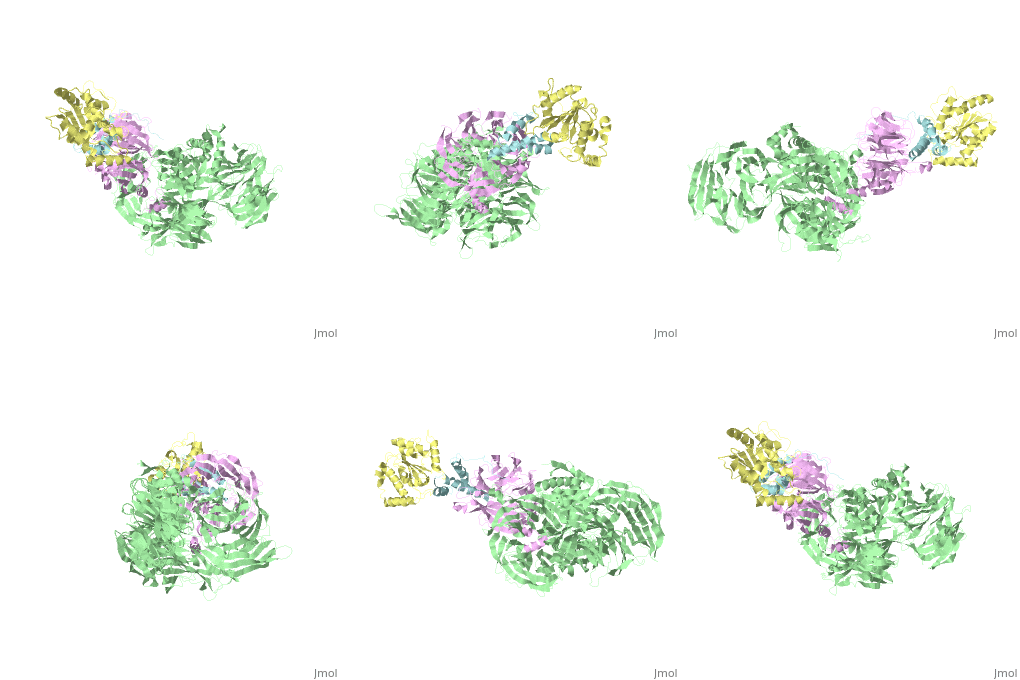
5jk7 – Vpr + DDB1 + DCAF-1 + UNG2 – X-ray solution - HIV-1
1x9v – Dimeric structure of the Vpr C-terminal domain - NMR
1vpc - C-terminal domain of Vpr - NMR - HIV-1
1fi0 - Vpr residues 13-33 in micelles - NMR - HIV-1
1bde - NMR solution of Vpr peptides connected to cell cycle arrest and nuclear provirus transfer
5b56 - Importin subunit alpha-1 + Vpr C-terminal domain - crystallographic analysis
1kzs, 1kzt, 1kzv - Vpr residues 34-51 - NMR - HIV-1
1dsj - Vpr residues 50-75 - NMR - HIV-1
1ceu - Vpr N-terminal domain - NMR - HIV-1
1dsk - Vpr residues 59-86 - NMR - HIV-1
References
- ↑ 1.0 1.1 Morellet N, Bouaziz S, Petitjean P, Roques BP. NMR structure of the HIV-1 regulatory protein VPR. J Mol Biol. 2003 Mar 14;327(1):215-27. PMID:12614620
- ↑ 2.0 2.1 Gonzalez ME. The HIV-1 Vpr Protein: A Multifaceted Target for Therapeutic Intervention. Int J Mol Sci. 2017 Jan 10;18(1). pii: ijms18010126. doi: 10.3390/ijms18010126. PMID:28075409 doi:http://dx.doi.org/10.3390/ijms18010126
- ↑ 3.0 3.1 Emerman M. HIV-1, Vpr and the cell cycle. Curr Biol. 1996 Sep 1;6(9):1096-103. PMID:8805364
