We apologize for Proteopedia being slow to respond. For the past two years, a new implementation of Proteopedia has been being built. Soon, it will replace this 18-year old system. All existing content will be moved to the new system at a date that will be announced here.
User:Alisa Cario
From Proteopedia
(Difference between revisions)
| Line 11: | Line 11: | ||
| - | == Stathmin-4 (RB3) bound to Tubulin stabilized with | + | == Stathmin-4 (RB3) bound to Tubulin stabilized with Vinblastine == |
[[4eb6]] | [[4eb6]] | ||
| Line 41: | Line 41: | ||
<scene name='77/778894/Stathmin_alone/1'>Stathmin</scene> consistis of a coiled coil alpha helix, that binds across two tubulin heterodimers, and a mostly disordered N-terminal region that also has some beta strand properties. These different regions of the protein are known to have different functions. | <scene name='77/778894/Stathmin_alone/1'>Stathmin</scene> consistis of a coiled coil alpha helix, that binds across two tubulin heterodimers, and a mostly disordered N-terminal region that also has some beta strand properties. These different regions of the protein are known to have different functions. | ||
| - | The <scene name='77/778894/Stathmin_nterm/1'>N-terminal region</scene> is known to increase tubulin catastrophe. This region helps destabilize the ends of the microtubule filaments by curving the tubulin dimers at the end, and disrupting lateral hydrogen bonds. The N-terminal region is known as the regulatory domain of the protein, because it is subject to most of the post-translational modifications. This region binds and caps alpha tubulin to accomplish this task. (<ref></ref>) | + | The <scene name='77/778894/Stathmin_nterm/1'>N-terminal region</scene> is known to increase tubulin catastrophe. This region helps destabilize the ends of the microtubule filaments by curving the tubulin dimers at the end, and disrupting lateral hydrogen bonds. The N-terminal region is known as the regulatory domain of the protein, because it is subject to most of the post-translational modifications. This region binds and caps alpha tubulin to accomplish this task. (<ref>PMID: 9880330</ref>) |
| - | The<scene name='77/778894/Stathmin_c_term/1'> C-terminal region</scene>, also known as the interaction domain, is known to sequester tubulin heterodimers. This region is comprised of a <scene name='77/778894/Stathmin_coiled_coil/1'>coiled-coil alpha helix</scene>. This region of stathmin is <scene name='77/778894/Zoom_of_stathmin_on_alpha/1'>known to bind to helix 10 of alpha tubulin</scene>. Helix 10 of alpha tubulin is thought to be important for incorporation into microtubules (<ref></ref>). | + | The<scene name='77/778894/Stathmin_c_term/1'> C-terminal region</scene>, also known as the interaction domain, is known to sequester tubulin heterodimers. This region is comprised of a <scene name='77/778894/Stathmin_coiled_coil/1'>coiled-coil alpha helix</scene>. This region of stathmin is <scene name='77/778894/Zoom_of_stathmin_on_alpha/1'>known to bind to helix 10 of alpha tubulin</scene>. Helix 10 of alpha tubulin is thought to be important for incorporation into microtubules (<ref>PMID: 9880330</ref>). |
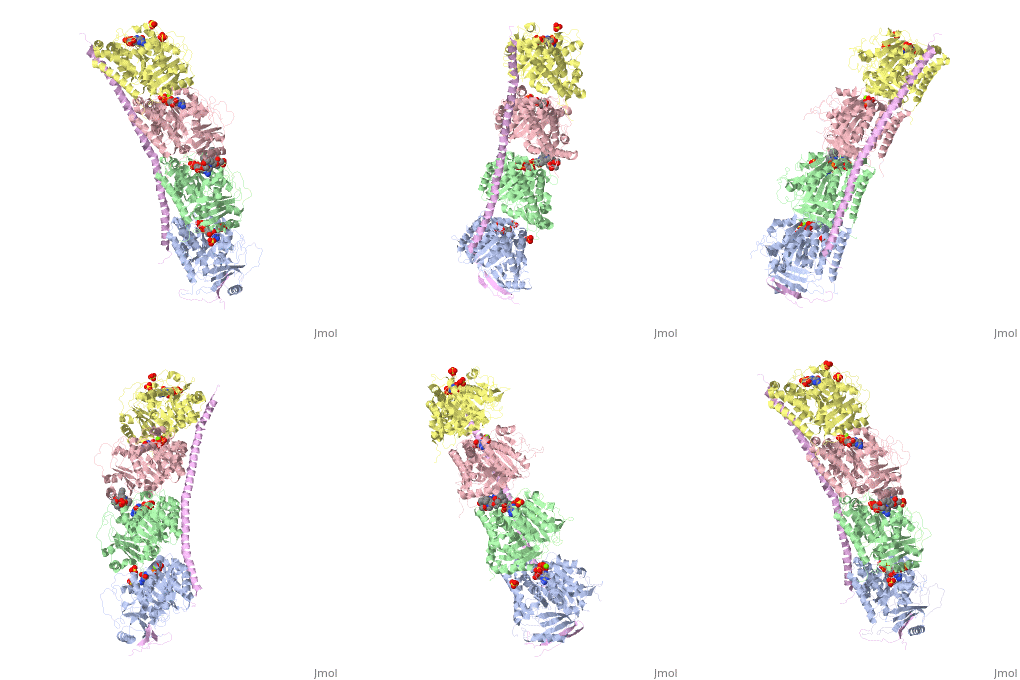
| - | The structure of stathmin, in 4eb6, is bound to two tubulin heterodimers. The tubulin dimers are bound to outside ligands. <scene name='77/778894/Vinblastine/1'>Vinblastine</scene> is a chemotherapeutic that binds to tubulin to prevent microtubule polymerization | + | The structure of stathmin, in 4eb6, is bound to two tubulin heterodimers. The tubulin dimers are bound to outside ligands. <scene name='77/778894/Vinblastine/1'>Vinblastine</scene> is a chemotherapeutic that binds to tubulin to prevent microtubule polymerization <ref>PMID: 1687171</ref>. The tubulin subunits are bound to from <scene name='77/778894/Gtp_gdp_highlight_of_tubulin/1'>GTP/GDP.</scene> The beta subunits of tubulin are bound to GDP and each of the alpha subunits are bound to GTP and a Magnesium ion. There are also <scene name='77/778894/Mutations_in_stathmin/1'>two mutations</scene> to the stathmin in this structure. The mutations at position 11 from an cysteine to an alanine and position 16 from a Phenylalanine to a Tryptophan. |
| Line 52: | Line 52: | ||
'''Multiple Schlerosis''': Stathmin expression is has been linked to multiple sclerosis (MS) , a neurodegenerative disorder characterized by lack of motor control and numbness. MS is caused by loss of myelination on axons in the nervous system. Myelination of axons is performed by cells called oligodendrocytes. Stathmin is regulated in oligodendrocyte lineage, with progenitor cells containing larger amounts than differentiated oligodendrocytes. Brain tissue samples from people suffering from multiple sclerosis found that stathmin is up regulated later in the lineage of oligodendrocytes. The up-regulation of stathmin showed a more globular morphology of the cells. Oligodendrocyte ability to myelinate axons in the central nervous system was greatly reduced in these patients <ref>PMID: 15659612</ref>. | '''Multiple Schlerosis''': Stathmin expression is has been linked to multiple sclerosis (MS) , a neurodegenerative disorder characterized by lack of motor control and numbness. MS is caused by loss of myelination on axons in the nervous system. Myelination of axons is performed by cells called oligodendrocytes. Stathmin is regulated in oligodendrocyte lineage, with progenitor cells containing larger amounts than differentiated oligodendrocytes. Brain tissue samples from people suffering from multiple sclerosis found that stathmin is up regulated later in the lineage of oligodendrocytes. The up-regulation of stathmin showed a more globular morphology of the cells. Oligodendrocyte ability to myelinate axons in the central nervous system was greatly reduced in these patients <ref>PMID: 15659612</ref>. | ||
| - | '''Cancer''': Due to stathmin's role in mitosis and cell migration, it is not surprising that is has been implicated in many cancers and is an active target of cancer therapeutics. Stathmin is defined as an oncoprotein. Overexpression of stathmin has been shown to increase metastasis, worse prognosis, and increased chemoresistance ( <ref></ref> ). Stathmin levels are known to be increasesd in a number of cancers. Stathmin was seen to be upregulated in breast cancer tissue comparative with normal breast tissue <ref>PMID: 10638981 </ref>. Another study was done to show stathmin upregulation in esophageal squamous cell carcinomas < | + | '''Cancer''': Due to stathmin's role in mitosis and cell migration, it is not surprising that is has been implicated in many cancers and is an active target of cancer therapeutics. Stathmin is defined as an oncoprotein. Overexpression of stathmin has been shown to increase metastasis, worse prognosis, and increased chemoresistance ( <ref></ref> ). Stathmin levels are known to be increasesd in a number of cancers. Stathmin was seen to be upregulated in breast cancer tissue comparative with normal breast tissue <ref>PMID: 10638981 </ref>. Another study was done to show stathmin upregulation in esophageal squamous cell carcinomas <ref>PMID: 23229199></ref>. Studies using a non-phosphorylatable stathmin mutant shows that cells arrest during mitosis <ref> PMID: 9788875 |
</ref>) | </ref>) | ||
Revision as of 23:18, 27 April 2018
* Full Real Name: Alisa Cario
- Position: Graduate Student
- Institution (NO ABBREVIATIONS): University of Vermont
- City, State/Province, Country: Burlington, VT USA
- Field of Expertise or Study: Creation of protopedia page for a class project. The class is Proteins 1 under Dr. Stephen Everse
Stathmin-4 (RB3) bound to Tubulin stabilized with Vinblastine
4eb6
| |||||||||||