This old version of Proteopedia is provided for student assignments while the new version is undergoing repairs. Content and edits done in this old version of Proteopedia after March 1, 2026 will eventually be lost when it is retired in about June of 2026.
Apply for new accounts at the new Proteopedia. Your logins will work in both the old and new versions.
3ert
From Proteopedia
(Difference between revisions)
| Line 1: | Line 1: | ||
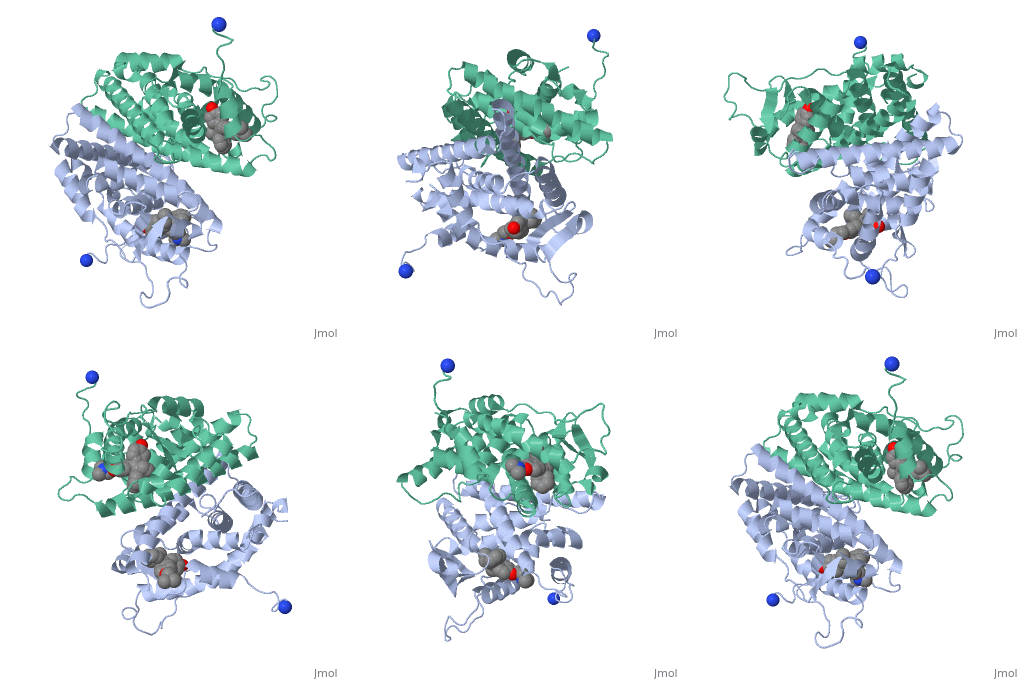
==HUMAN ESTROGEN RECEPTOR ALPHA LIGAND-BINDING DOMAIN IN COMPLEX WITH 4-HYDROXYTAMOXIFEN== | ==HUMAN ESTROGEN RECEPTOR ALPHA LIGAND-BINDING DOMAIN IN COMPLEX WITH 4-HYDROXYTAMOXIFEN== | ||
| - | <StructureSection load='3ert' size='340' side='right' caption='[[3ert]], [[Resolution|resolution]] 1.90Å' scene=''> | + | <StructureSection load='3ert' size='340' side='right'caption='[[3ert]], [[Resolution|resolution]] 1.90Å' scene=''> |
== Structural highlights == | == Structural highlights == | ||
| - | <table><tr><td colspan='2'>[[3ert]] is a 1 chain structure with sequence from [ | + | <table><tr><td colspan='2'>[[3ert]] is a 1 chain structure with sequence from [https://en.wikipedia.org/wiki/Human Human]. This structure supersedes the now removed PDB entry [http://oca.weizmann.ac.il/oca-bin/send-pdb?obs=1&id=2ert 2ert]. The September 2003 RCSB PDB [https://pdb.rcsb.org/pdb/static.do?p=education_discussion/molecule_of_the_month/index.html Molecule of the Month] feature on ''Estrogen Receptor'' by David S. Goodsell is [https://dx.doi.org/10.2210/rcsb_pdb/mom_2003_9 10.2210/rcsb_pdb/mom_2003_9]. Full crystallographic information is available from [http://oca.weizmann.ac.il/oca-bin/ocashort?id=3ERT OCA]. For a <b>guided tour on the structure components</b> use [https://proteopedia.org/fgij/fg.htm?mol=3ERT FirstGlance]. <br> |
| - | </td></tr><tr id='ligand'><td class="sblockLbl"><b>[[Ligand|Ligands:]]</b></td><td class="sblockDat"><scene name='pdbligand=OHT:4-HYDROXYTAMOXIFEN'>OHT</scene></td></tr> | + | </td></tr><tr id='ligand'><td class="sblockLbl"><b>[[Ligand|Ligands:]]</b></td><td class="sblockDat" id="ligandDat"><scene name='pdbligand=OHT:4-HYDROXYTAMOXIFEN'>OHT</scene></td></tr> |
| - | <tr id='gene'><td class="sblockLbl"><b>[[Gene|Gene:]]</b></td><td class="sblockDat">ESTROGEN RECEPTOR ALPHA ([ | + | <tr id='gene'><td class="sblockLbl"><b>[[Gene|Gene:]]</b></td><td class="sblockDat">ESTROGEN RECEPTOR ALPHA ([https://www.ncbi.nlm.nih.gov/Taxonomy/Browser/wwwtax.cgi?mode=Info&srchmode=5&id=9606 HUMAN])</td></tr> |
| - | <tr id='resources'><td class="sblockLbl"><b>Resources:</b></td><td class="sblockDat"><span class='plainlinks'>[ | + | <tr id='resources'><td class="sblockLbl"><b>Resources:</b></td><td class="sblockDat"><span class='plainlinks'>[https://proteopedia.org/fgij/fg.htm?mol=3ert FirstGlance], [http://oca.weizmann.ac.il/oca-bin/ocaids?id=3ert OCA], [https://pdbe.org/3ert PDBe], [https://www.rcsb.org/pdb/explore.do?structureId=3ert RCSB], [https://www.ebi.ac.uk/pdbsum/3ert PDBsum], [https://prosat.h-its.org/prosat/prosatexe?pdbcode=3ert ProSAT]</span></td></tr> |
</table> | </table> | ||
== Function == | == Function == | ||
| - | [[ | + | [[https://www.uniprot.org/uniprot/ESR1_HUMAN ESR1_HUMAN]] Nuclear hormone receptor. The steroid hormones and their receptors are involved in the regulation of eukaryotic gene expression and affect cellular proliferation and differentiation in target tissues. Ligand-dependent nuclear transactivation involves either direct homodimer binding to a palindromic estrogen response element (ERE) sequence or association with other DNA-binding transcription factors, such as AP-1/c-Jun, c-Fos, ATF-2, Sp1 and Sp3, to mediate ERE-independent signaling. Ligand binding induces a conformational change allowing subsequent or combinatorial association with multiprotein coactivator complexes through LXXLL motifs of their respective components. Mutual transrepression occurs between the estrogen receptor (ER) and NF-kappa-B in a cell-type specific manner. Decreases NF-kappa-B DNA-binding activity and inhibits NF-kappa-B-mediated transcription from the IL6 promoter and displace RELA/p65 and associated coregulators from the promoter. Recruited to the NF-kappa-B response element of the CCL2 and IL8 promoters and can displace CREBBP. Present with NF-kappa-B components RELA/p65 and NFKB1/p50 on ERE sequences. Can also act synergistically with NF-kappa-B to activate transcription involving respective recruitment adjacent response elements; the function involves CREBBP. Can activate the transcriptional activity of TFF1. Also mediates membrane-initiated estrogen signaling involving various kinase cascades. Isoform 3 is involved in activation of NOS3 and endothelial nitric oxide production. Isoforms lacking one or several functional domains are thought to modulate transcriptional activity by competitive ligand or DNA binding and/or heterodimerization with the full length receptor. Isoform 3 can bind to ERE and inhibit isoform 1.<ref>PMID:7651415</ref> <ref>PMID:10970861</ref> <ref>PMID:9328340</ref> <ref>PMID:10681512</ref> <ref>PMID:10816575</ref> <ref>PMID:11477071</ref> <ref>PMID:11682626</ref> <ref>PMID:15078875</ref> <ref>PMID:16043358</ref> <ref>PMID:15891768</ref> <ref>PMID:16684779</ref> <ref>PMID:18247370</ref> <ref>PMID:17932106</ref> <ref>PMID:19350539</ref> <ref>PMID:20705611</ref> <ref>PMID:21937726</ref> <ref>PMID:21330404</ref> <ref>PMID:22083956</ref> |
== Evolutionary Conservation == | == Evolutionary Conservation == | ||
[[Image:Consurf_key_small.gif|200px|right]] | [[Image:Consurf_key_small.gif|200px|right]] | ||
| Line 32: | Line 32: | ||
==See Also== | ==See Also== | ||
*[[Estrogen receptor|Estrogen receptor]] | *[[Estrogen receptor|Estrogen receptor]] | ||
| - | *[[ | + | *[[Estrogen receptor 3D structures|Estrogen receptor 3D structures]] |
| - | + | ||
== References == | == References == | ||
<references/> | <references/> | ||
| Line 40: | Line 39: | ||
[[Category: Estrogen Receptor]] | [[Category: Estrogen Receptor]] | ||
[[Category: Human]] | [[Category: Human]] | ||
| + | [[Category: Large Structures]] | ||
[[Category: RCSB PDB Molecule of the Month]] | [[Category: RCSB PDB Molecule of the Month]] | ||
[[Category: Agard, D A]] | [[Category: Agard, D A]] | ||
Revision as of 09:14, 23 February 2022
HUMAN ESTROGEN RECEPTOR ALPHA LIGAND-BINDING DOMAIN IN COMPLEX WITH 4-HYDROXYTAMOXIFEN
| |||||||||||