This old version of Proteopedia is provided for student assignments while the new version is undergoing repairs. Content and edits done in this old version of Proteopedia after March 1, 2026 will eventually be lost when it is retired in about June of 2026.
Apply for new accounts at the new Proteopedia. Your logins will work in both the old and new versions.
2y3i
From Proteopedia
(Difference between revisions)
| Line 3: | Line 3: | ||
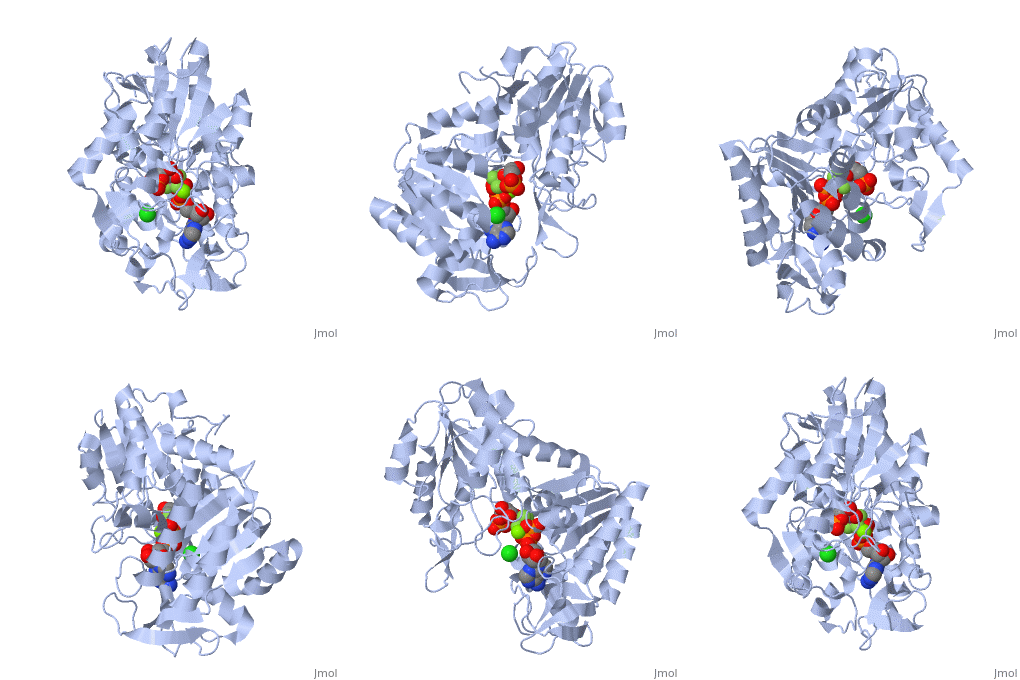
<StructureSection load='2y3i' size='340' side='right'caption='[[2y3i]], [[Resolution|resolution]] 2.90Å' scene=''> | <StructureSection load='2y3i' size='340' side='right'caption='[[2y3i]], [[Resolution|resolution]] 2.90Å' scene=''> | ||
== Structural highlights == | == Structural highlights == | ||
| - | <table><tr><td colspan='2'>[[2y3i]] is a 2 chain structure with sequence from [ | + | <table><tr><td colspan='2'>[[2y3i]] is a 2 chain structure with sequence from [https://en.wikipedia.org/wiki/Human Human]. Full crystallographic information is available from [http://oca.weizmann.ac.il/oca-bin/ocashort?id=2Y3I OCA]. For a <b>guided tour on the structure components</b> use [https://proteopedia.org/fgij/fg.htm?mol=2Y3I FirstGlance]. <br> |
| - | </td></tr><tr id='ligand'><td class="sblockLbl"><b>[[Ligand|Ligands:]]</b></td><td class="sblockDat"><scene name='pdbligand=3PG:3-PHOSPHOGLYCERIC+ACID'>3PG</scene>, <scene name='pdbligand=ALF:TETRAFLUOROALUMINATE+ION'>ALF</scene>, <scene name='pdbligand=CL:CHLORIDE+ION'>CL</scene>, <scene name='pdbligand=LA8:L-ADENOSINE-5-DIPHOSPHATE'>LA8</scene>, <scene name='pdbligand=MG:MAGNESIUM+ION'>MG</scene></td></tr> | + | </td></tr><tr id='ligand'><td class="sblockLbl"><b>[[Ligand|Ligands:]]</b></td><td class="sblockDat" id="ligandDat"><scene name='pdbligand=3PG:3-PHOSPHOGLYCERIC+ACID'>3PG</scene>, <scene name='pdbligand=ALF:TETRAFLUOROALUMINATE+ION'>ALF</scene>, <scene name='pdbligand=CL:CHLORIDE+ION'>CL</scene>, <scene name='pdbligand=LA8:L-ADENOSINE-5-DIPHOSPHATE'>LA8</scene>, <scene name='pdbligand=MG:MAGNESIUM+ION'>MG</scene></td></tr> |
| - | <tr id='related'><td class="sblockLbl"><b>[[Related_structure|Related:]]</b></td><td class="sblockDat">[[2xe7|2xe7]], [[2xe6|2xe6]], [[2wzb|2wzb]], [[2wzc|2wzc]], [[2x14|2x14]], [[2x15|2x15]], [[2wzd|2wzd]], [[2x13|2x13]], [[2xe8|2xe8]]</td></tr> | + | <tr id='related'><td class="sblockLbl"><b>[[Related_structure|Related:]]</b></td><td class="sblockDat"><div style='overflow: auto; max-height: 3em;'>[[2xe7|2xe7]], [[2xe6|2xe6]], [[2wzb|2wzb]], [[2wzc|2wzc]], [[2x14|2x14]], [[2x15|2x15]], [[2wzd|2wzd]], [[2x13|2x13]], [[2xe8|2xe8]]</div></td></tr> |
| - | <tr id='activity'><td class="sblockLbl"><b>Activity:</b></td><td class="sblockDat"><span class='plainlinks'>[ | + | <tr id='activity'><td class="sblockLbl"><b>Activity:</b></td><td class="sblockDat"><span class='plainlinks'>[https://en.wikipedia.org/wiki/Phosphoglycerate_kinase Phosphoglycerate kinase], with EC number [https://www.brenda-enzymes.info/php/result_flat.php4?ecno=2.7.2.3 2.7.2.3] </span></td></tr> |
| - | <tr id='resources'><td class="sblockLbl"><b>Resources:</b></td><td class="sblockDat"><span class='plainlinks'>[ | + | <tr id='resources'><td class="sblockLbl"><b>Resources:</b></td><td class="sblockDat"><span class='plainlinks'>[https://proteopedia.org/fgij/fg.htm?mol=2y3i FirstGlance], [http://oca.weizmann.ac.il/oca-bin/ocaids?id=2y3i OCA], [https://pdbe.org/2y3i PDBe], [https://www.rcsb.org/pdb/explore.do?structureId=2y3i RCSB], [https://www.ebi.ac.uk/pdbsum/2y3i PDBsum], [https://prosat.h-its.org/prosat/prosatexe?pdbcode=2y3i ProSAT]</span></td></tr> |
</table> | </table> | ||
== Disease == | == Disease == | ||
| - | [[ | + | [[https://www.uniprot.org/uniprot/PGK1_HUMAN PGK1_HUMAN]] Defects in PGK1 are the cause of phosphoglycerate kinase 1 deficiency (PGK1D) [MIM:[https://omim.org/entry/300653 300653]]. It is a condition with a highly variable clinical phenotype that includes hemolytic anemia, rhabdomyolysis, myopathy and neurologic involvement. Patients can express one or more of these manifestations.<ref>PMID:8673469</ref> <ref>PMID:8043870</ref> <ref>PMID:8615693</ref> <ref>PMID:9744480</ref> <ref>PMID:2001457</ref> <ref>PMID:1586722</ref> <ref>PMID:1547346</ref> <ref>PMID:6941312</ref> <ref>PMID:6933565</ref> |
== Function == | == Function == | ||
| - | [[ | + | [[https://www.uniprot.org/uniprot/PGK1_HUMAN PGK1_HUMAN]] In addition to its role as a glycolytic enzyme, it seems that PGK-1 acts as a polymerase alpha cofactor protein (primer recognition protein). |
<div style="background-color:#fffaf0;"> | <div style="background-color:#fffaf0;"> | ||
== Publication Abstract from PubMed == | == Publication Abstract from PubMed == | ||
Revision as of 14:51, 29 December 2021
The structure of the fully closed conformation of human PGK in complex with L-ADP, 3PG and the TSA aluminium tetrafluoride
| |||||||||||